From Trillions to Modern Slang: The Wild 18th-Century History Behind Nepal’s Favorite Insult
Have you ever sat on the couch all day, demanding a glass of water, only for a family member to hit you with: “Tyo gharko Jagat Seth tero bau ho?” (Is your dad the Emperor of Bankers that you are sitting there like a king?)
Or maybe you’ve seen someone acting incredibly privileged and bossy, and thought, “Kasto Sahu palatiraheko!”
In modern Nepal, calling someone a “Sahu” or a “Jagat Seth” means they are acting like a lazy, demanding boss who refuses to do any manual labor. But if you roll back the clock to the 1700s—the era when King Prithvi Narayan Shah was forging the foundations of modern Nepal—these weren’t insults. They were the titles of the most terrifyingly wealthy financial oligarchs the world has ever seen.
Here is the wild, interconnected story of how a multi-trillion-dollar banking empire funded regional wars, built secret fortress palaces, and permanently altered the language we speak today.
The Money Machine: Who Was the Real “Jagat Seth”?
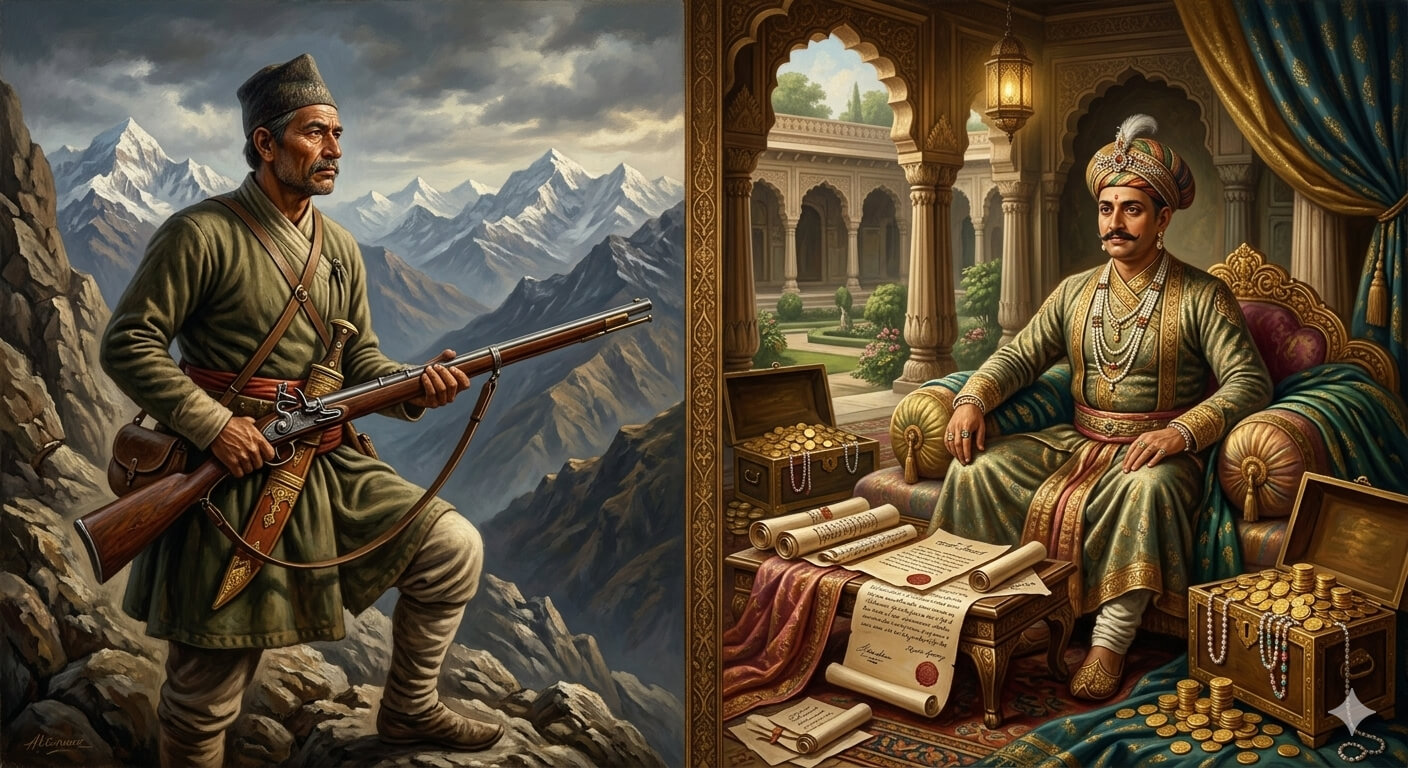
The title Jagat Seth literally means “Banker of the World.” It was a hereditary honor bestowed by the Mughal Emperor upon a Marwari Jain banking family based in Murshidabad, India.
Led by financial geniuses like Seth Manik Chand and later Seth Mahtab Chand, this family didn’t just run a bank; they controlled the financial infrastructure of South Asia. They were the official tax collectors of the wealthiest provinces, ran the royal mints, and possessed a fortune that historians estimate exceeded the entire economy of the British Empire at the time.
They were so powerful that they functioned as “Kingmakers.” If a regional ruler or Nawab didn’t behave, the Jagat Seths would cut off their credit lines, finance a rival prince, or buy off the ruler’s own military generals to trigger a coup.
The 18th-Century “Bitcoin”: How the Hundi Flourished
How did they move their unimaginable wealth across a continent filled with highway bandits and warring kingdoms? They used the Hundi (हुन्डी) system.
Today, Hundi is completely illegal in Nepal—classified as a serious financial crime that robs the government of revenue and fuels black-money markets. But in the 1740s, Hundi was the very oxygen of international trade.
Instead of loading heavy, dangerous chests of silver coins onto mules to cross the rugged Himalayan passes, a merchant would hand cash to a Jagat Seth branch in Kathmandu and receive a handwritten paper note (a Hundi). They could walk across borders wearing nothing but a traveler’s robes, present that paper slip at a branch in Varanasi, and instantly withdraw their money. It was a trust-based, decentralized banking network that allowed cross-border commerce to flourish.
Swords, Spies, and the Gorkhali Connection
This global web of money and trade collided directly with King Prithvi Narayan Shah’s unification campaign.
When Shah set out to conquer the Kathmandu Valley, he was heavily outgunned. To modernize his army, he traveled incognito (in disguise) to Varanasi—the premier trading and intelligence capital of northern India. The city was a hornets’ nest heavily monitored by British East India Company spies and Mughal tax collectors.
To secure weapons without getting caught, Shah relied on his father-in-law, a prominent local chieftain named Abhiman Singh, who had deep connections to the local banking networks. Through this underground system, the Gorkhali king managed to smuggle flintlock muskets, ammunition, and foreign gunsmiths back into the hills of Nepal.
Furthermore, traveling merchant-warriors known as Gosain traders used their tax-free pilgrimage routes to move gold, silk, and military intelligence across borders. While Shah initially utilized these wandering ascetics as wartime spies, he was ruthlessly pragmatic. The moment he won the Kathmandu Valley, his army systematically rounded up and expelled the foreign Gosain cartels, ensuring that no outside financial monopoly could ever threaten Nepal’s sovereign treasury.
The Taboo That Ruined an Empire
So, how did history’s richest family fall? They fell because a military ruler broke the ultimate rule of politics.
In 1763, an independent-minded Nawab named Mir Qasim grew tired of banking interference and used his army to kidnap and execute the head of the house, Seth Mahtab Chand, throwing his body into the Ganges River.
It was a fatal mistake. Without the Jagat Seths’ financial stabilization, the regional economy collapsed, the military ran out of gunpowder money, and the British East India Company swiftly swept in to take total control of the banking system. Within a few generations, the family’s vast treasuries vanished into history.
From Kingmakers to Living Room Slang
The Jagat Seths and the ultra-wealthy Sahus of the 18th century were so unimaginably rich that they never had to lift a finger for physical labor. They sat in their fortified palaces, pulling the strings of empires with the stroke of a pen, while kings and generals marched to their beat.
Centuries later, the empires are gone, the ancient mines are closed, and the Hundi is outlawed. But the memory of those pampered, bossy, ultra-privileged oligarchs lives on in the most hilarious way possible: embedded right inside our daily Nepali vocabulary.
So, the next time someone tells you to stop acting like a “Jagat Seth,” take it as a compliment—you are being compared to the most powerful bankers to ever walk the earth!