The Mathematical Blueprint of AI: Metric Spaces, Hypercubes, and the Geometry of Data
When we think about artificial intelligence, we often imagine lines of code, massive data centers, and complex neural networks. But beneath the surface, modern AI does not process language, images, or user data as text or pixels. It treats them as points moving through abstract geometric landscapes.
To truly understand how deep learning works, you have to understand two fundamental mathematical concepts: Metric Spaces and Hypercubes. Together, they form the physical geography of machine intelligence.
1. The Playground Rules: Metric Spaces
A metric space is simply a collection of points paired with a strict mathematical rulebook for measuring distance. For a distance function—called a metric—to be valid, it must obey four absolute rules (axioms):
- Non-negativity: The distance between any two things can never be less than zero.
- Identity of Indiscernibles: The distance between a point and itself is always zero. If the distance between A and B is zero, they are the exact same point.
- Symmetry: The distance from A to B is identical to the distance from B to A.
- The Triangle Inequality: A straight line is always the shortest path. If you detour from A to B through a third point C, your total journey will always be equal to or longer than the direct path.
In AI, these rules are vital. Simple algorithms like K-Nearest Neighbors (KNN) use them to classify data by finding the closest neighbors. Advanced algorithms rely on them to ensure that as an AI learns, its calculations steadily converge toward a correct solution rather than spinning out into mathematical chaos.
2. The Container: The Hypercube
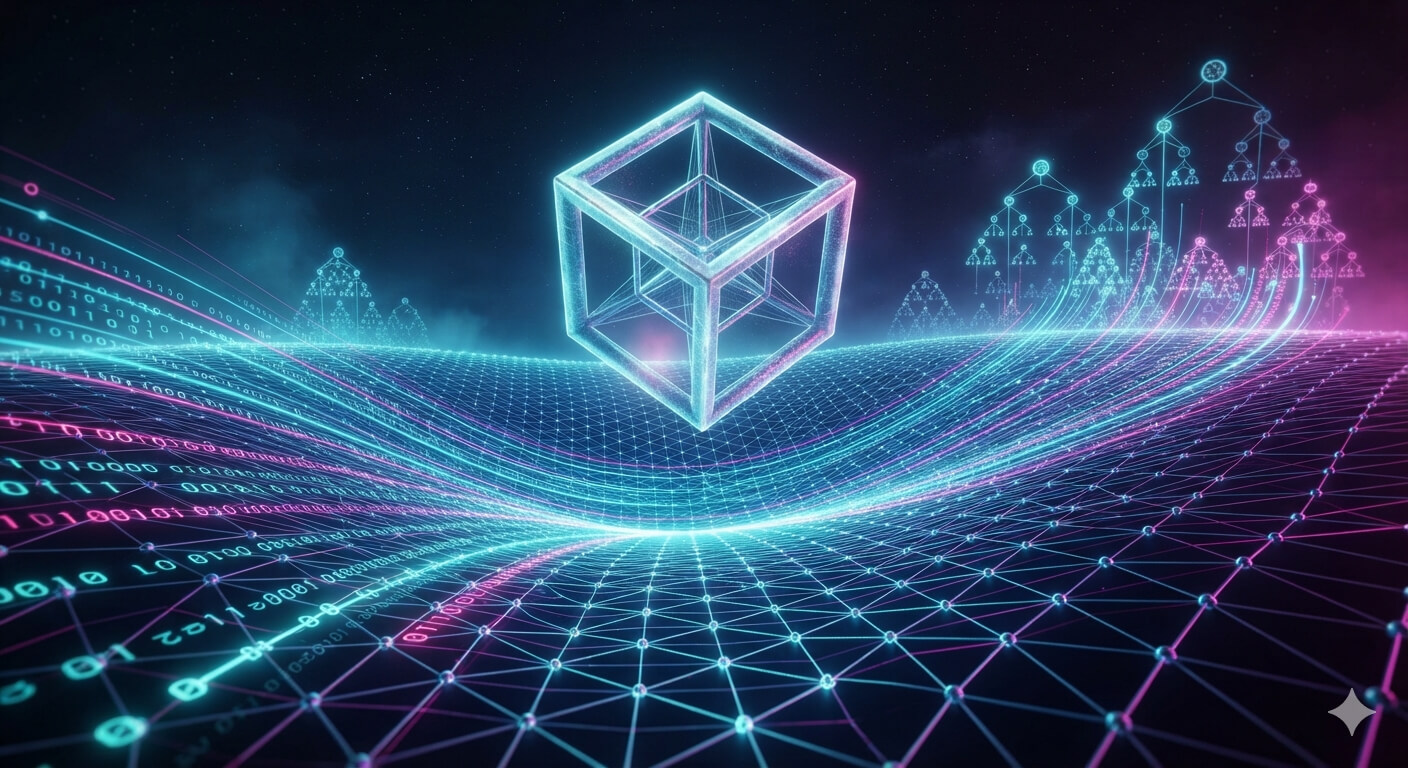
While a metric space gives us the rules of distance, a hypercube provides the boundaries of the data. A hypercube is just a familiar 3D cube scaled up into any number of dimensions.
As you add dimensions to a hypercube, its math begins to behave in ways that human brains—biologically locked into a 3D world—find highly counter-intuitive:
- The Exploding Corners: A standard 3D cube has 8 corners. A 4D hypercube has 16. A 100-dimensional hypercube has corners—more than the total number of atoms in the observable universe.
- The Stretching Diagonal: While the volume of a standard “unit” hypercube is always exactly 1, the corner-to-corner diagonal distance expands to (where d ) is the number of dimensions).
How to Visualize a 4D Hypercube (The Slicing Method)
We cannot look at a 4-dimensional hypercube directly, but we can visualize it by passing it through our 3D space like a scan. A 4D hypercube is bounded by 8 identical 3D cubes. If it passed through your room along the 4th dimension over a distance of 1 meter, here is what you would see:
- At 0 meters: A single, perfect 3D cube instantly materializes in front of you. This is the starting boundary cap.
- From 0.01 to 0.99 meters: That starting cube vanishes. You are now continuously slicing through the 6 middle cubes that are seamlessly welded together in 4D space.
- At 1 meter: The middle cubes disappear, and you are left looking at the 8th and final cube (the ending boundary cap) before it vanishes entirely.
3. The Nightmare: The Curse of Dimensionality
In data science, every independent variable we track acts as a new dimension. If you track a house’s price, square footage, and number of bedrooms, you are working in a 3D space.
But modern Large Language Models (LLMs) operate in thousands or even trillions of dimensions. At this scale, the hypercube encounters the Curse of Dimensionality, and traditional metric spaces break down completely:
- Loss of Distance Contrast: In ultra-high dimensions, the distance between the closest neighbor and the furthest neighbor becomes practically identical. Everything becomes roughly equidistant, making straight-line calculations useless.
- The Empty Desert: Because the corners stretch so far apart, all data points migrate to the thin outer “skin” of the hypercube. The middle becomes entirely empty.
The AI Workarounds
To survive this geometric desert, modern Transformers bypass traditional straight-line distances (Euclidean distance) entirely. Instead, they use Cosine Similarity, which measures the angle between vectors rather than physical distance. They also use Layer Normalization, which forces all data points out of the empty hypercube center and pins them smoothly onto the surface of a curved sphere where angles can be measured reliably.
4. Expanding Horizons: Hyperbolic Metric Spaces
Traditional geometric spaces expand polynomially (like a flat sheet of paper). This works well for grid-like data, but it is terrible for hierarchical data like family trees, company folder structures, or linguistic categories, which expand exponentially.
If you try to squeeze an exponentially growing tree into flat Euclidean space, the outer nodes get crushed together into a massive bottleneck, ruining your distance calculations.
Euclidean Space (Flat)          Hyperbolic Space (Saddle/Pringles Chip)
  Growth: Polynomial              Growth: Exponential
  [ Bottleneck at edges ]         [ Infinite room at edges for trees ]
The cutting-edge solution in AI is Hyperbolic Metric Spaces. These spaces feature a constant negative curvature (shaped like a saddle or a Pringles potato chip). Because a hyperbolic space naturally expands exponentially as you move away from the center, hierarchical trees can be mapped into them with virtually zero geometric distortion. In fact, research has shown that a 2-dimensional hyperbolic space can map massive language hierarchies more accurately than a 200-dimensional flat space.
5. Summary: Raw Data vs. The Trained Metric Space
The entire ultimate goal of training a deep learning model is to take disorganized, chaotic “raw data” and map it into a structured, trained metric space.
| Feature | Raw Data (Strings, Pixels) | Trained Embedding Outputs |
|---|---|---|
| Search Matching | Looks for exact characters (misses synonyms like “feline” and “cat”). | Looks for semantic proximity (groups concepts by actual meaning). |
| Data Quality | Unorganized, noisy, and massive in file size. | Highly compressed, feature-extracted, and denoised. |
| Relationships | Connections are arbitrary and manually hardcoded. | Connections are fluid and governed by geometric gravity. |
Conclusion
The next time you type a prompt into an AI tool, remember the journey your words are taking. They are being converted into mathematical coordinates, navigating through a trillion-dimensional hypercube, and utilizing the strict laws of metric spaces to find the exact cluster of concepts that form a meaningful answer. The hypercube is the container of all possible AI thoughts, but the metric space is the internal GPS that guides the model to intelligence.