
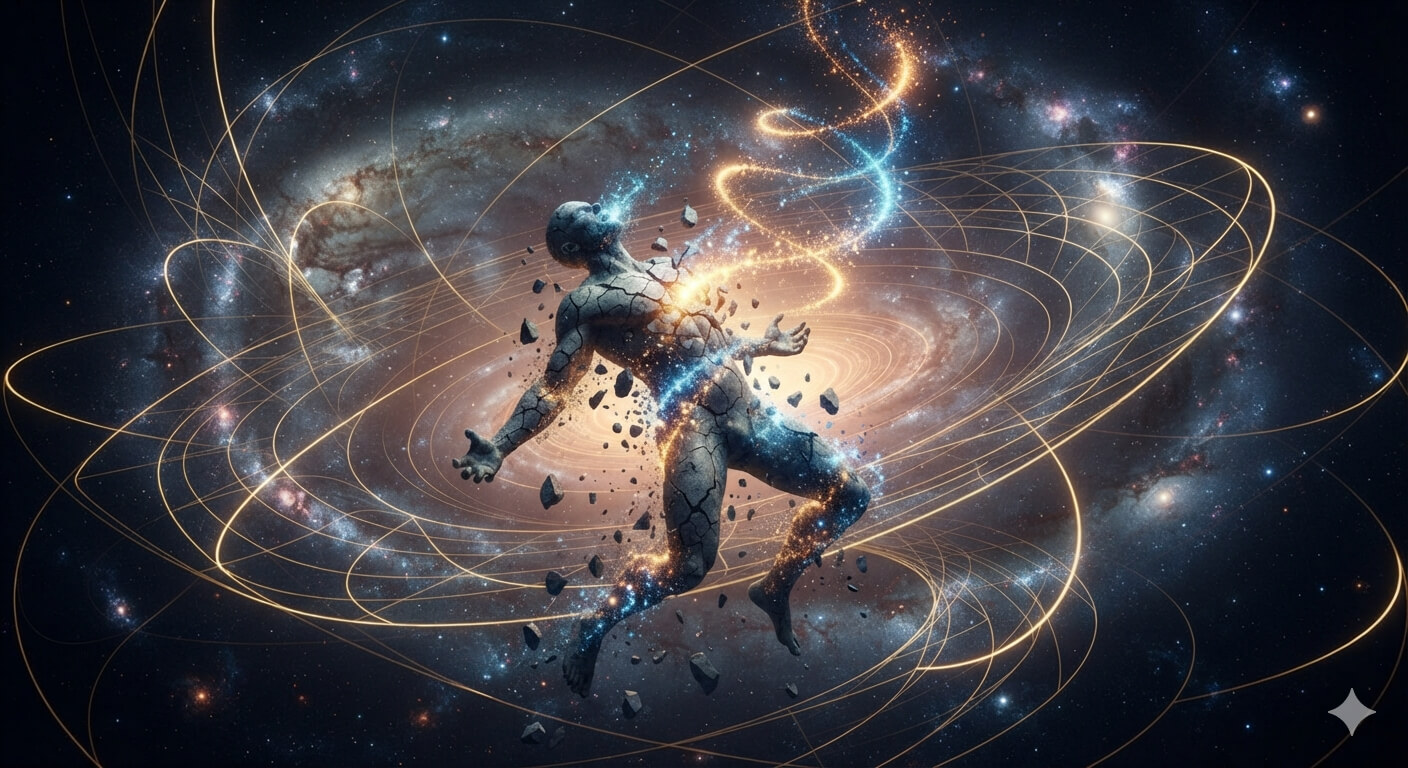
The Physics of Motivation: Breaking Sloth with Dante, Newton, and Einstein
We have all been there. You have a massive project due, a difficult conversation you need to have, or a major life transition staring you in the face. Instead of dealing with it, you spend three hours organizing your email inbox, deep-cleaning your kitchen, or scrolling through social media. You are exhausted, stressed, and completely wiped out at the end of the day.
You feel incredibly busy. But according to the 14th-century poet Dante Alighieri, you are actually committing the dangerous sin of Sloth.
In our modern world, we treat slothfulness like a physical joke. We picture a “couch potato” surrounded by snack wrappers, refusing to move. But in his masterpiece The Divine Comedy, Dante presents a much more terrifying truth: Sloth is not a failure of the body. It is a paralysis of the will.
By connecting 14th-century theology with 17th-century physics and 20th-century geometry, we can unlock the ultimate blueprint for human motivation—and learn exactly how to escape the paralyzing trap of Sloth.
1. The Shared Cosmic Blueprint: Invisible Attraction
Both Dante and Sir Isaac Newton looked at the night sky and discovered an identical truth: the universe is held together by an invisible, attractive pull that prevents everything from flying apart into cold chaos.
- Dante’s Language (1321): He called this attraction Love. In the final line of The Divine Comedy, he famously writes: “L’amor che move il sole e l’altre stelle” (The Love that moves the sun and the other stars). To Dante, every star and planet rotates because it passionately yearns toward a purposeful center.
- Newton’s Language (1687): He called this attraction Gravity. Newton mathematically quantified this invisible web with his Law of Universal Gravitation:
Newton proved that every single object in existence exerts an invisible, unbreakable pull on every other object simply because it exists. One man used poetry and the other used calculus, but both defined the exact same cosmic glue.
2. The Mechanics of Love: Dante’s Three Categories
To understand how this cosmic glue fails and causes Sloth, we have to look at Dante’s unique psychological breakthrough in Canto XVII of Purgatorio: Everything a human being does is driven by love, but that love can be warped in three distinct ways.
                           ┌───────────────────────────┐
                           │   THE SPECTRUM OF LOVE    │
                           └─────────────┬─────────────┘
                                         │
       ┌─────────────────────────────────┼─────────────────────────────────┐
       ▼                                 ▼                                 ▼
[PERVERTED LOVE]                 [DEFICIENT LOVE]                 [EXCESSIVE LOVE]
(Pride, Envy, Wrath)             (SLOTH / ACEDIA)                 (Greed, Gluttony, Lust)
Actively harms others            Lukewarm; zero momentum          Selfish but unmalicious
  "Toxic Interference"             "The Dead Engine"                "Collateral Damage"
- Perverted Love (Pride, Envy, Wrath): This occurs when love is completely twisted into a desire to see your neighbor suffer so that you can feel superior. These people are driven by toxic self-interest. When reality doesn’t give them the superiority they crave, they strike out to punish, diminish, or destroy others. This is why Dante places them at the very bottom of Hell and Purgatory—they are actively malicious.
- Excessive Love (Greed, Gluttony, Lust): These are people who just want the best food, the best partners, or a mountain of money to fulfill their desires. Their primary motivation isn’t to hurt you; they are just entirely consumed by fulfilling their own desires. If you get in the way of their pleasures, they might cause collateral damage, but their baseline goal is just selfish consumption. Dante ranks them as the “least bad” because they are chasing good things (pleasure, security, beauty) in a completely broken, undisciplined way.
- Deficient Love (Sloth / Acedia): This is the true home of Sloth. Sloth is not a sin of malice (like Pride), and it is not a sin of over-enthusiasm (like Lust). It is lukewarm love. It is a complete failure to love the true good—your purpose, your duties, and your potential—with enough energy, speed, or passion.
3. Sloth as the Breaking of Newton’s Law
When we apply Newton’s mathematical formula to Dante’s moral universe, we can precisely define the tragedy of Sloth:
- Dropping Your Mass to Zero: In Newton’s equation, if an object has zero mass, the gravitational force becomes zero. Sloth is the active choice to make yourself weightless. While the passionate sinners are running around with hot engines, the slothful person turns their internal engine completely off. They use frantic, low-priority busywork to avoid their true calling, refusing to choose a side or take risks.
- The Ghost of the Waiting Room: Because they choose to have no weight, Dante leaves them in the ultimate “nowhere”. They are rejected by Heaven because they did no good, and rejected by Hell because even the wicked villains look down on them. A proud villain at least had the courage and “mass” to do something. The slothful person chose to be a ghost.
4. The Newton-Dante Cure: How to Move
To escape that paralyzing, weightless waiting room, you have to use the mechanics of physics and love to change your variables:
- Increase Your Mass through Commitment: You cannot feel the pull of purpose if you have no skin in the game. Stop being indifferent. Pick a project, a relationship, a career path, or a cause. The moment you commit, you gain psychological weight, and the universe starts pulling you forward.
- Decrease the Distance to the Target: Newton’s equation proves that the farther away a target is, the weaker the gravitational force becomes. Sloth thrives when your goals are too distant and massive. Close the gap. Don’t try to write the whole book today; just write one paragraph.
- Lean Into the Curve: Albert Einstein later updated Newton’s math by showing that gravity is actually the curving of space and time around a massive object. When a task feels heavy or difficult, stop viewing it as a roadblock. View that as natural and as proof that you are finally moving toward something that matters.
The Final Synchronization
You cannot sit around and wait for motivation to hit you. Action creates motivation; motivation rarely creates action.
In The Purgatorio, Dante cures the slothful by forcing them into an endless, running marathon. They aren’t being whipped by external demons; they are running because they are finally, desperately hungry for momentum.
By increasing your mass through immediate commitment and shortening your distance through micro-actions perfected by James Clear, you hook yourself back into the cosmic gears. You step out of the ghost-like waiting room of indifference and become exactly what Dante and Newton envisioned: an active, pulling, passionate force in a universe built on movement and love.