The Inkbottle Dominoes: How a Candle Maker’s Son Accidentally Set Off a 150-Year Global Explosion
By Lil B Gurung
Reading Time: 7 minutes
Act I: The Midnight Ink
In the autumn of 1722, a sixteen-year-old boy stood over a wooden printing press in Boston, his knuckles stained with black ink and his clothes smelling faintly of boiled animal fat.
His name was Benjamin Franklin. By day, he melted tallow for his father’s candle shop—a miserable, greasy job he absolutely detested. By night, he bound himself to a brutal apprenticeship under his abusive older brother, James, who ran a local newspaper.
Benjamin desperately wanted to write, but James wouldn’t allow it. So, the teenager engineered a deception. He invented a fictional persona: a middle-aged, sharp-tongued widow named Silence Dogood. Writing by candlelight, he slipped satirical letters under the print shop door in the dead of night. They became an overnight sensation.
To fuel his brain, Benjamin made a radical trade-off. He became a vegetarian solely because vegetables were cheaper than meat. He demanded his brother give him half the cash normally spent on his boarding food, ate nothing but biscuits and raisins, and spent every saved penny on books of philosophy, arithmetic, and grammar.
He didn’t know it yet, but he was building a weapon. He was mastering a deliberate method of reading classic essays, reducing them to basic notes, waiting days for the memory to fade, and then forcing his brain to reconstruct them in his own words. He realized a fundamental truth that would alter human geography: in a world ruled by kings, written words were the ultimate equalizer. Words equaled power.
Fast forward fifty years. That same boy, now a world-famous scientific celebrity who had tamed lightning with a silk kite, stood in the courts of Paris. The American colonies were in open rebellion against the British Crown, and George Washington’s army was starving and freezing to death at Valley Forge. They were a disorganized, disease-ridden militia. They were about to lose.
Franklin, serving as America’s slickest diplomat, met a broke, out-of-work Prussian captain named Friedrich Wilhelm von Steuben. Von Steuben had the exact skills Washington needed: he knew how to drill an army into an elite machine. But the Continental Congress was sick of foreign mercenaries demanding high salaries.
So, Franklin lied.
Using his mastery of written persuasion, Franklin drafted a letter of introduction inflating the humble captain into a “Lieutenant General” and dubbing him the “Apostle of Frederick the Great.” He gave von Steuben the unearned prestige needed to command instant respect. Von Steuben arrived at Valley Forge, restructured the camps to stop deadly diseases, and taught the Americans how to fight like professionals.
Franklin’s ink had successfully bought America its independence. But the first domino had just been tipped, and it was falling directly toward the very nation that helped him.
Act II: The Bill for Liberty
To guarantee America’s victory, Franklin had pulled off a diplomatic miracle: he convinced King Louis XVI of France to bankroll the revolution.
France poured 1.3 billion livres (about $90 billion today) into the war. French gunpowder, French ships, and French blood secured the final British surrender at Yorktown. Elite French officers, like the young Marquis de Lafayette, fought side-by-side with Washington and returned home completely intoxicated by radical American ideas of liberty, equality, and constitutions.
But when the smoke cleared, King Louis XVI looked at his treasury. It was completely empty.
France was bankrupt. By 1788, the interest alone on the national debt swallowed over 50% of the royal budget. Desperate for cash, the King took a fatal political gamble: he called a meeting of the Estates-General—a representative assembly that hadn’t met in 175 years—to levy new taxes on the working class.
It was like opening a floodgate. The overtaxed, starving French peasants, inspired by the American model, didn’t just argue about taxes—they demanded a total demolition of the feudal system. Lafayette sat down with his close friend Thomas Jefferson in Paris, and with Jefferson editing the margins, Lafayette penned the Declaration of the Rights of Man and of the Citizen.
The revolution rapidly outpaced its moderate architects. Lafayette wanted a peaceful constitutional monarchy, but the anger of centuries could not be managed. The streets ran red. The guillotine was invented. The working-class revolutionaries turned inward, eating their own alive. Radicals like Maximilien Robespierre executed their rivals, only to be dragged to the blade themselves.
Out of the smoking embers of this absolute political collapse stepped a brilliant, ruthless military general who took control of the only system in France that still functioned: the army. His name was Napoleon Bonaparte.
Act III: The Frost of Defiance
Napoleon didn’t just inherit an army; he inherited an ideological war machine. The revolution had abolished aristocratic privilege, meaning anyone from a peasant background could rise to become a general based on raw merit.
Napoleon used this unstoppable machine to conquer almost all of mainland Europe. But one stubborn obstacle remained: Great Britain. Protected by the world’s most powerful navy, the British island was physically unreachable. Napoleon’s fleet had been utterly obliterated at the Battle of Trafalgar in 1805, ending any hope of a direct invasion.
So, Napoleon turned to economic warfare. He instituted the Continental System, an airtight embargo banning any European nation from trading with Britain. He wanted to starve them into submission.
Enter Tsar Alexander I of Russia.
Russia’s economy relied heavily on exporting timber and grain to the British. The embargo was causing a domestic economic depression. By 1810, the Tsar openly defied Napoleon, throwing his ports back open to British merchant ships.
His own logic trapped Napoleon. If he let Russia slide, his entire European empire would see him as weak, and the embargo would shatter.
In 1812, Napoleon marched a staggering 600,000 men to the Russian border. He didn’t want to conquer Russia; he just wanted to bully the Tsar back into the embargo. But the Russians refused to play by his rules. They retreated deep into their own frozen interior, burning their own crops and villages in a brutal “scorched-earth” strategy.
When Napoleon finally captured Moscow, he found a ghost town wrapped in flames. Starving, freezing, and hunted by Russian winter wolves, Napoleon’s retreat became a slaughter. He lost over 80% of his army.
The invincible Emperor had been broken. Europe united to crush him, and the Napoleonic era crashed to a definitive end at Waterloo. France’s absolute monarchy was temporarily restored, but the revolutionary blueprint had already been copied, translated, and shipped eastward.
Act IV: The Siberian Basement
Centuries of emulation meant that the Russian aristocracy spoke French, read French philosophy, and modeled their courts after Versailles. But they also inherited the same structural decay: an out-of-touch, absolute monarchy ruling over millions of starving, landless peasants.
By 1917, structural collapse and the meat-grinder of World War I pushed Russia to its absolute breaking point.
When Vladimir Lenin and his radical Bolsheviks launched their coup to overthrow the government, they didn’t view themselves as pioneers. They viewed themselves as the direct descendants of the French Jacobins. Lenin had spent his life meticulously studying Robespierre’s Reign of Terror. He arrived at a dark conclusion: The French Revolution failed because it wasn’t ruthless enough.
The Romanov family, led by Tsar Nicholas II and Empress Alexandra, had also studied French history. Terrified of repeating the mistakes of Louis XVI, Nicholas refused to ever negotiate or share power, believing compromise equaled death. Alexandra, gripped by fear for her hemophiliac son, isolated the family entirely, falling under the spell of the mystic healer Rasputin, whose political meddling completely ruined the monarchy’s remaining public credibility.
The Romanovs tried to avoid the French fate by being unyielding. Instead, they created the exact same pressure cooker.
In 1918, to ensure the old world could never return, the Bolsheviks marched the Tsar, his wife, and his children into a Siberian basement and executed them by firing squad. Lenin instituted the “Red Terror,” openly citing the French Committee of Public Safety as his moral and tactical justification.
The third domino had fallen. And Lenin immediately looked toward the east to push the next one.
Act V: The Peasant Monolith
Lenin established the Comintern, a state-funded organization designed to export communist revolution to the rest of the world. In 1921, Soviet agents arrived in Shanghai, renting a quiet brick building to help a tiny group of Chinese intellectuals organize a new political faction: the Chinese Communist Party (CCP).
Among those young men was a schoolteacher named Mao Zedong.
For nearly thirty years, Mao fought a grinding, bloody civil war against the Nationalist government. The Soviet Union acted as his lifeline, providing funding, strategic advisors, and eventually handing over massive stockpiles of captured infantry weapons at the end of World War II.
But Mao pulled off the ultimate adaptation. Lenin’s ideological blueprint dictated that revolutions must be led by urban factory workers. China, however, had no factories—it was a nation of poor farmers. Mao swapped the factory workers for the peasants, utilizing the exact same generational rage that had fueled the French and Russian collapses.
On October 1, 1949, Mao stood in Tiananmen Square and declared the birth of the People’s Republic of China.
Epilogue: The Line of Fire
The Western world watched the rise of Red China in absolute horror. By 1954, U.S. President Dwight D. Eisenhower looked at the global map and coined a phrase that would define modern history: The Domino Theory.
Washington planners became fanatically convinced that if South Vietnam fell to communism, the surrounding nations of Laos, Cambodia, and Thailand would tumble sequentially like a row of physical blocks. This singular psychological fear—born from a century of watching revolutions trigger one another—is the exact mechanism that dragged the United States into the tragic, bloody jungles of the Vietnam War.
It is a dizzying historical circle.
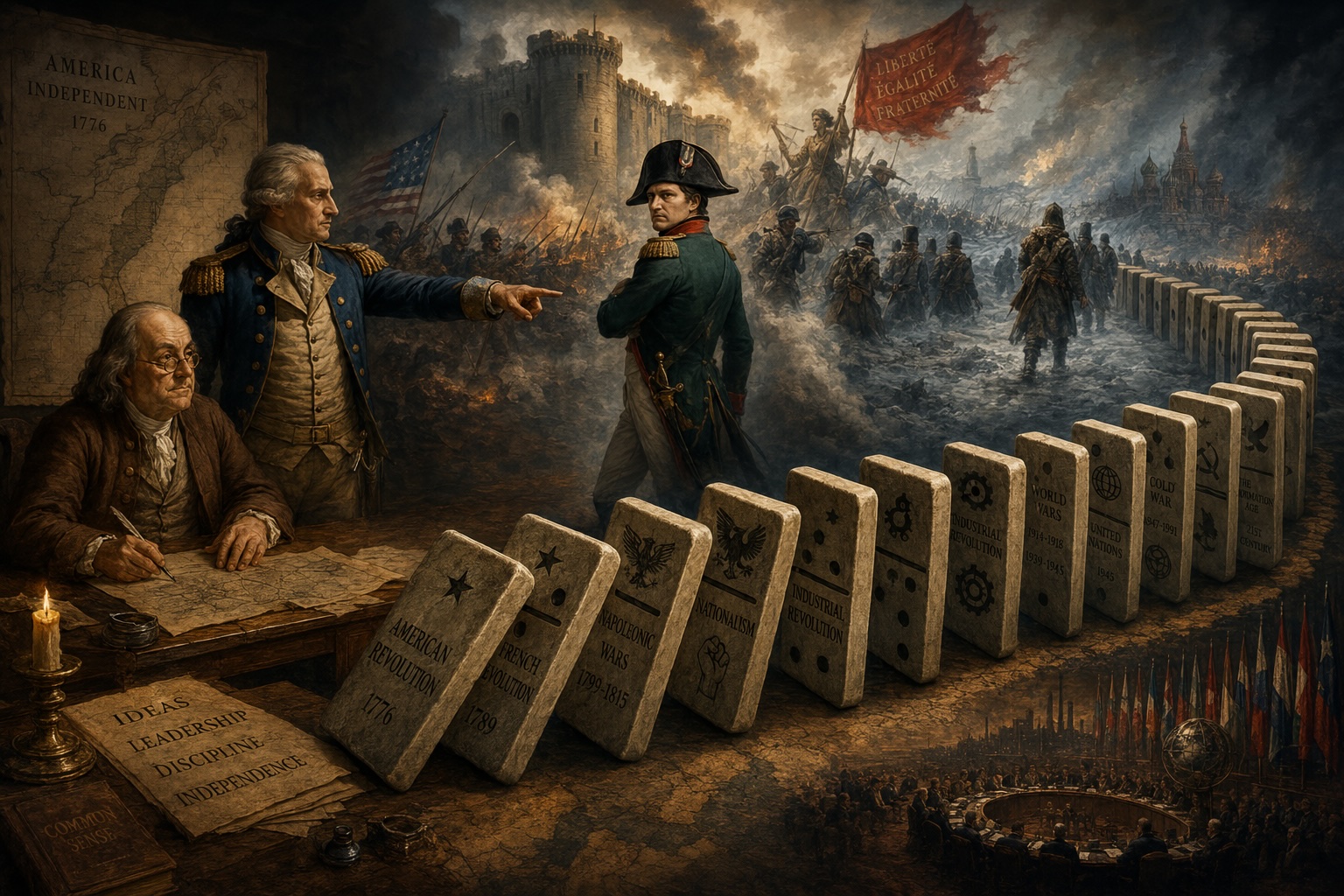
If Benjamin Franklin hadn’t skipped his meals to buy books, he wouldn’t have mastered the written word. If he hadn’t mastered the word, he couldn’t have successfully forged a resume for a Prussian captain or charmed the French king into spending 1.3 billion livres. Without that crushing debt, the French gates don’t fly open. Without the French blueprint, Lenin doesn’t build his terror machine, Mao doesn’t receive his Soviet rifles, and American soldiers aren’t drafted to fight in Vietnam.
History isn’t a collection of isolated chapters. It is a single, continuous line of falling blocks—and sometimes, a spark struck by a candle-maker’s son in Boston can end up burning down the other side of the world.