The Ghost of Nikolsburg: How the Firing of One Man Cost Germany the World
In the hot, suffocating summer of 1866, inside a temporary military headquarters in Nikolsburg, a grown man was sobbing hysterically, threatening to jump out of a fourth-story window.
That man was Otto von Bismarck.
Outside his door, Prussian military generals—drunk on their legendary blitzkrieg victory over Austria—were screaming to march on Vienna. They wanted blood, glory, and total humiliation for their rival. But Bismarck knew a terrifying truth that those generals were too blind to see: If you completely crush your enemy today, you guarantee they will hunt you for revenge tomorrow.
Bismarck fought his own King and won, forcing a soft peace treaty. It was a masterclass in geopolitical restraint.
But just twenty-four years later, in 1890, a young, arrogant new emperor named Kaiser Wilhelm II fired Bismarck. The “Pilot” was dropped from the ship of state, and with him went the sanity of European politics.
What followed is one of history’s greatest tragedies. Germany’s aggressive rise wasn’t an unstoppable force of nature—it failed simply because it lost the diplomatic restraint of its founding father. Had Bismarck stayed, or had his successors shared his genius, both World War I and World War II might never have happened.
The Unstoppable Rocket (Without a Steering Wheel)
When Germany unified in 1871, it didn’t just join the European stage; it exploded onto it.
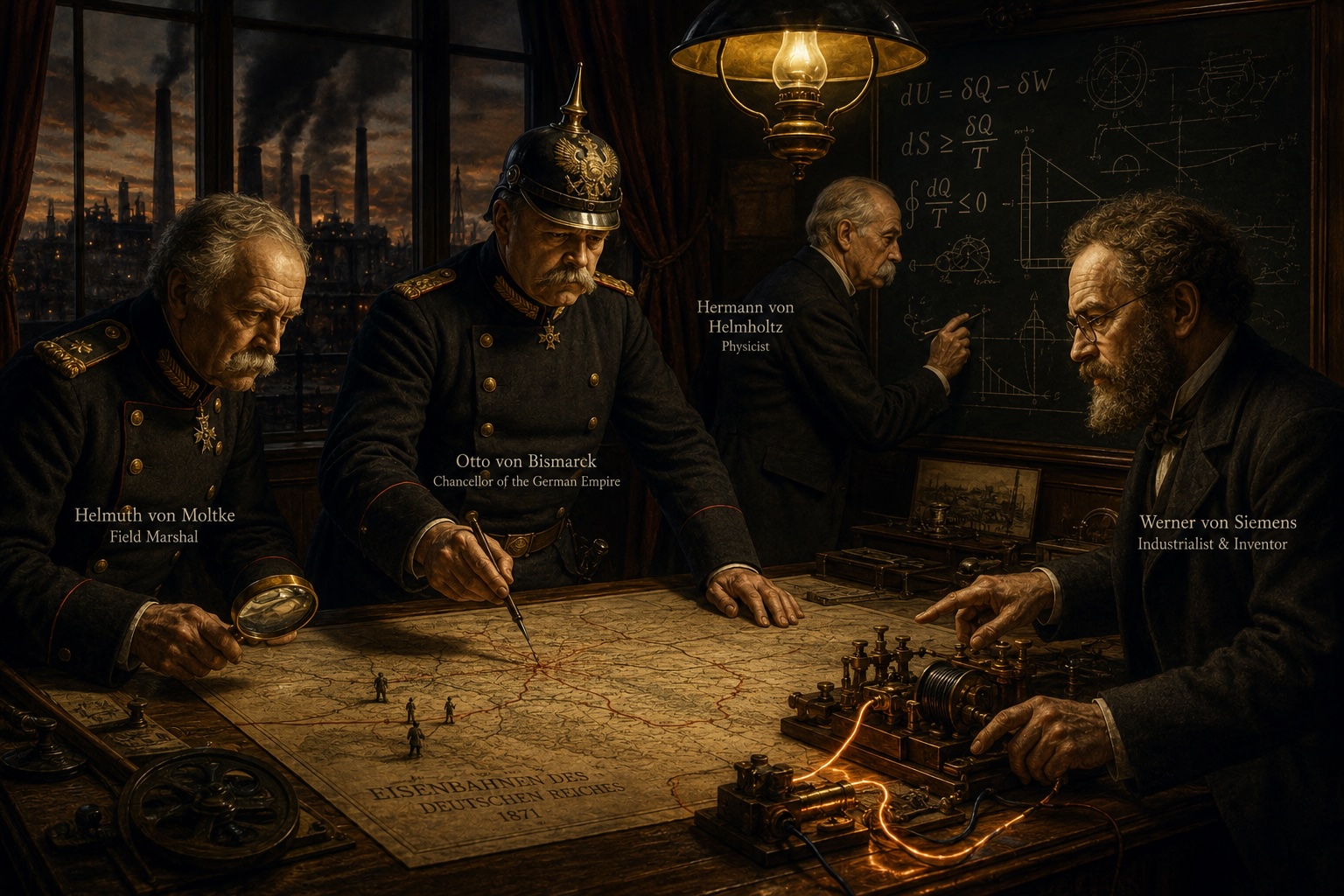
Thanks to the physics of Hermann von Helmholtz and the industrial factories of Werner von Siemens, Germany skipped the slow, messy stages of early industrialization. They went straight into the Second Industrial Revolution, mass-producing high-grade steel, advanced chemicals, and global electrical grids.
By 1913, Germany was producing more steel than Britain and France combined. Its population had exploded from 41 million to 67 million.
Germany was a high-tech rocket. But a rocket without a guidance system is just a missile waiting to crash. Bismarck had been that guidance system.
[Bismarck's Strategy] ➔ Keep France isolated, stay friendly with Russia, don't anger Britain.
                                   VS.
[The Kaiser's Reality]  ➔ Fire Bismarck, build a rival navy, threaten everyone at once.
The Kaiser’s Playground: Fired Bismarck’s golden rule
Bismarck’s golden rule of survival was simple: Always be one of three in a world of five great powers. He constantly spun a web of secret treaties to keep Russia and Austria friendly with Germany, while keeping a defeated France completely isolated.
Kaiser Wilhelm II looked at Bismarck’s delicate web and called it cowardly.
The Kaiser wanted a global colonial empire—Germany’s “place in the sun.” But instead of using quiet diplomacy, he used bullying tactics. During the Moroccan Crises of 1905 and 1911, the Kaiser literally sent warships to North Africa to flex Germany’s muscles.
Instead of breaking his rivals apart, his aggressive overreach accomplished the one thing Bismarck had spent his life preventing: it terrified Great Britain and France into ending their centuries-old rivalry. They joined hands with Russia, forming a massive wall of alliances around Germany.
By 1914, Germany felt surrounded, claustrophobic, and paranoid. When a spark lit the fuse in the Balkans, Germany’s leaders didn’t try to stop the war—they welcomed it as a chance to break out of their cage.
The Butterfly Effect: Saving 100 Million Lives
If Bismarck’s spirit of restraint had survived past 1890, the dominoes of the 20th century would have fallen in an entirely different direction:
- No World War I: Without the aggressive German naval expansion that threatened London, Britain would have likely remained neutral in continental squabbles. Without German backing, Austria would have been forced to negotiate with Russia over the Balkans. The July Crisis of 1914 would have been just another diplomatic meeting, not a global slaughterhouse.
- No Treaty of Versailles: If World War I never happened, Germany would never have been humiliated, bankrupt, and stripped of its dignity in 1919.
- No Adolf Hitler: Hitler was a direct product of the toxic, resentful post-WWI landscape. Without the devastating defeat of 1918 and the economic collapse that followed, radical extremism would have remained on the lunatic fringes of German society. Hitler would have lived out his days as a failed, obscure postcard painter in Vienna.
The Verdict of History
Germany’s industrial rise was inevitable. Its descent into total global warfare was not.
The tragedy of modern Germany is that it mastered the hard sciences—physics, engineering, metallurgy, and military logistics—but it fired the one man who mastered the soft science of human restraint.
Bismarck famously predicted that “One day the great European War will come out of some damned foolish thing in the Balkans,” and that his own system would collapse twenty years after his departure. He missed the mark by just four years.
In the end, Germany didn’t fall because it lacked steel, soldiers, or science. It fell because it forgot the lesson of Nikolsburg: the ultimate purpose of power is knowing exactly when not to use it.