The Opium Millions: How an Indian Billion-Dollar Dynasty Was Built on the High Seas
When we walk through the glittering skyline of Central Mumbai today, we see towering glass skyscrapers, luxury gated townships, and international corporate headquarters. But if you peel back the layers of history, you’ll find that the concrete foundations of India’s financial capital weren’t built on IT, banking, or modern real estate.
They were built on a century-long imperial blood feud, global maritime warfare, a brutal corporate shift, and an underground, billion-dollar triangular drug trade with China.
To understand how modern Indian industrial capitalism was born, we have to trace a fascinating line of dominoes that starts with the collision of two mighty empires and the destruction of the world’s richest banking houses.
The Spark: The Hundred-Year Feud That Broke India
Long before the British East India Company (EIC) ruled the subcontinent, the fate of India was dictated by the brutal, exhausting conflict between the Mughal Empire and the rising Maratha Empire.
In the late 1600s, the Mughal Empire had reached its absolute zenith under Emperor Aurangzeb. But as Aurangzeb pushed his armies south into the Deccan plateau, he collided with a legendary military genius: Chhatrapati Shivaji Maharaj. Using brilliant hit-and-run guerrilla tactics (Ganimi Kava), Shivaji fractured the myth of Mughal invincibility and established a sovereign Maratha state founded on local pride and independence.
Furious and obsessed with crushing the Marathas, Aurangzeb moved his entire royal court and a massive army of over 500,000 soldiers to the Deccan. For 25 agonizing years, the aging Emperor lived in military tents, waging a relentless, draining war.
It was a catastrophic mistake. When Aurangzeb died in 1707, the war had completely bankrupted the imperial Mughal treasury and shattered the empire’s highly organized administrative systems—like Akbar’s provincial Subahs and the merit-based Mansabdari System.
The result? A massive power vacuum. Over the next 50 years, the Maratha cavalry surged north, capturing Delhi and reducing the proud Mughal emperors to weak, blind puppets who were used merely as “legal rubber stamps” to legitimize regional rule. But in their rapid expansion, the Marathas aggressively extracted heavy protection taxes (Chauth) from their neighbors, deeply alienating natural northern allies like the Sikh Misls (democratic warrior clans) and the wealthy Jats of Bharatpur.
When the Afghan King Ahmad Shah Durrani invaded India in 1761, this lack of unity proved fatal. At the Third Battle of Panipat, the isolated Marathas were decisively crushed, leaving a completely fractured, defenseless subcontinent open to a new kind of invader: a foreign trading corporation.
The Old Guardians: The Illusion of Political Leverage
While the military fought on the battlefields, the economic heart of the Mughal Empire was controlled by native banking dynasties. Foremost among them were the Jagat Seths (a title meaning “Bankers of the World”), a Marwari Jain family based in Bengal. They were arguably the wealthiest bankers on the planet, managing the state treasury, minting imperial currency, and funding kings.
They were the ultimate political kingmakers. When the erratic Mughal Nawab of Bengal, Siraj-ud-Daulah, threatened their business, the Jagat Seths chose what they thought was a pragmatic political solution: they bankrolled a conspiracy with Robert Clive and the British East India Company to overthrow the Nawab at the Battle of Plassey (1757).
Similarly, merchants like Amichand, a fabulously wealthy Punjabi trader in Calcutta, tried to use political blackmail, demanding 5% of the Nawab’s confiscated treasure to keep the British plot a secret.
The Fatal Political and Business Blindspot
The old merchant elite operated under a major delusion: they assumed the British were just another set of foreign mercenaries who could be managed, bought, and controlled through traditional private credit. They failed to realize that the East India Company was a new type of animal—a state-backed, corporate military monopoly that did not respect the ancient rules of merchant honor.
Robert Clive ruthlessly forged signatures on a fake treaty to deny Amichand his payout, causing the merchant to suffer a total mental collapse. More devastatingly, when Clive secured the Diwani Rights in 1765—the official imperial(from Mughal) right to collect all land taxes directly from Bengal—the British completely bypassed the native banking system.
The British no longer needed to borrow from the Jagat Seths because they were now directly extracting millions from the peasantry. They took over the mints, heavily taxed independent Indian traders, and systematically drove the ancient banking houses into absolute ruin.
The Business Lesson: Never confuse access with leverage. The Jagat Seths funded their own executioners because they assumed financial superiority could control a predatory entity armed with sovereign military power.
The New Vanguard: The Parsi Adaptation on the High Seas
As the old banking elite of Bengal collapsed, a new class of Indian merchants emerged on the western coast by learning a completely different business lesson: instead of trying to manipulate or compete with the corporate state, they integrated themselves into its global supply chain.
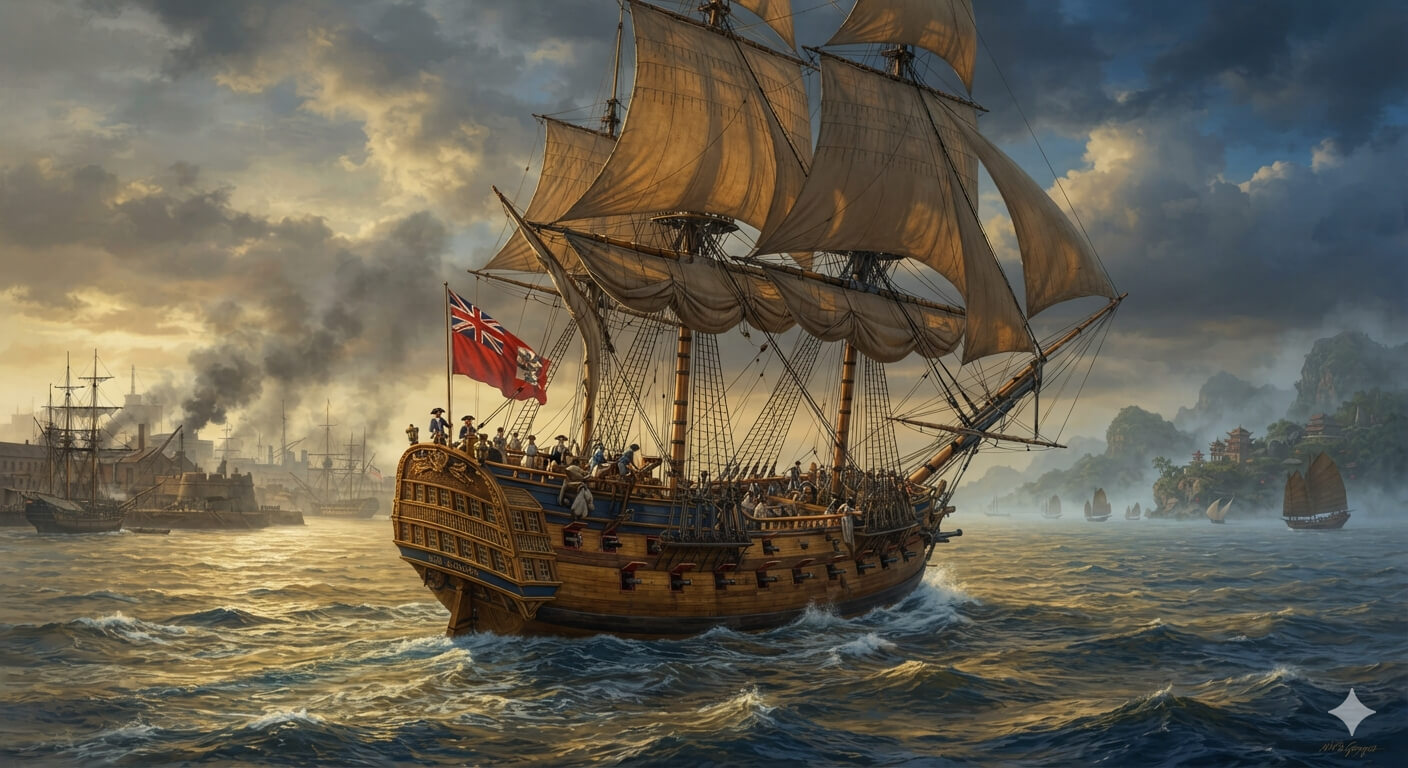
The British East India Company faced a massive maritime crisis: European oak warships were rotting rapidly in the tropical waters of the Arabian Sea. Looking for a solution, they turned to western India and convinced a master Parsi shipbuilder from Surat, Lowjee Nusserwanjee Wadia, to move to Bombay and establish the Bombay Dockyard in 1736—Asia’s very first dry dock.
Wadia brought a revolutionary material asset to the table: Malabar Teak. Teak was immensely strong, naturally oily, water-resistant, and lasted four times longer than oak.
Over the next 150 years, seven generations of the Wadia family built over 400 magnificent vessels for the British Empire. They didn’t just build cargo boats; they built 84-gun battleships of the line for the Royal Navy.
In fact, a Wadia-built ship, the HMS Minden, was the exact vessel on which Francis Scott Key wrote “The Star-Spangled Banner” (the American national anthem) while watching a British bombardment in 1814. Another Wadia ship, the HMS Cornwallis, hosted the signing of the historic Treaty of Nanking in 1842.
Through shipbuilding, Parsi merchants gained something the old Bengali elite never had: unrestricted access to British naval technology, global shipping lanes, and marine insurance networks.
The Drug Trade Triangle: Enter the “Opium Kings”
By the early 1800s, Great Britain was facing a crippling economic crisis. The British public had developed an insatiable addiction to Chinese tea, but the Chinese Emperor demanded payment only in silver bullion. This was bleeding Britain dry of its precious metals.
To reverse the flow of wealth, the British designed a ruthless global trade triangle: grow opium in India, smuggle it into China in exchange for silver, and use that silver to buy tea for Europe.
While the EIC controlled opium in Bengal, they had zero control over Malwa Opium, grown in the independent princely states of Central India. Parsi merchants brilliantly capitalized on this loophole.
Leading the charge was Sir Jamsetjee Jejeebhoy. Born a broke, 16-year-old orphan who collected empty liquor bottles for recycling, Jejeebhoy used his street smarts to board ships to China. He survived heavy naval bombardments by the French navy, was taken prisoner of war, and was once stranded in South Africa.
But his grit paid off. Jejeebhoy built a fleet of ultra-fast Opium Clippers that bypassed British monopolies, making him the undisputed king of the international Malwa trade. He accumulated a fortune so staggering that he became the wealthiest man in India, eventually becoming the first Indian knighted by Queen Victoria.
Guided by his Zoroastrian faith, Jejeebhoy poured his drug fortunes directly into the soil of Mumbai—single-handedly building the city’s first modern public hospitals (JJ Hospital), clean water reservoirs, and art institutions.
Laundering Opium into Industry: The Rise of the Tatas
The maritime opium and cotton trade networks pioneered by Jejeebhoy laid the exact financial blueprint for India’s most famous conglomerate: The Tata Group.
In the mid-1850s, a merchant named Nusserwanji Tata broke away from his family’s priestly traditions to join the booming Bombay trade networks. His firm struck gold during the American Civil War (1861–1865), when a British blockade of American ports forced global textile mills to buy Indian cotton at highly inflated prices.
Though the subsequent post-war crash nearly bankrupted the family, Nusserwanji secured a massive British military supply contract during the Abyssinian Campaign of 1867. His firm walked away with a staggering profit of ₹40 lakh (4 million rupees)—an astronomical sum that completely wiped out their debts.
In 1868, Nusserwanji’s 29-year-old son, Jamsetji Nusserwanji Tata, took a tiny fraction of that wartime surplus—just ₹21,000—to start his own independent trading company.
By age 35, Jamsetji made a bold gamble that defied the entire Bombay business community. While everyone insisted that factories had to be built near shipping ports, Jamsetji took his capital and founded the Empress Mills in Nagpur (1877), right in the heart of India’s raw cotton and coal fields.
It was a roaring success. But more importantly, Jamsetji used his fortune to pioneer corporate welfare. Decades before the West implemented labor laws, Tata introduced the 8-hour workday, free medical aid, and employee provident funds. He would later use this financial bedrock to establish India’s first indigenous steel plant (Tata Steel) and its first luxury hotel (The Taj Mahal Palace).
From Docks to Skyscrapers: The Modern Metamorphosis
So, what happened to these dynasties when the age of wooden ships and opium clippers came to an end? They didn’t vanish; they evolved.
When the maritime industry shifted to heavy steel-hulled steamships in the early 20th century, the Wadia family left the docks for good in 1913. They pivoted their immense wealth toward consumer goods and textiles, building iconic modern brands such as Britannia Industries (biscuits and dairy) and Bombay Dyeing.
Today, that same inheritance is transforming Mumbai all over again. Through their real estate arm, Bombay Realty, the Wadia Group is actively converting their historic, centennial textile mill land banks into ultra-luxury residential and commercial skyscrapers. Their flagship Island City Centre (ICC) mega-township features twin superstructures stretching up to 67 stories into the sky, commanding apartment prices upwards of ₹30 crore.
The Ultimate Business & Political Takeaway
The transition from the Mughal economic system to British colonial rule was a brutal filter that destroyed almost all of India’s traditional ruling elites.
The Jagat Seths and Amichands played an old, static game. They relied on local political proximity and short-term financial leverage over individual rulers, failing to realize that colonial capitalism would completely rewrite the legal and economic rules of the state.
The Wadias, Jejeebhoys, and Tatas survived because they mastered the macro-environment. They looked past local borders, mastered global maritime logistics, built the assets the sovereign power desperately needed, and then brilliantly laundered those controversial trading fortunes into hard, modern heavy industries, workforce welfare, and premier real estate.
The next time you look at a luxury skyscraper or pick up a packet of Britannia biscuits, remember: it all started with a load of Malabar teak, a fast clipper ship, and the chaotic power vacuum left behind by the falling titans of the Mughal and Maratha empires.