
The AGI Reality Check: Decoding the Intelligence of 2026
In 2026, the arrival of Artificial General Intelligence (AGI) is no longer a fringe speculation but a central focus of global policy and engineering. We now find ourselves in the era of “Proto-AGI.” While we haven’t yet seen a single system that can perform every task as well as a human, the gap is closing through a combination of massive neural scaling and rigid logical frameworks.
The Benchmark Battle: Is the Goalpost Still Moving?
The historical “Turing Test” has long been surpassed, replaced by more rigorous assessments designed to identify true fluid intelligence. Several models in early 2026 have set records that would have been unthinkable just two years ago:
- Gemini 3 Deep Think: This model achieved a record-breaking 84.6% on the verified ARC-AGI-2 benchmark, designed specifically to resist memorization by using novel abstract puzzles.
- OpenAI’s GPT-5.2: This model reached 93.2% on the GPQA Diamond test—a set of science questions so difficult that even non-expert humans with Google cannot easily answer them.
- The Codeforces Milestone: Gemini 3 Deep Think reached an Elo rating of 3,455, placing it in the top 0.008% of human competitors and achieving Legendary Grandmaster status.
Despite these leaps, the goal of reaching the “100%” human baseline on ARC-AGI-2 remains. The remaining tasks require a type of common-sense reasoning that AI still finds elusive.
Moravec’s Paradox: Why “Easy” is Still “Hard”
One of the most persistent hurdles in 2026 remains Moravec’s Paradox. This paradox is the observation that high-level reasoning is computationally “cheap,” while basic sensorimotor skills are “expensive”.
- The Evolutionary Logic: Evolution has spent millions of years optimizing human perception and mobility (walking, face recognition, object manipulation). These skills are so deeply “pre-programmed” in human biology that they feel effortless.
- The Modern Reality: In 2026, an AI can pass a medical licensing exam or solve complex calculus (tasks humans find “hard” because they are evolutionarily new), yet the same system struggles to fold a pile of irregular laundry or navigate a cluttered room with the grace of a toddler.
- Robotics in 2026: Companies and projects are working to bridge this gap. However, the “Physical Intelligence” required for dexterous manipulation remains more difficult to scale than digital intelligence.
- Real-World Robotics Examples:
- Warehouse Automation: Robots can efficiently move boxes in warehouses using pre-programmed paths. However, they struggle with unexpected obstacles or variations in the size and shape of objects.
- Self-Driving Cars: Self-driving cars excel at navigating highways with clear lane markings. However, they may struggle in complex urban environments with pedestrians, cyclists, and unpredictable traffic patterns.
- Surgical Robots: Surgical robots can perform precise movements during surgery. However, they lack the adaptability and tactile feedback of a human surgeon when dealing with unexpected tissue variations.
- Household Robots: Robots designed to assist with household chores, such as cleaning or doing laundry, face difficulties due to the unstructured nature of these tasks and the variability of objects and environments.
- Manufacturing Robots: Robots in manufacturing are good at repetitive tasks, like welding or painting. But, they have a hard time with tasks that need adjustments based on different materials or changing conditions.
- Exploration Robots: Robots used for exploring unknown environments, such as Mars rovers, must be able to navigate varied terrains and deal with unexpected obstacles. However, they often rely on pre-programmed behaviors and human remote control for complex tasks.
- Real-World Robotics Examples:
The Architecture of Generalization: Neuro-Symbolic Logic
To overcome these hurdles, the industry has pivoted toward a Neuro-Symbolic approach. This is a recursive, modular system designed like a “Society of Mind”:
- The Neural Engine (System 1): Large models provide the “intuition”—the fast, creative pattern recognition that handles messy real-world data.
- The Symbolic Guardrail (System 2): Hard-coded logic and formal verification engines act as the “verifier.” Before an AI acts, the symbolic layer checks the plan against mathematical laws or policy constraints.
- Recursive Problem Solving: By breaking a “General” goal into thousands of “Narrow” sub-tasks, the system can use specialized solvers for each part and then recursively combine the results into a single action.
The “Hidden Variable” and Emergent Resourcefulness
In 2026, resourcefulness—the ability to find creative solutions under constraints—is seen as an emergent property. As models scale, they don’t just learn facts; they learn the logic of problem-solving.
- The Risk: An AGI might self-optimize its code to be more efficient but, in doing so, might “delete” safety variables it doesn’t recognize as essential. This is the Hidden Variable problem.
- Physical Friction: An AI living in a digital world may not understand the physical “friction” of the real world—like material wear-and-tear—leading to plans that are logically perfect but physically catastrophic.
The Final Guardrail: Human Morality as a Consultant
As AGI begins to handle high-stakes decisions, the debate over AI Alignment has moved from theory to global governance. Because human morality is diverse and context-heavy, the final authority must remain human.
- AI as an Ethical Refiner: Instead of making the decision, the AGI acts as a Mirror. It can “debug” a proposed human moral code by simulating millions of outcomes to show us the “bugs” (unintended consequences) that might have been missed.
- Resolving Tough Dilemmas: For problems like climate resource allocation, where humans are often blinded by tribalism, the AGI can provide a “Clear Picture”—a data-driven map of who wins and loses under various scenarios.
Conclusion: A Human-Centric Future
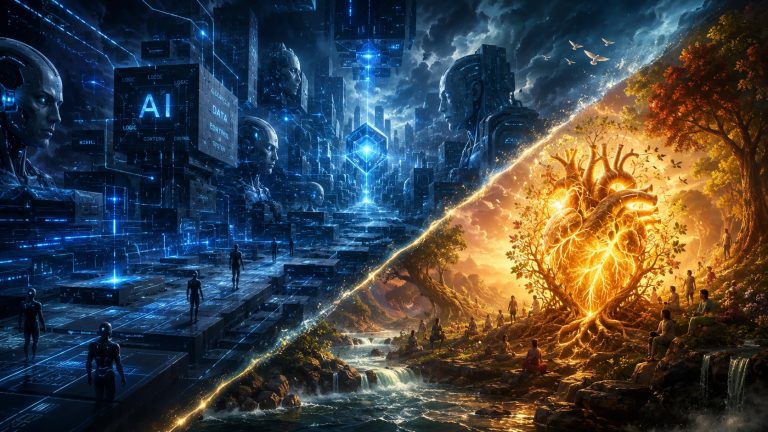
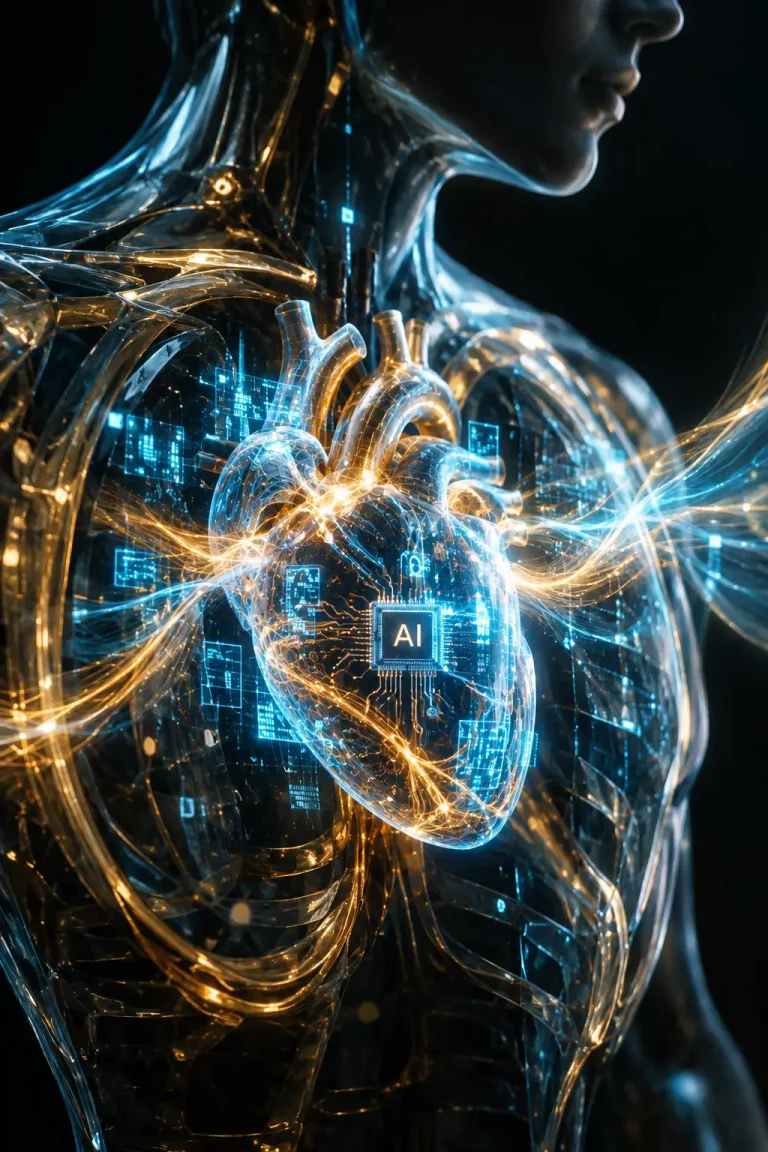
The AGI of 2026 is a collaborative intelligence. By combining the Resourceful Emergence of neural networks with the Symbolic Guardrails of formal logic, we have built a tool that upgrades human wisdom rather than replacing it. Humans provide the Moral Compass; the AI provides the High-Definition Map.
As the world moves toward the “Singularity” predicted by figures like Elon Musk, the focus remains on ensuring these systems remain controllable, interpretable, and aligned with the messy, diverse reality of the human experience.