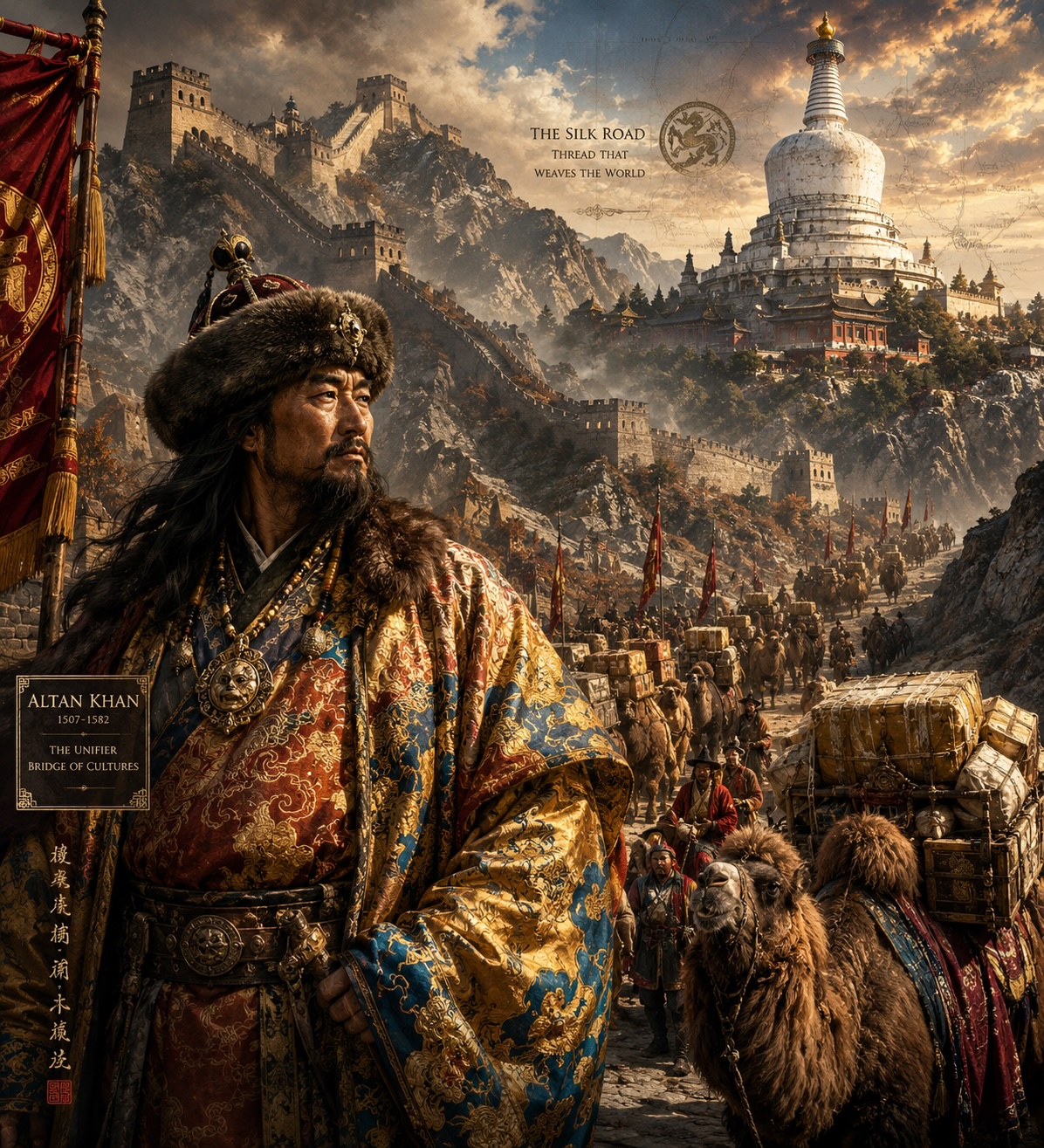
The Silk, The Steppe, and The Stupa: How a Nomad Warlord’s Obsession Rebuilt the World
Introduction
History loves a good paradox. If you ask the average person who built the iconic stone towers of the Great Wall of China or established the holy lineage of the Dalai Lama, they will likely point to peaceful monks or defensive Chinese emperors.
But the real answer lies thousands of miles away, carried on the backs of 200-camel caravans, locked inside a secret law code, and driven by a single nomadic warlord’s burning obsession with a roll of Chinese silk.
This is the story of Altan Khan—and how his quest for luxury temporarily revived a ghost network, reshaping the geopolitics, architecture, and spirituality of Asia forever.
The Ghost of the Global Relay Race
To understand Altan Khan’s desperation, we must first look at the ancient system he was trying to resurrect. For over a millennium, the Silk Road was not a single paved highway, but a shifting, multi-tiered web of overland desert tracks and maritime sea lanes. It operated as a massive global relay race. Individual merchants rarely traveled the entire 4,000-mile expanse from China to Europe. Instead, goods were traded from oasis to oasis through highly specialized middlemen.
[China:Xi'an]──> [Central Asian Sogdians]──> [Persian Middlemen]──>  [European Nobility]
Arid air keeps   Guarded by fortified        Exorbitant tariffs     Marked up over silk pristine          Caravanserais             and toll gates         1,000% in value
At its height under the Pax Mongolica (the 13th-century Mongol Peace), the Silk Road became an absolute economic and technological conveyor belt. Genghis Khan’s empire enforced a strict legal code known as the Yassa, which protected foreign traders with terrifying efficiency. Under the Yassa, committing a crime against a merchant caravan meant immediate execution for an entire local village.
The Mongols also invented the Paiza—a golden imperial passport that granted high-value traders free food, fresh horses, and armed escorts at every Örtöö (postal relay station) across the continent. This open network allowed life-changing technologies like paper-making, woodblock printing, and gunpowder to flow seamlessly into the West.
The Trans-Himalayan Sub-Route
Nepal sat as a crucial mountain artery of this massive web. Through the Trans-Himalayan branch route, Newar merchants from the Kathmandu Valley established vibrant trading houses in Lhasa, Tibet. They operated a brutal, high-altitude barter system: carrying grain and textiles up through the precipitous Kuti and Kyirong mountain passes to trade for Tibetan rock salt and gold dust.
[ Tibet: Salt Lakes ] ────> (Yaks carrying Rock Salt) ────> [ Kathmandu Valley ]
                                                                             │
                                                                             ▼
[ Newar Merchants ]  <─── (Bags of Rice and Mountain Grain) ── [ Nepal's Middle Hills ]
This mountain artery didn’t just move salt; it was a highway for artistic genius. In 1260, a 17-year-old Newar architect named Araniko led a team of craftsmen into Tibet and eventually to the court of Kublai Khan. Araniko completely revolutionized Mongol imperial art, building the iconic 50-meter White Stupa in Beijing and weaving the official silk brocade portraits of the Khan himself. At the exact same time, Venetian explorer Marco Polo was walking those same palace corridors, utilizing his own Gold Paiza to marvel at the Newar-infused architecture that defined the peak of the Silk Road.
The Western Terminal: Constantinople and Venice
While the eastern half of the Silk Road was governed by nomadic horsemen, the ultimate western destination of this luxury trade belonged to two legendary Mediterranean superpowers: Constantinople and Venice.
  [ Silk Road Overland Trails ]
               │
               ▼
   [ CONSTANTINOPLE ] ──( Aquatic Chokepoint )──> [ THE VENETIAN LAGOON ]
    • Built as a Christian Fortress                • Built on mud, salt, & wood
    • Smuggled silkworm secrets                    • Monopolized European sales
Constantinople: The Gateway where Christianity Met Silk
For over a thousand years, Constantinople (capital of the Byzantine Empire) was the ultimate bottleneck where the Silk Road entered Europe. Originally built by Roman Emperor Constantine the Great as the world’s first grand Christian capital, the city was treated as a holy sanctuary. But it was also a fortress of immense wealth.
For centuries, the Chinese fiercely guarded the secret of silk manufacturing. Anyone caught smuggling silkworm eggs out of China was executed. But around 552 CE, Byzantine Emperor Justinian pull off the ultimate corporate espionage. He hired two Christian monks to secretly hollow out their bamboo walking canes, fill them with live silkworm eggs, and walk them thousands of miles from China straight to Constantinople.
With those stolen eggs, Constantinople built its own imperial silk factories. Silk quickly became intertwined with Western Christianity—used exclusively to weave the magnificent robes of emperors, the heavy vestments of Orthodox priests, and the altar cloths of the grand Hagia Sophia cathedral.
Venice: The Mud-Born Middleman
Further west sat Venice. Venice was literally built on mud, salt, and millions of wooden logs driven deep into a saltwater lagoon to protect refugees from barbarian invasions. Lacking forests, stone quarries, or fresh water, the Venetians had to build their wealth entirely on trade. They started by dominating the local salt market—the “crude oil” of the medieval world, essential for preserving food through winter.
Once they mastered the sea, Venetian merchants sailed directly to Constantinople and Levant ports to meet incoming Silk Road caravans. They bought raw silk and spices in massive bulk, rowed them back to their lagoon, marked up the prices exponentially, and sold them to the rest of Western Europe.
By the 14th century, Venice became so wealthy off this middleman loop that they imported skilled weavers, set up strict textile guilds, and began manufacturing their own luxury velvet and silk brocades, transforming Venice into the high-fashion capital of the Western world.
The Black Death and the Ottoman Monopoly
But this hyper-connectivity carried a dark price. In the 1340s, the highly efficient Mongol trade routes became a biological super-highway for Yersinia pestis—the bacteria that causes the Bubonic Plague. Packed inside the saddlebags of merchants and flea-ridden marmot furs, the Black Death swept cleanly from Central Asia into Europe. Within years, it wiped out up to half the population of Europe and China, collapsing global trade and fracturing the Mongol administration.
The killing blow to the old overland route landed in 1453, when the Islamic Ottoman Empire conquered Constantinople, converting the Hagia Sophia into a mosque and ending 1,500 years of Roman political power. The Ottomans did not close the Silk Road, but they placed massive, exorbitant tariffs on all goods passing through.
Faced with soaring prices and heavy Ottoman taxes, European kingdoms like Spain and Portugal completely abandoned land travel. This financial desperation triggered the Age of Exploration, forcing sailors to take to the oceans to map direct sea routes around Africa to reach Asian spice and silk markets, leaving the land networks completely obsolete.
By the 1500s, the ancient Silk Road was a ghost of its former self.
The King on the Dirt Frontier
This brings us back to the 16th century, and the world of Altan Khan (1508–1582). He ruled the Tümed Mongols on the vast, freezing northern steppes bordering Ming Dynasty China. His timeline briefly overlapped with that of Babur, his distant cousin and fellow Turco-Mongol descendant who marched south to conquer India and found the Mughal Empire. But while Babur used gunpowder to build an urban empire in the south, Altan Khan was trapped in the original, nomadic homeland of his ancestors.
  [ The Nomad Dilemma ]
  Steppe lands provide: Meat, Dairy, Horses.
  Steppe lands LACK:    Grain, Tea, and... LUXURY SILK.
To survive, the nomads needed to trade. Altan Khan desperately wanted to revive the ancient horse-for-silk exchanges of his ancestors. He sent peaceful envoys to the Ming court in Beijing, offering premium warhorses in exchange for basic grain and luxury silks. Altan didn’t just want the silk to wear; on the rugged steppe, shimmering bolts of Chinese silk were a high-status currency. To keep minor chieftains loyal and prevent tribal civil wars, he had to reward them with premium luxury textiles.
But the paranoid Ming court, bound by an anti-Mongol ideology, executed his diplomats and reinforced the border.
The Day Beijing Burned
Altan Khan decided that if the Chinese would not let him buy silk, he would ride over and take it.
In September 1550, a massive cloud of dust rose on the northern horizon. The “Great Wall” at the time was nothing but a joke—a series of eroded, crumbling mounds made of tamped earth and mud. Altan Khan’s cavalry didn’t even need to dismount; they galloped right over the collapsing mud walls at the Gubei Pass.
Within days, the Mongols encircled Beijing.
From the windows of the Forbidden City, the terrified Ming Emperor watched the suburbs burn. Altan’s horsemen looted the Grand Canal terminals, filling their saddlebags with livestock, grain, and precious textiles. The corrupt imperial garrison hid behind the inner city’s 40-foot stone walls, completely paralyzed.
[Altan Khan's Raid] ──> [Bypasses Mud Walls] ──> [Torches Beijing Suburbs] ──> [Withdraws with Booty]
Altan Khan never wanted to conquer China. He lacked the heavy siege infrastructure and foot soldiers to hold a massive stone metropolis. Satisfied with his plunder, he turned his horses around and trotted back to Mongolia.
The Brick Revolution
The panic in Beijing changed global architecture forever. Realizing their earthen walls were completely useless against mobile horse archers, the Ming Dynasty launched the largest masonry fortification project in human history.
They permanently abandoned mud. They established hundreds of military kilns along the mountain ridges, wrapping the frontier in millions of granite blocks and kiln-fired bricks bound by a legendary, waterproof mortar made of sticky rice flour.
They widened the top of the wall into an elevated highway, allowing troop reinforcements to ride horses directly to a breached sector, and built thousands of multi-story brick watchtowers armed with advanced gunpowder cannons. The iconic, serpentine stone Great Wall of China that tourists visit today at Badaling and Mutianyu was not built to make a grand statement; it was a desperate, multi-billion-dollar emergency upgrade triggered entirely by Altan Khan’s raid.
From Warlord to Kingmaker
By the time Kublai Khan claimed the throne in 1260, the Mongol Empire had conquered hundreds of different cultures—including Han Chinese, Central Asian Muslims, and European Christians. Kublai realized a critical political reality: You can conquer an empire from the back of a horse, but you cannot govern it with power alone.
The Lamas declared Kublai to be a Chakravarti (a rightful universal monarch ruling through divine law) and an incarnation of Manjushri (the Bodhisattva of Wisdom). This gave him holy legitimacy in the eyes of millions of Asian subjects.
By 1571, the Ming Dynasty realized the stone wall was too expensive to maintain forever. They finally yielded, signing the Longqing Peace Treaty. The trade embargo was lifted. Legal frontier markets opened, and Altan Khan was officially showered with thousands of bolts of imperial silk every year in exchange for horses.
With his treasury full and his borders secure, the aging warlord turned his mind to eternity. He looked across the Himalayas toward Tibet, seeking a way to spiritually unify his people.
[ Altan Khan (Mongol Cavalry) ] ◄───► [ Sonam Gyatso (Tibetan Monk) ]
  • Grants political protection        • Invents the title "Dalai Lama"
  • Enforces Buddhism on the Steppe    • Grants Khan divine right to rule
In 1578, on the shores of Lake Qinghai, Altan Khan met a brilliant Tibetan religious leader named Sonam Gyatso. Reviving the ancient Cho-yon (Priest-Patron) alliance model first used by Kublai Khan, they struck a historic deal. Altan Khan legally banned traditional Shamanist blood sacrifices across Mongolia, forcing his people to convert to Tibetan Buddhism.
In return, the holy man granted Altan Khan the divine right to rule as a universal monarch. To honor the monk’s oceanic depth of wisdom, Altan Khan bestowed upon him a grand Mongolian title: The Dalai Lama.
The Lasting Echoes of the Steppe
When we look at the modern world, the threads of the historic Silk Road are everywhere.
The stone wall that winds across the mountains of China exists because a nomad prince wanted to trade. The highest spiritual office of Tibetan Buddhism bears a Mongolian name because a warlord needed religious legitimacy.
History is not a straight line of isolated events. It is a vast, interconnected relay race—where a single leader’s desperate hunger for a roll of silk can ripple across centuries, altering the architecture of empires, launching global exploration, and shaping the faith of millions.