The Compromise of 1787: The Great Political Blunder
The story of the American Civil War did not begin with the firing of cannons at Fort Sumter in 1861. It began eighty years earlier, in a hot, sealed room in Philadelphia, with a fatal stroke of a pen.
┌────────────────────────────────────────────────────────┐
│             THE ORIGINAL FAULT LINE: 1787              │
├────────────────────────────────────────────────────────┤
│  Northern Free States          Southern Slave States  │
│  • Industrializing Economy      • Tobacco & Rice Farms │
│  • Growing Free Workforce      • Total Dependence on   │
│  • Pushing for Central Taxes   │   Chattel Slavery     │
└────────────────────────┬───────┴───────────────────────┘
                         │
                         ▼
           THE 3/5ths COMPROMISE LOOPHOLE
           • Counted enslaved human beings as property
             for taxes, but as 3/5ths of a person to
             inflate Southern political power in Congress.
In the summer of 1787, the founding fathers gathered to write the U.S. Constitution. They faced an existential gridlock. The Northern states were transitioning toward an economy of merchants, small farms, and early factories. The Southern states were a sprawling agricultural empire built on the backs of enslaved Black Americans
To stitch the fragile new nation together, Northern politicians committed the first great political blunder: they traded human rights for political unity.
They agreed to the Three-Fifths Compromise, legally classifying enslaved human beings as three-fifths of a person. This didn’t give enslaved people rights; instead, it artificially inflated the political power of Southern white slaveholders in Congress. The founders falsely hoped that slavery would naturally fade away.
Instead, a machine tore that hope to shreds.
The White Gold: How the Cotton Gin Trapped a Nation
In 1793, Eli Whitney invented the cotton gin. Before this mechanical separator, cleaning a single pound of short-staple cotton took an enslaved worker an entire day. The machine could clean fifty pounds in the same amount of time.
============================================================
              THE ACCELERATION OF AN EMPIRE
============================================================
[1793: Cotton Gin Invented]
         │
         ▼
[Massive Global Demand from British & Northern Mills]
         │
         ▼
[The Domestic Slave Trade: 1 Million People Forced South]
         │
         ▼
[1860: 4 Million Enslaved People / "King Cotton" Rule]
============================================================
Suddenly, cotton became the most valuable commodity on earth, feeding textile mills in Manchester, England, and Lowell, Massachusetts [Great Britain: The Divided Superpower, The Culture of “King Cotton”]. But the machine only cleaned the cotton; it couldn’t plant or pick it.
To maximize profits, the Southern elite turned their society into a brutal machine of human extraction. Over the next fifty years, the number of enslaved people exploded from 700,000 to nearly 4 million. Enslaved humans were legally classified as chattel—property to be bought, sold, or mortgaged like livestock through a brutal economic system known as chattel slavery.
By the 1850s, the value of the enslaved population exceeded the combined value of all American railroads, factories, and banks. The South was completely trapped in its own multi-billion-dollar cage of white gold.
The Blundering Generation and the Match
As the United States expanded westward, the political compromise of 1787 was shattered. If a new Western territory became a “free state,” the North would gain power in Congress and might restrict slavery. If it became a “slave state,” the South would expand its empire.
A new, reckless generation of politicians replaced the founders. The phrase “blundering generation” was coined by historian James G. Randall. They tore up older peace treaties, passed laws forcing Northern citizens to catch runaway slaves, and outsourced the problem to the Supreme Court. In 1857, the Court ruled in the Dred Scott decision that Black Americans had “no rights which the white man was bound to respect.”
Instead of settling the peace, it lit a fuse.
       ┌──────────────────────────────────────────────────┐
       │         THE UNRAVELING TENSION (1831-1860)       │
       └────────────────────────┬─────────────────────────┘
                                │
         ┌──────────────────────┴──────────────────────┐
         ▼                                             ▼
┌─────────────────────────┐                 ┌─────────────────────────┐
│     DOMESTIC TERROR     │                 │   THE FINAL TRIGGER     │
├─────────────────────────┤                 ├─────────────────────────┤
│ • Nat Turner's Revolt   │                 │ • Lincoln Elected 1860  │
│   (1831) Sparks Police  │                 │   With Zero South Votes │
│   State Slave Codes     │                 │ • Southern Secession    │
│ • John Brown's Raid     │                 │   To Protect Property   │
│   (1859) Confirms War   │                 │ • Fort Sumter Attacked  │
└─────────────────────────┘                 └─────────────────────────┘
The South descended into paranoia. When an armed abolitionist named John Brown raided a federal arsenal in 1859 to spark a slave rebellion, the Southern elite realized white Northerners were willing to die to destroy their way of life.
When Abraham Lincoln—a Northern Republican who openly opposed the expansion of slavery—was elected president in 1860, the South drew a line in the sand. They refused to compromise. They seceded from the Union, and on April 12, 1861, they fired the first shots of a four-year war that would swallow over 700,000 American lives.
The Screaming Eagles of Elm Street
The conventional military war ended in 1865 with the destruction of the plantation economy. Still, the ideological war over white supremacy shifted to the shadows. For nearly a century, Jim Crow laws legally segregated the South, using state-sanctioned terror to strip Black citizens of their hard-won freedom.
Which brings us back to the humid morning of September 25, 1957, in Little Rock, Arkansas.
============================================================
              OPERATION ARKANSAS: CONTINUING THE WAR
============================================================
[Fort Campbell, KY] ───✈───► [Little Rock, AR]
Unit: 101st Airborne Division ("Screaming Eagles")
Mission: Enforce Federal Supremacy; Protect Nine Teenagers
============================================================
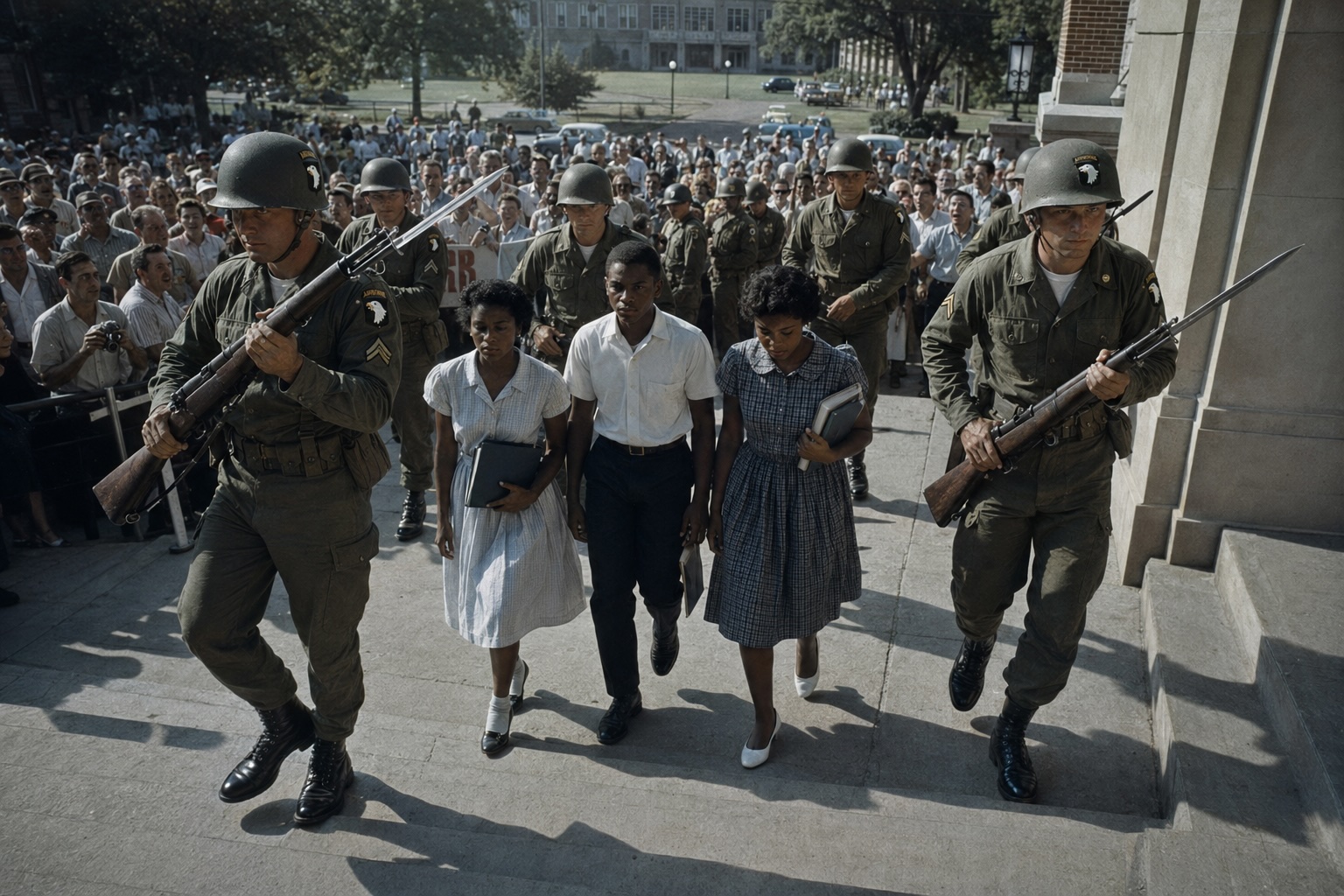
Nine Black teenagers, chosen for their resilience, stood outside Central High School (The Chosen Nine). Surrounding them was an angry, roaring white mob of over a thousand adults, carrying bricks and screaming for blood. Arkansas Governor Orval Faubus had used the state’s National Guard to block these children from entering, directly defying the U.S. Supreme Court.
President Dwight D. Eisenhower, a five-star general who understood the danger of a regional insurrection, decided that the authority of the United States was under attack. He bypassed the local guard, whom he suspected of sympathizing with the mob, and deployed the elite 101st Airborne Division—the “Screaming Eagles” who had dropped into Normandy on D-Day.
With absolute, terrifying military discipline, the paratroopers formed a human wall around the nine teenagers. They drew their rifles and snapped long, gleaming bayonets onto the steel barrels.
“Keep moving forward,” the commander ordered.
As the crowd surged and yelled profanities, the soldiers did not flinch. One rioter lunged forward; a paratrooper slammed his rifle butt into the man’s chest, throwing him to the ground. Another stepped into the path; a soldier leveled a cold bayonet inches from his throat. The mob broke, scattering like dry leaves.
The Little Rock Nine walked up those concrete steps and into the building. They faced a year of psychological torture inside those hallways, but the myth of unyielding state defiance was broken forever.