Sujata’s Bowl: Why You Can’t Meditate Away a Broken Body
The Middle Way Through a Broken Body
If you try to sit in a silent room and meditate while your lower back is actively throbbing, you quickly run into a wall. The modern wellness industry likes to pitch mindfulness as a universal fix—a mental shield that can override anything if you just breathe deeply enough. But when you try to apply an abstract mental exercise to a physical crisis, it usually fails.
Human beings have been hitting this exact wall for five thousand years. The fix isn’t to grit your teeth and force yourself to breathe through an emergency. It requires a realistic look at how our biology and our minds actually interact.
Sujata’s Solution
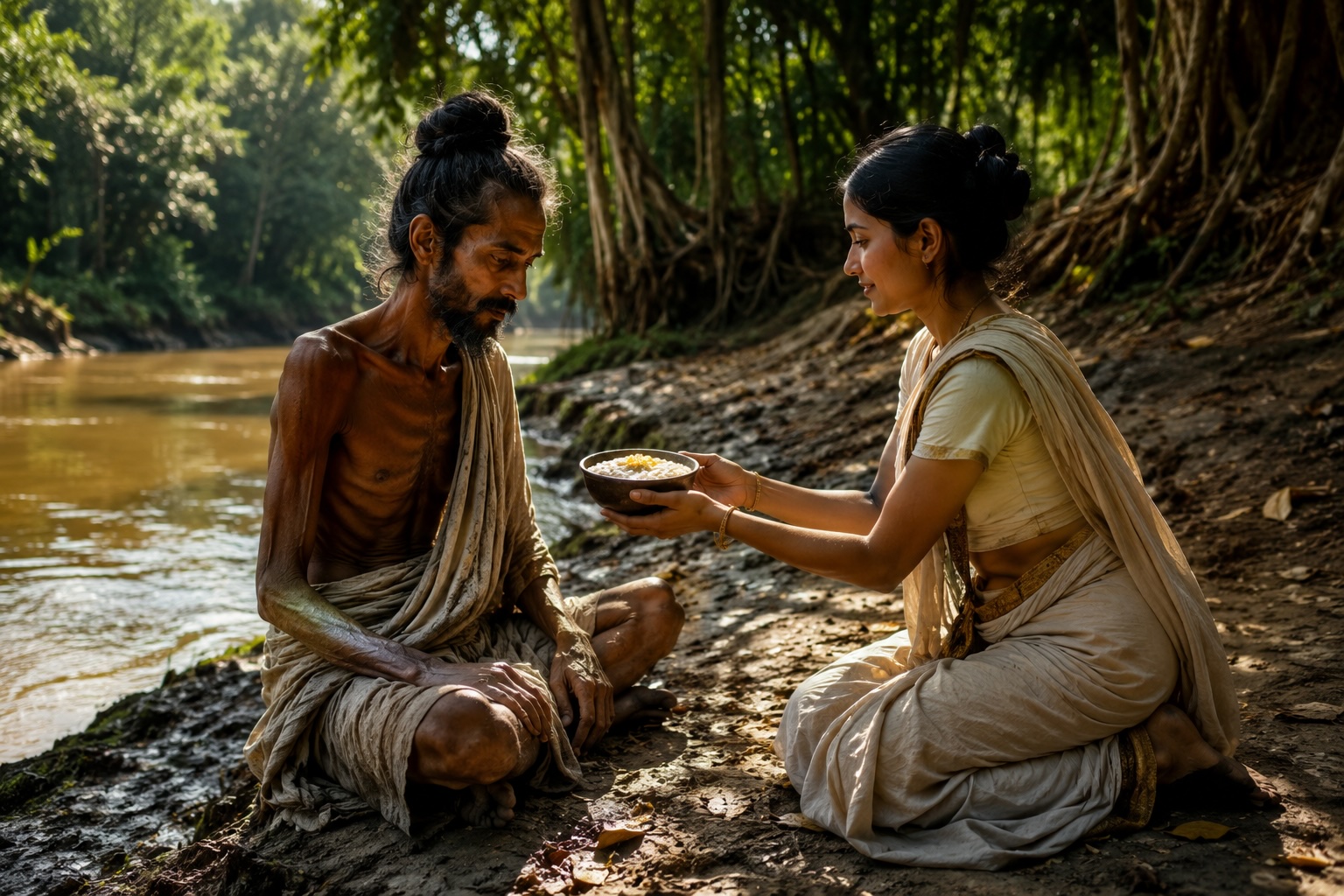
Before he was known as the Buddha, Siddhartha Gautama spent six years trying to starve his way to enlightenment. He lived on a single grain of rice or a drop of fruit juice a day, hiding out in the jungles of ancient India. By the end of it, his skin was stuck to his spine. He genuinely believed that by punishing his physical body, his mind would finally break free.
Instead, he fainted from sheer exhaustion and nearly drowned in a river.
A village girl named Sujata found him lying on the bank. She didn’t offer him a mantra or a spiritual lecture. She handed him a bowl of cold milk rice sweetened with honey—a simple, dense mix of fat, protein, and carbohydrates.
That meal saved his life. It cleared his brain fog, stabilized his nervous system, and gave him the physical stamina to sit down and figure out how human consciousness actually works.
This was the origin of the “Middle Way.” The Buddha realized something we still ignore: you cannot meditate away a physical deficit. If your body is aching because you are severely short on protein or sodium, your nervous system is flashing a biological warning light. Low salt forces fluid into your cells, causing your brain to swell and your muscles to cramp. Mindfulness cannot replace nutrition. It is simply the tool that forces you to slow down, notice that warning light, and eat some food.
Fighting the Ogre
Sometimes, though, the pain isn’t a quick fix like a missing meal. What do you do when a headache won’t quit, or you are dealing with chronic, long-term physical damage?
An old fable from the Buddhist Jataka collection explains the psychology of this perfectly. A young prince encounters a forest monster named Demon Sticky-Hair. The prince shoots fifty arrows, strikes with his sword, and lunges with his spear, but every single weapon gets glued inside the monster’s matted fur. Desperate, the prince punches and kicks the beast until his entire body is physically stuck to the monster’s chest. He is completely trapped.
The demon asks, “Why aren’t you screaming?” The prince looks him in the eye and says, “Because my mind is still free. If you eat me, you will choke on my clarity.” The monster, shocked by this total lack of panic, lets him go.
If you look at modern pain management, this sticky demon is a perfect metaphor for chronic illness. When we hurt, our immediate instinct is to fight back. We tense up, get angry, and obsess over when the ache will stop. But that resistance tells the brain to dump stress hormones into your blood, which tightens your muscles and actually dials up the raw pain signals. Mindfulness tells you to drop the weapons. You stop fighting the sensation, look it in the eye, and let it sit there. By removing the mental panic, you take away the monster’s leverage.
The Shadow and the Shield
We aren’t always strong enough to play the warrior prince, though. There are days when your body is spent, your stamina is gone, and the intellectual discipline of mindfulness feels entirely exhausting.
The ancient world understood this vulnerability. Around the 7th century, the cultural pendulum in India swung away from cold, intellectual meditation toward something much warmer: the Bhakti movement. They took a very old, unpredictable deity—Lord Shiva—and turned him into a refuge for anyone who felt left out by polite society.
Shiva doesn’t live in a clean, perfect heaven. He hangs out in cremation grounds, covers himself in ash, and travels with an army of ghosts, outcasts, and Asuras (demons). He represents the wild, uncalibrated side of nature. Mentally, Shiva’s army is a picture of our own shadow sides—our deep anxieties, past traumas, and broken physical parts. While ordinary logic tells us to suppress or hate our inner demons, this philosophy tells us to do what Shiva did: accept them as part of the family.
For the ordinary person, these poets offered a different path: pure, unadulterated faith. They argued that when a crisis is too big for your ego to handle, you stop trying to fix it. You close your eyes and surrender the problem to time or a higher power.
From a neurological standpoint, this kind of surrender acts like medicine. By genuinely believing that you are safe in the big picture and that this too shall pass, you signal your nervous system to calm down. It gives your body the deep rest it needs to release its own natural endorphins and heal.
The Trailing Language
This human struggle to balance active effort with total surrender isn’t new; it is etched into the very history of our languages.
Thousands of years ago on the Eurasian grasslands, an ancient tribe spoke a language that eventually split apart. One branch traveled west to become Ancient Greek; the other moved east to become Vedic Sanskrit. They shared the same grammatical DNA—using musical pitches to accent words and adding the same specific prefix to turn a verb into the past tense.
They entirely forgot each other for two thousand years, until Alexander the Great marched his army into India in 326 BCE. That reunion didn’t change the local languages, but it allowed ideas to cross borders. Indian astronomers openly borrowed the Greek word for a circle’s center (Kéntron) and turned it into Kendra, which is still a core word in Indian math today.
Later, Indian merchants sailed across the Bay of Bengal, carrying these stories and the Sanskrit language to Southeast Asia. They didn’t invade; they just shared their worldview. The Khmer people took those concepts and built Angkor Wat—a massive, 400-acre palace-city designed as a physical, stone model of the universe. They didn’t just build a church; they built an empire based on strict water engineering, storing monsoon rains to grow enough rice to feed the millions living within its walls.
Eventually, just as Latin became the silent anchor of the Catholic Church, Sanskrit became a ceremonial language. It stopped being used to buy vegetables in the market. Still, it stayed frozen in time on purpose—a permanent, unalterable hard drive meant to pass down the exact laws of yoga, medicine, and mindfulness without letting them mutate over generations.
Grounding the Knowledge
When you step back and look at the whole picture, you realize that science and storytelling, or active mindfulness and deep faith, are not enemies. They are two gears in the same survival machine.
You need mindfulness and science for your daily, active choices. You have to stay awake to your body’s physical needs. You need to balance your nutrition, drink your electrolytes, and catch your anger before it takes the wheel.
But you also need faith and surrender for the big picture. When the storm hits, when your energy is completely gone, and the pain is too heavy for your intellect to solve, you have to know how to let go. You have to trust that time is a healer, and that you are just a small part of a much older story.
True peace isn’t about finding a place where there is no noise or trouble. It is simply the ability to stand right in the middle of the mess and keep your heart still.