The Thermodynamic Empire: Why Energy is Swallowing the Global Economy
Prologue: The Whisper in the Oil Scraps
In the late autumn of 1942, a shadow fell across the Caucasus mountains. Adolf Hitler, staring at maps of an expansive Soviet Union, made a decision that baffled his traditional military generals. He ordered the German armies to bypass Moscow—the political heart of his enemy—and throw their entire mechanical weight south The Bibi-Heybat Oil Field.
His destination was Baku, a windswept peninsula on the Caspian Sea where black oil bubbled naturally out of the dirt Facebook (SPE Members).
“If I do not get the oil of Baku,” Hitler confessed behind closed doors, “then I must end this war.”
Baku was the engine of the Soviet war machine, pumping out over 70% of the USSR’s entire fuel supply. Had the German Panzers captured those wells intact, the Soviet T-34 tanks would have frozen into useless blocks of rusted iron, prolonging the war.
This historical flashpoint reveals the foundational law of human history: nations do not run on paper money, political treaties, or ideology. They run on the raw, unforgiving laws of thermodynamics.
The $5 Trillion Hemorrhage: The Modern Economic Brake
Fast forward to the modern global landscape. The battlefields have shifted from the trenches of the Caucasus to the high-tech trade corridors of Asia, but the core thermodynamic struggle remains identical.
Over the last two decades, China and India experienced an industrial expansion unmatched in human history. Millions entered the middle class, purchasing cars, booking flights, and constructing megacities. But this economic miracle came with a devastating price tag: a combined $5 trillion oil import bill.
To put $5 trillion into perspective, it is roughly equivalent to the entire annual Gross Domestic Product (GDP) of Germany—the third-largest economy on Earth.
[ The Oil Drain Cycle ]
Rapid Industrial Growth ──> Skyrocketing Oil Consumption ──> Massive Trade Deficit ──> Currency Devaluation ──> Forced Economic Slowdown
Every single year, these manufacturing superpowers were forced to harvest billions of dollars in hard foreign currency, pack it into digital vaults, and ship it permanently out of their borders just to keep their vehicles moving. For India, which imports over 85% of its crude, this “Oil Drain” acted as a structural economic emergency.
Every time the Indian economy began to grow at breakneck speeds, its oil consumption spiked. The resulting trade deficit weakened the Rupee and triggered domestic inflation. Time and again, foreign oil acted as an automatic “brake,” forcing central banks to slow down domestic growth engines just to preserve foreign exchange reserves.
Where did that $5 trillion go? It flowed directly into the sovereign wealth funds and state oil companies of OPEC and Russia. It built the hyper-luxurious, futuristic skylines of Dubai and Riyadh. It funded Saudi Arabia’s trillion-dollar Public Investment Fund (PIF), purchasing global tech giants, premium real estate, and international sports leagues. It built Russia’s massive foreign exchange shield, creating a financial war chest that allowed its economy to withstand unprecedented Western sanctions.
Through the “Endowment Model,” these oil states converted a finite physical resource into an infinite financial legacy. They realized that while oil will eventually run out or decline in value, a well-diversified global investment portfolio never expires. They became the global financial landlords of the 21st century.
The Limits of the Green Illusion
Realizing that sending another $5 trillion abroad is an economic dead end, the world’s manufacturing powers have attempted a massive energy revolt.
Look at Brazil, which turned its biofuel transition into a multi-decade industrial marathon. Today, 95% of new cars sold in Brazil are flex-fuel vehicles. By mandating that every single gas station across the country offer 100% pure sugarcane ethanol (E100) right next to standard gasoline pumps, and developing engine software that calculates fuel blends on the fly via exhaust gases, Brazil effectively insulated its citizens from global oil shocks.
But while Brazil succeeded because of its tropical climate and massive agricultural surplus, other nations face an unyielding geographic barrier. The United States tries to replicate this with corn-based ethanol, but corn contains complex starches rather than simple sugars.
Processing it requires an energy-intensive chemical conversion process powered by natural gas, creating a fierce “food vs. fuel” dilemma over prime farmland.
[ The Biofuel Yield Trap ]
Sugarcane (Brazil) ──> Simple Sugars ──> Ferments Instantly ──> High Efficiency
Corn / Grains (US/Russia) ──> Complex Starches ──> Requires Intense Cooking ──> Energy Deficit
The math simply does not add up for global transport. To run a modern economy on biomass requires an unsustainable amount of water and fertile land, threatening national food security.
Similarly, Green Hydrogen is highly celebrated as a clean energy savior, but it carries a severe efficiency penalty. When you convert green electricity into hydrogen, compress it, transport it through specialized infrastructure, and convert it back into power inside a fuel cell, you lose roughly 60% to 70% of the original energy along the way.
The War Machine Paradox
As the civilian world transitions to electric vehicles, ethanol, and hydrogen, an uncomfortable paradox emerges: the theater of war completely rejects green technology.
No military general can afford to fight a war without petroleum. A single modern 70-ton main battle tank travels less than 0.6 miles per gallon of fuel. A lone mechanized division requires hundreds of thousands of gallons of diesel every single day to sustain an advance.
To power that same division with electric batteries, you would need battery packs weighing dozens of tons per vehicle. Furthermore, you cannot plug a tank into a charging station in the middle of a muddy trench or a ruined combat zone.
Electric grids and charging stations are the very first targets destroyed by long-range missiles or cyberattacks during a conflict. A diesel truck can carry fuel anywhere in simple jerrycans; an EV fleet becomes a line of motionless metal boxes the moment the power plant is bombed.
Furthermore, to achieve supersonic speeds and survive aerial dogfights, fighter jets and bombers require an immense concentration of chemical energy that batteries cannot physically provide.
Beyond fuel, oil is the fundamental raw material used to manufacture military hardware. The manufacturing of modern military explosives, propellants, bulletproof Kevlar armor, synthetic rubber for tank tracks, and sterile field medical supplies all require raw chemical components derived exclusively from crude oil refining.
The civilian shift to EVs is actually a massive military advantage for superpowers. By moving civilian commuters off the oil grid, countries free up their domestic oil reserves. The civilian world can run on batteries, but the war machine will always run on oil.
The Phased Private Nuclear Era: Closing the Debt Loop
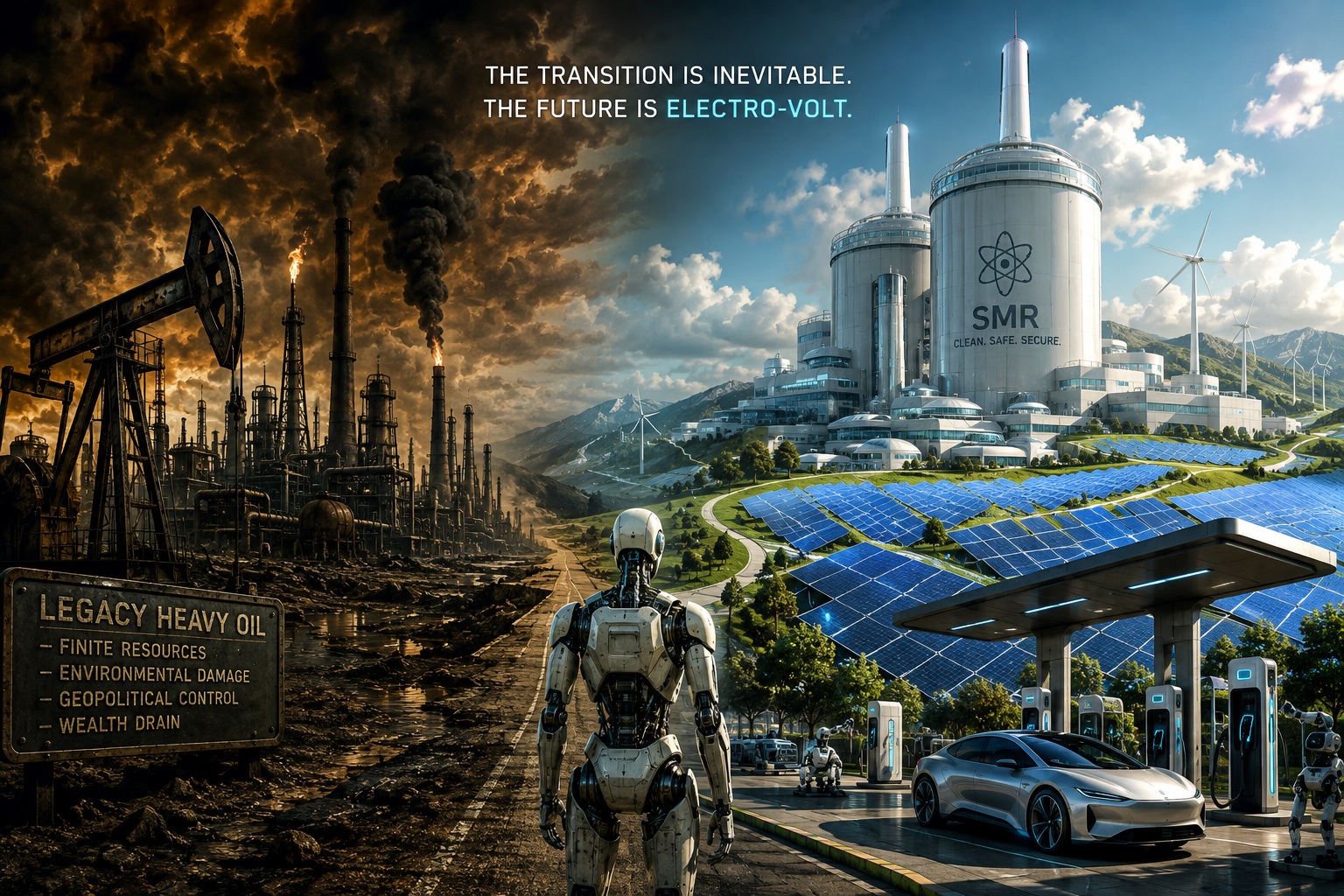
If a nation wants to survive this cutthroat landscape, it must build an unstoppable baseline grid of independent energy. It must go nuclear.
While a massive $300 billion nuclear buildout seems initially unaffordable for a developing nation like India, with cash up front, a specialized financial blueprint called a Phased Project Finance Model changes the entire equation.
India would never try to build 75 to 100 reactors simultaneously. By breaking construction down into a 20-year multi-phase pipeline, the actual capital requirement drops to a highly manageable $15 billion per year.
[ The Self-Paying Energy Loop ]
Borrow $15B/Year ──> Build Standardized Nuclear Fleet ──> Power Electric Transit & Local Industry ──> Drop Oil Import Bill ──> Use Saved Oil Cash to Pay Off Loan
Once the debt is cleared, a nuclear plant becomes a literal money-printing machine, providing massive, weather-independent power for up to 80 years.
Furthermore, this financial burden is shifting away from public treasuries and onto corporate balance sheets. Trillion-dollar tech conglomerates are facing an energy crisis because a single advanced AI query consumes roughly 10 times as much electricity as a traditional search engine query.
In emerging markets, legislation is adapting to this reality. India’s historic overhauls of its civil nuclear sector have removed the state’s absolute monopoly, allowing major private conglomerates to own, finance, and operate nuclear assets.
However, true success relies heavily on workforce continuity. As France’s 17-year construction delays at Flamanville-3 proved, halting nuclear construction for twenty years causes “industrial amnesia”. When an entire generation of elite nuclear engineers and precision welders retires, the tribal knowledge disappears, leading to catastrophic delays and broken budgets when you try to build again.
China and India are countering this by treating nuclear construction as a continuous, active assembly line, packed with permanent training pipelines to ensure their human machinery stays sharp.
The Kinetic Explosion: The Robot Energy Crisis
This brings us to the final, ultimate bottleneck of human automation: the rise of the Humanoid Robot.
If humanoid robots become a ubiquitous commercial reality, their global power consumption will absolutely dwarf the current energy footprint of AI data centers.
When an AI sits inside a data center, it requires electricity to do one thing: change the magnetic states of silicon transistors. It is an exercise in pure information. But the moment you take that AI and put it inside a 150-pound humanoid body that must walk, lift, climb, and manipulate tools, the energy requirement explodes exponentially.
[ The Energy Hierarchy ]
1. Static Search: Minimal energy consumption.
2. AI Data Centers: High-compute silicon power (Fires up nuclear interest).
3. Humanoid Robots: Massive kinetic torque against gravity (Demands entire national power outputs).
To fight gravity and maintain balance on two legs, a robot relies on dozens of high-torque electric actuators and motorized joints. Moving physical mass requires massive mechanical force.
If the world deploys 1 billion humanoid robots, and each machine draws a conservative average of 2 kW of power while working, they will consume roughly 730 Terawatt-hours (TWh) of electricity per year—more than the entire annual energy consumption of Germany.
A billion-robot workforce running 24/7 in automated factories will create massive, unpredictable spikes in grid load that would instantly crash standard, legacy power networks.
Energy as the De Facto Future Currency
Throughout human history, we have chased illusions of wealth. We traded gold coins, printed paper fiat money, and built digital stock markets. But paper money can be printed infinitely by central banks, leading to structural inflation, and digital tokens are bounded entirely by human agreement.
You cannot print a single Kilowatt-hour. You cannot replicate a Joule.
Energy is anchored strictly to the immutable laws of physics. Because it is the finite, non-negotiable input required for every single unit of human, robotic, or digital work, energy is becoming the de facto future currency of global civilization.
We are moving away from an economy where the wealthiest nations are the ones with the largest paper treasuries, and into an era defined by Sovereign Energy Capacity. The world’s elite financial actors—such as BlackRock, NBIM, and Middle Eastern sovereign wealth funds—already reflect this reality; their multi-trillion-dollar portfolios are simply recycled physical energy converted into a permanent financial monopoly.
In an automated century, manufacturing human wages drop to zero. The secret to winning global trade will no longer be cheap human labor. A factory’s running cost will be determined almost entirely by two variables: the cost of the robot and the cost of the electricity to keep that robot moving 24/7.
[ The New Global Power Equation ]
Country A (Imported Oil/Gas Grid) ──> 12¢ per kWh ──> Expensive Robotic Labor ──> Industrial Collapse
Country B (Sovereign Nuclear Grid) ──>  2¢ per kWh ──> Virtually Free Robotic Labor ──> Global Monopoly
The nations that successfully secure a paid-off, sovereign nuclear or solar baseline grid will automatically hold the most stable currency on Earth. Cheap electrons equal cheap labor and cheap computing power.
The country that commands the cheapest, most secure energy grid will hold an unbeatable industrial monopoly over global trade, permanently cementing its position as a global economic superpower. The wrapper of paper wealth is being torn away, leaving behind the ultimate standard of future power: the atom and the grid.
What Are Your Thoughts?
- If cheap nuclear power makes robotic labor virtually free, what happens to the economies of developing nations that rely heavily on human labor exports?
- As energy becomes the true backer of national wealth, would you support your country issuing a currency explicitly pegged to Megawatt-hours instead of gold or debt?