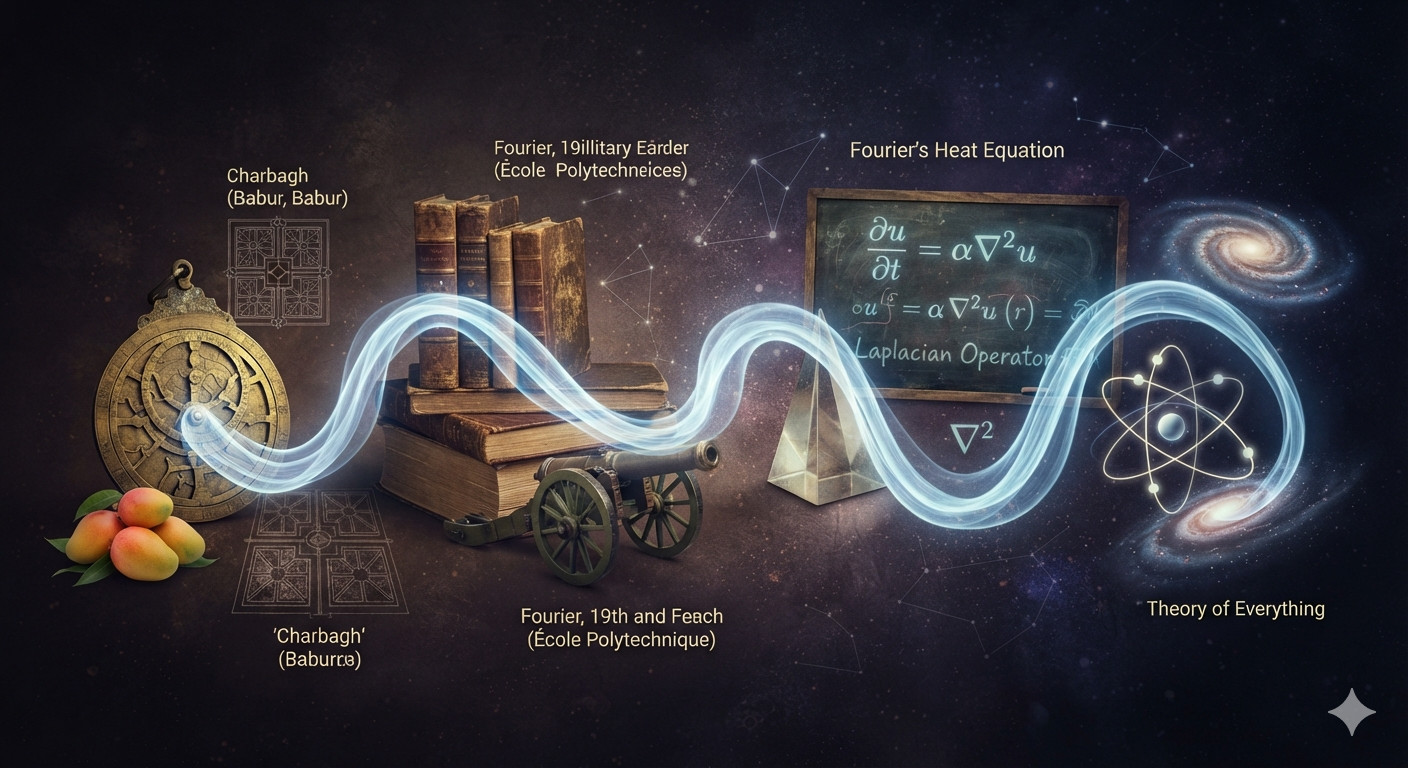
From Mangoes to Multi-Dimensions: The Invisible Thread of the Cosmos
Act I: The Emperor’s Mango
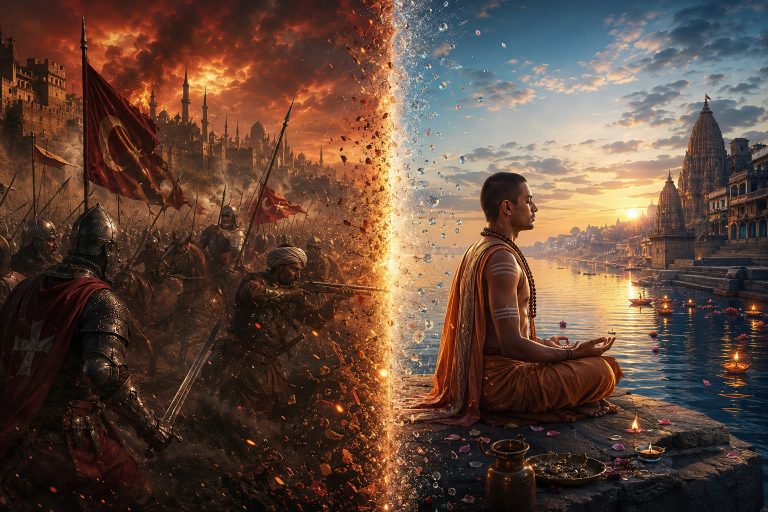
In the scorching summer of 1526, a man sat in a newly laid geometric garden in Agra, modern-day India. His name was Zahir-ud-Din Muhammad Babur, the founder of the Mughal Empire. He had just won a continent at the Battle of Panipat using a revolutionary, terrifying military tactic: chaining heavy baggage wagons together to form a wall, behind which he deployed Ottoman-style cannons.
Yet, as he sat in the humid air of Hindustan, he was not writing about gunpowder or blood. He was writing about mangoes.
  [ Central Asia ] --(A yearning for order)--> [ Hindustan ]
  (Melons & Cold Rivers)                       (Mangoes & Rhinoceroses)
In his highly candid diary, the Baburnama, Babur acted as a deeply observant naturalist. Coming from the cool, crisp mountain valleys of Central Asia, he was obsessed with cataloging the world. He meticulously measured the horns of the Indian rhinoceros, mapped the monsoon wind directions, and famously reviewed the local mango, declaring it the finest fruit in the land while complaining bitterly about the sticky juice and the lack of cold running water.
Babur had a psychological need to force order onto chaos. Wherever he conquered, he built Charbaghs—perfectly symmetrical, terraced Persian gardens with precise water channels cutting through the dirt at exact right angles. He looked at the wild, untamed wilderness of India and used the geometry of his time to create balance.
What Babur could not possibly know was that his deep desire to find order in nature, his obsession with the flow of water, and his use of advanced artillery were early ripples of an invisible intellectual current. A current that would flow across centuries, connecting an imperial warlord to a secret French military academy, a legendary British university exam, and ultimately, the final equations of modern quantum physics.
Act II: The Secret Weapon of the Revolution
Jump forward nearly three centuries to the year 1794. The world is on fire again, but this time the epicenter is Paris. The French Revolution has degenerated into the bloody Reign of Terror. At the center of this chaos stands a young, brilliant mathematical prodigy named Joseph Fourier.
Fourier was a passionate believer in the early ideals of the Revolution. Still, he openly despised the senseless violence of the guillotine—a machine invented to bring swift, humane “equality” to execution, but which was now running red in public squares. Fourier risked his life to protect local citizens from Jacobin extremists and was promptly thrown into prison. He was scheduled to be guillotined.
He survived by a miracle of pure timing: days before his execution date, the tyrant Robespierre was himself overthrown and executed. The Reign of Terror collapsed.
  [ The French Revolution ] ---> [ École Polytechnique (1794) ]
  (Chaos & The Guillotine)       (Monge, Lagrange, Laplace, & Fourier)
Upon his release, Fourier joined the faculty of a newly minted elite institution: the École Polytechnique. The school was a dream team of human intellect. The star of the academy was Gaspard Monge, the father of Descriptive Geometry. Years earlier, Monge had invented a visual way to project 3D architectural spaces onto 2D sheets of paper. The French military realized this math allowed them to design fortifications and map artillery lines at lightning speed.
The government immediately classified Monge’s geometry as a top-secret military weapon, banning it from public schools. But at the École Polytechnique, the secret was finally out. Monge taught the students how to draw the physical world; Lagrange and Laplace taught them the rigid calculus needed to analyze forces.
It was here that Fourier became obsessed with a highly practical military problem: How does heat move through the iron of an artillery cannon? If a cannon heated up too quickly during rapid fire, the metal would fracture and explode, killing the soldiers.
In 1822, Fourier published The Analytical Theory of Heat. In the preface, he penned a deeply philosophical line:
“Fundamental causes are not known to us, but they are subject to simple and constant laws which can be discovered by observation…”
Fourier realized he didn’t need to know what heat fundamentally “was” at an atomic level. He just needed to map its behavior. He took the structural, spatial thinking he learned from Monge and combined it with calculus to write down the universal Heat Equation:
To solve this equation, Fourier invented Fourier Series, proving a mind-bending mathematical truth: any jagged, complex, chaotic curve in the universe could be broken down into a smooth, harmonious sum of simple sine and cosine waves.
Act III: The Intellectual Gladiators
Across the English Channel, the mathematical torch passed to the University of Cambridge. By the Victorian era, Cambridge had turned mathematics into an elite, brutal competitive sport known as the Mathematical Tripos.
Students trained like physical athletes for 14 hours a day under private coaches. The student who scored the absolute highest marks on this mind-meltingly fast, grueling exam was crowned the Senior Wrangler. A Senior Wrangler was celebrated as a national hero, their victory printed in newspapers and toasted with torchlit parades.
In 1841, a young student named George Gabriel Stokes entered Cambridge. He would go on to become Senior Wrangler, and his mind naturally gravitated toward the physics of fluids—how water moves through rivers and how air flows over surfaces.
  [ Fourier's Heat Equation ]                 [ Stokes's Fluid Fluid Equation ]
  Heat diffusing through iron   ===(MATH)===   Speed diffusing through a river
Stokes looked at the chaotic swirling of a river and noticed something profound. If a fast-moving current rubs against a stagnant shoreline, the speed doesn’t vanish randomly. The velocity “diffuses” through the layers of water, smoothing out the friction.
Stokes realized that nature was recycling its own source code. He utilized Fourier’s Heat Equation and applied it directly to fluid dynamics. In his famous Navier-Stokes Equations, the mathematical engine that drives the fluid is the exact same operator Fourier used: the Laplacian (∇²).
Where Fourier used a material constant called Thermal Diffusivity (α) to describe how fast heat cuts through an iron bar, Stokes used a material constant called Kinematic Viscosity (ν) to describe how fast speed diffuses through a flowing river. Because of Fourier’s foundational work, Stokes formalized a terrifyingly beautiful truth: nature uses the exact same mathematical language to move heat through iron as it does to move water through a river.
Act IV: The Metaphysics of Reality
How is this possible? Why should a coin flip, a boiling pot of water, a flowing river, and a piece of solid iron all lock together under the exact same mathematical formula?
This is where physics sheds its skin and becomes metaphysics.
In 1960, the physicist Eugene Wigner wrote a classic essay titled “The Unreasonable Effectiveness of Mathematics in the Natural Sciences.” He argued that the way abstract math perfectly predicts the physical universe is a profound mystery—a “wonderful gift which we neither understand nor deserve.”
                    [ The Laplacian: ∇² ]
                             |
         +-------------------+-------------------+

         |                   |                   |
         v                   v                   v
   [ The Iron Bar ]    [ The Great River ] [ The Universe ]
    Thermal Balance     Momentum Balance    Cosmic Flow
When we look at the universe through the lens of Ontic Structural Realism, we realize that the individual “things” we see—the iron bar, the river water, the mango tree—are secondary. The true, foundational reality of the universe is the mathematical structure that relates them.
Ancient Eastern philosophies intuitively understood this centuries before calculus. Daoism speaks of the Tao(The Way) as an invisible, fluid force that binds the cosmos. The Tao is constantly smoothing down the jagged mountain peaks and filling up the empty valleys to achieve harmony. The Laplacian operator (∇²) is simply the Western mathematical translation of the Tao: it looks at a point in space, measures its unevenness relative to its neighbors, and naturally flows to restore perfect, unified balance.
Act V: The Ultimate Equation
Today, modern physics stands at the edge of the ultimate frontier. We live in a fractured reality. For the macro-cosmos of stars and galaxies, we use Einstein’s smooth, geometric General Relativity. For the micro-cosmos of atoms and subatomic particles, we use the choppy, chaotic probabilities of Quantum Mechanics.
When we try to force these two theories together, the math explodes into nonsensical infinities.
               THE GREAT DIVIDE
  [ Macro-Cosmos ]           [ Micro-Cosmos ]
  General Relativity         Quantum Mechanics
  (Smooth Spacetime)         (Chaotic Particles)
          \                         /
           \                       /
            v                     v
         [ A Theory of Everything? ]
Physicists are searching for a Theory of Everything (ToE)—a single master framework like String Theory or Loop Quantum Gravity that can elegantly govern both the atom and the galaxy.
Is a single unified equation a logical necessity for the universe to function? Perhaps not. As the philosophy of Emergence suggests, “More Is Different.” When you pile enough chaotic quantum particles together, entirely new macro-laws like gravity and heat conduction naturally emerge, just as wetness emerges from a collection of dry water molecules.
But humanity keeps hunting for that single equation anyway. Why? Because we crave the elegance. We are still like Emperor Babur in his garden, looking at a wild, chaotic world and seeking the beautiful, symmetric lines hidden underneath.
From the imperial gardens of Agra to the chalkboard of Albert Einstein, the story of science is not a story of disconnected discoveries. It is a single, continuous, epic human journey to find the invisible mathematical thread that weaves us all into the fabric of the cosmos.