Breaking the Bell Curve: The Hidden Math and Psychology of Wealth in 2026
Introduction
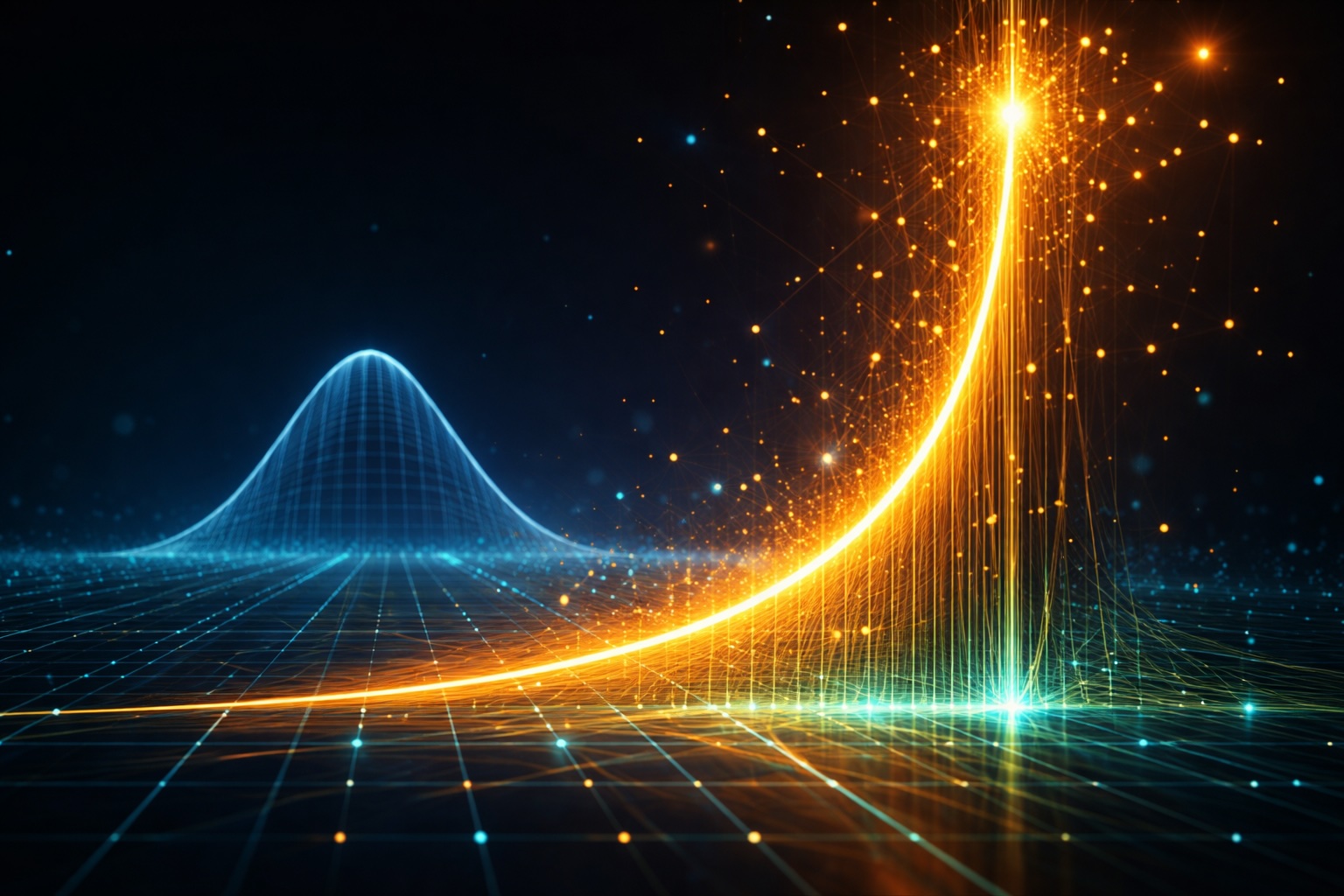
For decades, we have been sold a comforting lie: the “Middle Class” dream. This dream is built on the Normal Distribution (the Bell Curve). We are taught that if we work a bit harder than the average person, we will get a bit more than the average reward. In this world, extremes are rare, the “middle” is safe, and life is linear.
But as we navigate the hyper-connected, AI-driven landscape of 2026, that old map is failing. If you look at the data—from the World Inequality Report to the dominance of tech giants—you see a different shape. It isn’t a bell; it’s a Power Law.
In a Power Law world, the “average” is a trap. To build true wealth today, you have to stop thinking about addition and start thinking about multiplication.
The Integrated Wealth Formula
To model your financial future, you cannot just look at your bank balance. You have to look at your system. Here is the formula for a “Power Law” life:
The Variables:
- : Total Wealth at time t.
- : Initial Capital (The Seed).
- r: Rate of return (Compounding).
- L: Labor/Time (The Base).
- I: Information Asymmetry (The Skill Multiplier).
- N: Network Centrality (The Graph Multiplier).
- E: Entropy (Expenses and Lifestyle Creep).
1. The Passive Engine: Compounding (K)
The left side of the formula, , is your “Money at Sleep.”
- The Math: This is exponential. Because your returns generate their own returns, time (t) is your greatest ally.
- The Psychology: As Morgan Housel notes in The Psychology of Money, compounding only works if you don’t interrupt it. You don’t need a “perfect” return (r); you need a “reasonable” one that lets you sleep at night so you never have to sell during a panic.
Example: Sam puts $500 into a compounding asset. After 20 years, Sam’s “Engine” isn’t just bigger; it produces wealth at a rate that Alex (who only saves cash) can never match. Sam has moved into a Power Law; Alex is stuck in a Normal Distribution.
2. The Skill Lever: Information Asymmetry (I)
I represents your Information Asymmetry—what you know that the market hasn’t priced in yet.
- The Math: I is a multiplier for your labor (L). If you have “common knowledge” (stuff anyone can find with a basic AI prompt), your I is effectively 1.
- The 2026 Reality: As AI commoditizes general knowledge, the value of “generalists” is plummeting. Wealth flows to Deep Niche Expertise.
Example: A general freelance writer (I = 1) is being replaced by AI. A “Technical Prompt Engineer” who understands Python and Healthcare Compliance (I = 50) is seeing their income skyrocket. They aren’t working more hours; they are multiplying those hours by a higher Information factor.
3. The Graph Effect: Network Centrality (N)
Even a genius (High I) stays in the “Long Tail” if they are an isolated node. N is your position in the Social Graph.
- The Math: This follows Metcalfe’s Law. The value of a network is the square of its users. If you are a “Hub”—a node that connects many others—your wealth potential explodes.
- The Psychology: Housel reminds us that most of the “tail events” in your life—the big breaks—come from being in the right place at the right time. Increasing your N increases your “surface area” for luck.
4. The Silent Killer: Entropy (E)
In physics, entropy is energy lost to heat. In your life, E is leakage—the denominator of your equation.
- The Math: E includes taxes, inflation, and Lifestyle Creep.
- The Psychology: Housel argues that “Getting wealthy” requires risk and multipliers, but “Staying wealthy” requires the opposite: Humility and Fear. If your ego makes E grow as fast as your income, you are running on a treadmill.
- The Strategy: You must decouple your income from your expenses. You want your numerator to be a Power Law (exploding upward) while your denominator stays a Normal Distribution (flat and low).
Why “Hard Work” is a Bell Curve
Labor (L) is the least important variable for extreme wealth because humans are biological. You have a finite amount of time (24 hours). Therefore, labor-based income always stays within a Normal Distribution. There is a “cap” on how much you can produce through effort alone.
To “break” the curve, you must shift from Addition (L) to Multiplication (I and N).
The Final Word
The Bell Curve is a law of nature, but the Power Law is the law of the Network. As our world becomes more digital and automated, the gap between the “average” and the “outlier” will only grow.
As Housel says, “Doing well with money has little to do with how smart you are and a lot to do with how you behave.” Stop being a “spoke” and start being a “hub.” Stop adding and start compounding. The “Middle” is disappearing—it’s time to choose which side of the curve you want to be on.