
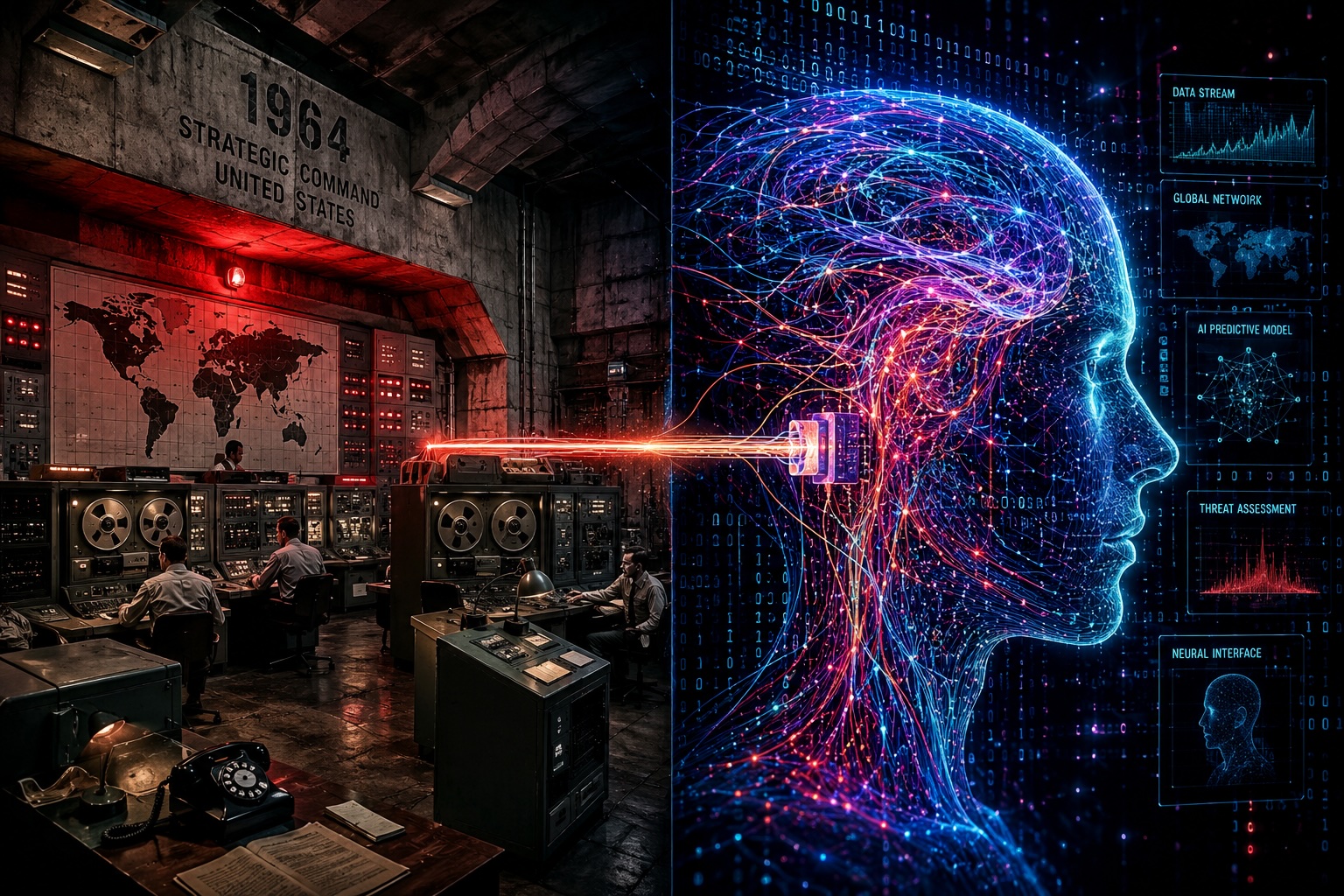
Evolution of the Internet: From the Shadow of the Bomb to the Battle for Your Mind
The concrete beneath the Green Mountains of Vermont felt solid, but to the men inside the bunker, it was as fragile as eggshells.
It was 1962, the height of the Cuban Missile Crisis. Thirteen days when humanity held its collective breath. Inside the Pentagon’s Command Center, a terrifying reality had paralyzed the Joint Chiefs: if the Soviet Union launched a “decapitation strike” on Washington, D.C., a single nuclear bomb would vaporize the central communication station.
To survive the atomic age, America didn’t just need stronger concrete. It needed an entirely new configuration of reality. It needed a network with no center. A network that could be blown apart, yet automatically heal itself in the dark.
They called it ARPANET. We call it the Internet.
But if the ghosts of those Cold War engineers walked into a Starbucks today, they would be horrified. The machine they built to save civilization from physical destruction has mutated into something they never anticipated: a psychological battlefield designed to tear civilization apart from the inside out.
This is the story of how a military shield evolved into a weapon for your mind, and why the final frontier of human sovereignty is no longer a physical border, but your own attention span.
Part I: The Shield of Concrete and Code
In the late 1960s, a brilliant, eccentric team of computer scientists funded by the Advanced Research Projects Agency (DARPA) set out to solve the Pentagon’s nightmare. They realized that traditional communication networks were built like a bicycle wheel: if you snap the central hub, every spoke fails.
Their counter-intuitive solution was radical: Decentralization.
They pioneered a technology called packet-switching. Instead of keeping a dedicated, physical copper phone line open between two points, data would be chopped up into tiny, independent digital blocks called “packets.” Each packet was stamped with a destination address and thrown into a web of interconnected computers.
If a Soviet nuclear strike vaporized a node in Chicago, the packets traveling from New York to San Francisco wouldn’t disappear. They would simply reroute through Houston or Seattle.
It was a masterpiece of military engineering. It was a network built to withstand the apocalypse. It was decentralized, democratic, and structurally indifferent to geography.
For a brief, shining moment in the 1990s, when the military handed this technology over to the public, the world fell in love. Early internet pioneers believed that a network connecting all humans, regardless of location, would render tyrannies obsolete, erase ancient racial or religious hatreds, and usher in a golden age of universal truth.
They forgot that human nature always follows the money.
Part II: The Great Re-Centralization
As the open internet grew, it ran face-first into a fundamental human wall: the desire for convenience.
Maintaining an independent, decentralized computer node is hard work. It requires technical skill, electricity, and constant maintenance. Most everyday people didn’t want absolute, sovereign freedom; they wanted frictionless connectivity.
Silicon Valley stepped in to provide it. Over two decades, an ecosystem composed of millions of independent, peer-to-peer websites was quietly corralled into a digital feudal system.
The internet did not stay decentralized. It re-centralized into massive, corporate chokepoints:
- Infrastructure Monopolies: Today, a staggering portion of the global web doesn’t live on scattered, independent computers. It lives in giant server farms owned by a handful of corporate titans, most notably Amazon Web Services (AWS) and Cloudflare.
- The Single Point of Failure: The very vulnerability ARPANET was built to destroy has crawled back into the architecture. When a single AWS data center region in Virginia experiences a technical glitch today, major news outlets, banking apps, and smart-home devices across the western hemisphere instantly go dark.
- Platform Enclosures: Human attention was concentrated into a few digital mega-cities: Google for discovery, Meta for connection, Apple for access.
And inside these digital mega-cities, a new economic engine was born—one that would prove far more volatile than the nuclear threats of the 1960s: The Attention Economy.
Part III: The Rise of Cognitive Obesity
When the internet became free to use, your attention became the product. Tech platforms realized that their profits were directly tied to how many seconds they could force your eyes to look at a glass screen.
To maximize engagement, engineers began tinkering with the deep, evolutionary wiring of the human brain. They discovered a dark biological truth: our brains are structurally optimized for outrage.
For hundreds of thousands of years, humans survived in a hostile natural world by paying intense attention to threats. A negative rumor, an angry face, or an opposing tribe were matters of immediate life or death. Our brains evolved a negativity bias—we are biologically helpless to ignore sensational, divisive, or terrifying information.
The algorithms of the modern feed don’t care about truth, nuance, or your mental well-being; they care about retention.
- If you click on an article that makes you mildly uncomfortable, the algorithm notices.
- To keep you scrolling, it feeds you an article that makes you slightly angrier.
- Within weeks, it pulls you deep into a hyper-polarized echo chamber where anyone who disagrees with your worldview is viewed as an existential monster.
We are currently living through a global crisis of cognitive obesity. Just as our bodies evolved to crave sugar and fat—leading to the current health crisis. Our minds are being flooded with algorithmic junk.
The result is systemic cognitive overload. Human brains were never built to absorb the simultaneous tragedies, scandals, and shouting matches of eight billion people at once. When the brain is chronically exhausted, it defaults entirely to primal, emotional, tribal reactions.
Part IV: Fifth-Generation Warfare: The Mind as the Battlefield
This systemic cognitive exhaustion has opened the door to a terrifying new paradigm of conflict: Cognitive Warfare.
In traditional war, the objective was to destroy the enemy’s physical tanks and factories. In Cognitive Warfare, the objective is to silently capture and control the informational ecosystem shaping how a population thinks.
The ultimate irony of modern geopolitics is that foreign adversaries don’t need to build advanced cyber-weapons to destabilize a democracy. They don’t need to bomb the physical hubs. They simply log onto the ad platforms built by Silicon Valley, pay a few thousand dollars, and drop drops of emotional poison into an algorithmic machine that is already designed to amplify that poison.
By using generative AI, bot networks, and deepfakes, bad actors can magnify internal racial, religious, and political fault lines. They turn a nation’s own citizens into the ammunition, causing a society to tear itself apart from the inside out through mutual distrust and civil unrest.
Part V: The Strategy for Cognitive Survival
If the battlefield has moved into the mind, then defensive military strategies are useless. A stealth fighter jet cannot protect you from a radicalizing algorithm. A missile or drone cannot stop a deepfake.
True sovereignty has migrated from national borders down to the individual. To survive the modern informational landscape, you have to build your own personal cognitive perimeter.
1. Audit what you consume
We must audit what we consume. If a piece of media is designed to make you instantly angry or self-righteous, recognize it as a structural exploit of your biological code. Treat it like poison.
2. Implement “Friction by Design”
The attention economy works because it is frictionless. Break the spell by installing intentional speed bumps on your devices:
- Go Grayscale: Strip your smartphone of its vibrant, fruit-like colors. Turn your screen to absolute grayscale in your accessibility settings. You will instantly find that your phone loses its hypnotic pull.
- Kill the Feed: Transform your digital consumption from a “push” model (where algorithms shove garbage into your face) to a “pull” model (where you only open a browser to search for a specific, premeditated piece of knowledge).
3. Deploy Local, Private AI bodyguards
The rise of quantized, open-source AI models allows you to run advanced intelligence locally on your own laptop, completely offline. Use local AI to digest the chaotic, emotional noise of the web. Feed it long-form documents and tell it: “Give me the objective, fact-based reality of this situation, stripped of editorial spin and outrage.”
The Final Argument
In 1648, the Peace of Westphalia established that a nation’s safety was defined by the physical lines drawn on a map. For nearly four hundred years, we believed that if we could guard those lines with weapons, our way of life was safe.
The machine born out of the Cold War destroyed that illusion forever.
Weapons still govern the physical world, but the digital world is governed by attention. If you do not actively claim sovereignty over your own mind, a corporate algorithm or a foreign psychological operation will claim it for you.
The ultimate act of defiance in the 21st century is not political protest or digital warfare. It is a quiet mind. It is a focused attention span. It is the absolute refusal to let the ghost in the machine dictate what you love, what you fear, and who you hate.