The Language of Fields: Why Partial Differential Equations Rule Our Reality
Introduction
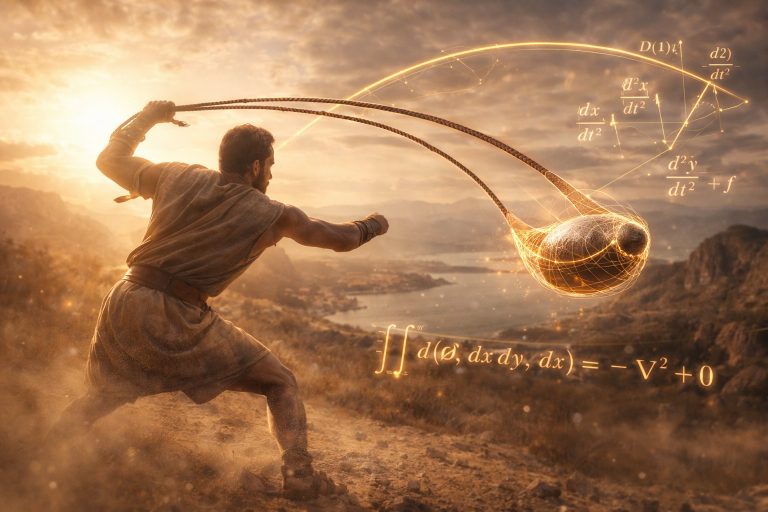
Mathematics is often taught as a static subject—black ink on white paper, fixed and final. But in the real world, math is alive. It is the science of change, a universal language that describes the curve of a hawk’s dive, the ripple of heat through a cooling engine, and the terrifyingly complex arc of an artillery shell whistling through a storm.
To understand how we moved from the dusty chalkboards of the 1940s to the silicon-powered supercomputers of today, we must look at the marriage between Calculus and Computation. It is a story of invisible forces, 30-ton machines, and the brilliant minds who figured out how to turn “logic” into “hardware.”
The Language of the Real World: Why We Need PDEs
In nature, nothing happens in a vacuum. Most fundamental laws—from how air flows over a wing to how a virus spreads through a population- are expressed as Partial Differential Equations (PDEs).
While a standard derivative measures how fast one thing changes (like your car’s speed), a Partial Derivative is more subtle. It asks: “If I freeze every variable except one, how does the system react?” Imagine standing on a mountainside. If you move only East, how steep is the climb? That is a partial derivative.
When these variables are linked, like air pressure changing as a shell climbs higher or temperature shifting as time passes, the math becomes a “monster.” PDEs are prevalent because they describe fields, continuous distributions of matter, energy, or probability that occupy all of space and time
The Geometry of the “Bend”
As we explore these equations, the Second Derivative emerges as the hero. Mathematically, it measures curvature. Nature is obsessed with curvature because it represents imbalance.
- The Heat Equation: Nature looks at the “sharpness” of a temperature spike and uses the second derivative to “smooth” it out.
- The Wave Equation: A guitar string pulls back harder the more it is “curved” or bent from its resting state.
This is the DNA of physics. However, there is a catch: these equations are often “analytically unsolvable,” meaning there is no simple formula to find the answer. You have to hunt for it.
Why “Trial and Error” Failed
Before the 1940s, hitting a target 15 miles away was an exercise in extreme frustration. You aren’t just aiming a gun; you are navigating a 3D obstacle course of invisible forces.
- The Air Density “Wall”: Air is a fluid. Cold morning air is “thick,” dragging a shell down. By noon, the sun thins the air, and the same shot might sail hundreds of yards past the target.
- The Layered Winds: The wind at the ground might be a breeze, but at 10,000 feet, it is a gale. A shell traveling through these layers is pushed in different directions throughout its flight.
- The Coriolis Effect: For long-range shots, the Earth actually rotates underneath the shell while it is in the air.
In the heat of battle, you cannot use trial and error. If you miss the first shot, the enemy dives for cover. You need to hit on the first try. To do that, the U.S. Army needed “Firing Tables”—thick books of math that told soldiers exactly where to aim based on the weather.
The bottleneck was human. It took a “human computer” (math experts, mostly women) about 20 hours to calculate a single 60-second flight path. The Army was designing new guns faster than the humans could do the math. They needed a machine that could “speak” calculus.
ENIAC: The 30-Ton Math Book
In 1945, the government unveiled ENIAC (Electronic Numerical Integrator and Computer). It was a 30-ton behemoth filling a 1,500-square-foot room, humming with 18,000 vacuum tubes.
ENIAC didn’t “think” like a modern computer. It was a Decimal machine, meaning it literally counted from 0 to 9 using pulses of electricity. More importantly, it had no “software.” To change a math problem, you didn’t type a command; you spent two days physically crawling inside the machine to flip 3,000 switches and plug in hundreds of heavy cables.
The six women who programmed ENIAC—Kay McNulty, Betty Jennings, Betty Snyder, Marlyn Wescoff, Ruth Lichterman, and Frances Bilas—were the true architects of logic. They took the “monsters” (the PDEs of ballistics) and broke them down into Numerical Integration.
Instead of solving the whole curve at once, they told ENIAC to calculate the flight in tiny time-steps.
- Where is the shell at 0.01 seconds?
- Calculate the drag, gravity, and wind for that millisecond.
- Update the position.
- Repeat thousands of times.
ENIAC could do this faster than the shell could fly. A trajectory that took a human 20 hours now took ENIAC 30 seconds.
How We Beat PDEs
Because PDEs are so complex, mathematicians have developed three primary battle plans to solve them:
1. Separation of Variables (The “Divide and Conquer”)
2. Discretization (The “Lego” Method)
Since computers can’t “see” a continuous curve, we turn the universe into a grid.
Finite Element Method (FEM): We break a complex object (like a car engine) into millions of tiny triangles (elements). We solve the PDE for each triangle and “glue” them together at the edges.
3. The Spectral Method (The “Frequency” Shortcut)
Instead of looking at a wave in space, we look at it as a sum of many sine and cosine waves. By moving the problem into the “Frequency Domain,” we can often turn hard calculus into simple multiplication.
V. The Final Boss: The Navier-Stokes Equations
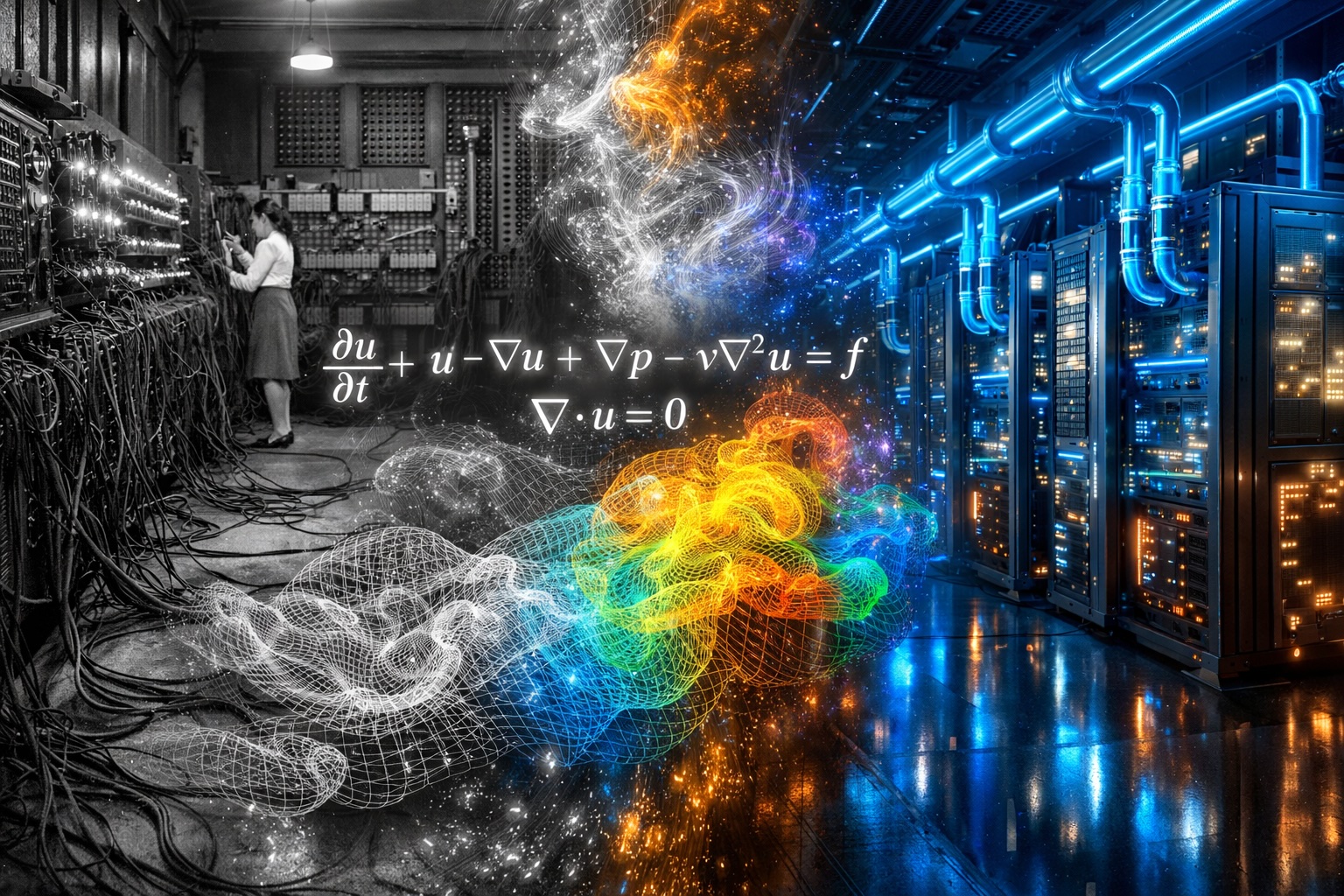
If you want to understand why the weather is hard to predict or why airplane wings stay in the air, you have to face the Navier-Stokes Equations. These are a set of PDEs that describe the motion of fluid substances (liquids and gases).
This equation is the “Everest” of mathematics. We use it every day to design planes and predict hurricanes, but mathematically, we haven’t proven they always have a smooth solution. In high-speed “turbulent” flow, the equations might “break.” If you can prove a smooth solution always exists, the Clay Mathematics Institute will hand you $1 million.
The Binary Revolution and Symmetry
When the Cold War began, mathematician John von Neumann realized that vacuum tubes are like lightbulbs, they are either ON or OFF. Using this Binary (0 and 1) logic was far more efficient than the “Decimal” ENIAC.
This allowed for the “Von Neumann Architecture,” where instructions were stored in memory as numbers. We moved from physical wiring to Software. Suddenly, we could use Symmetry to solve problems faster. By assuming a planet is a perfect sphere, you can turn a 3D PDE into a 1D equation.
As we’ve discussed, this “ignores the noise.” While symmetry doesn’t add error, it loses detail. Today’s supercomputers are finally powerful enough to “add the noise back in,” using Perturbation Theory to account for the tiny imperfections—the bulges, the wobbles, and the turbulence—that make our world real.
Conclusion
We have come a long way from the “plug-and-pull” wiring of the 1940s. Today, we use AI-based solvers and Quantum Algorithms to hunt for the secrets of the universe. But the core logic remains the same:
- Observe the change (Calculus).
- Measure the curvature (Second Derivatives).
- Break it into steps (Numerical Integration).
- Let the machine do the heavy lifting.
Math is the blueprint, and the computer is the builder. We started by trying to hit a target over a hill; we ended up building a digital world where we can simulate the stars. The next time you see a weather forecast or fly in a plane, remember: you are seeing the result of a 30-ton machine and a set of equations that refuse to be solved.