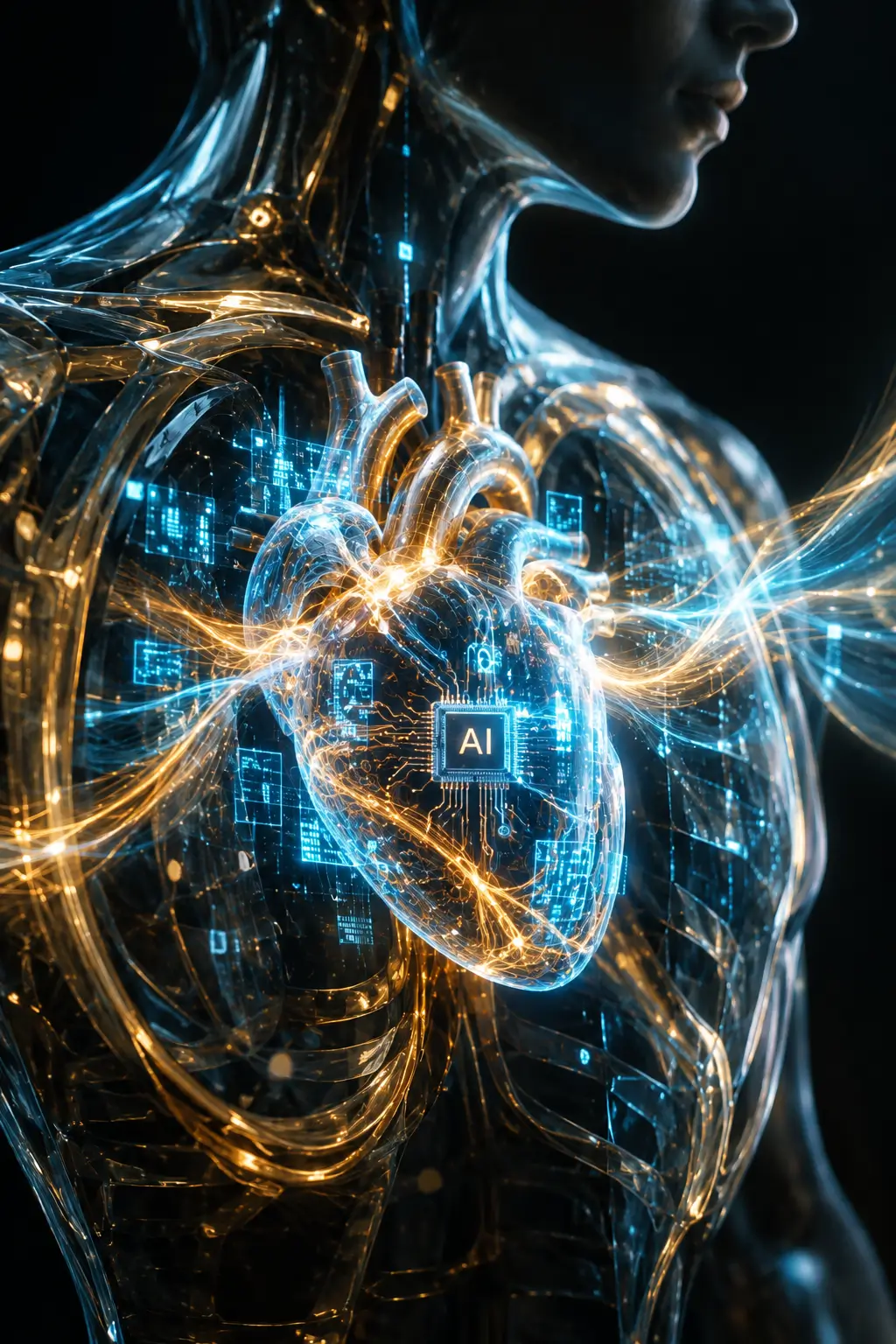
The Algorithm of the Heart: Why Math Can Save Our Science, But Can’t Solve Our Morality
Introduction
We live in an era captivated by numbers. We watch artificial intelligence models calculate fluid dynamics, predict protein foldings in milliseconds, and generate cinematic videos from a single text sentence. Because computers are so staggeringly intelligent, we have fallen into a dangerous modern assumption: we believe that given enough time and data, every human problem can be solved like a math equation.
But history, philosophy, and the laws of science show us a very different reality.
If we trace the lineage of human thought from the cobblestones of the Enlightenment to the cleanrooms of Silicon Valley, we uncover a profound truth: Mathematics is the ultimate language of pure reason—but morality is completely alien to it.
The Birth of the Loop: Mind Meets Matter
To understand where we are going, we have to look at how we got here. In the 17th century, the intellectual world was paralyzed by a civil war over truth.
On one side stood the Rationalists, who argued that the human mind holds absolute, innate truths, and that pure logical reasoning is the only thing we can trust. On the other side stood the Empiricists, who countered that the mind is a blank slate at birth (tabula rasa), and that all real knowledge must be gathered through sensory evidence, observation, and physical experimentation.
The deadlock broke when pioneers like Francis Bacon and Sir Isaac Newton forged the modern scientific method. They realized that truth is a continuous loop:
                  ┌──────────────────────────────┐
                  │      THEORY (Reason)         │
                  │  Using logic and math to     │
                  │  predict how nature works.    │
                  └──────────────┬───────────────┘
                                 │  Predicts
                                 ▼
                  ┌──────────────────────────────┐
                  │    EXPERIMENT (Evidence)     │
                  │  Using tools and senses to   │
                  │  test if the math is real.   │
                  └──────────────┬───────────────┘
                                 │  Corrects / Confirms
                                 ▼
                    [Repeat Loop Continuously]
In this loop, mathematics serves as the ultimate form of pure reason. It is a flawless language built inside our minds. But science dictates that even the most elegant mathematical theory is utterly useless unless it is validated by physical, real-world evidence. In the kingdom of science, evidence is sovereign.
When Math Met Reality: The Einstein Check
Consider the legendary case of Albert Einstein. In 1915, sitting alone in a quiet room with nothing but paper and ink, Einstein used pure mathematical deduction to draft his Theory of General Relativity. His calculations yielded a radical prediction: the massive gravity of the Sun warps the very fabric of space, meaning a beam of starlight passing near it should physically bend because the space itself around the Sun is curved.
It was a beautiful, logically perfect mathematical theory. But it wasn’t science yet. It was just brilliant reasoning until human eyes could secure the sensory evidence.
Four years later, during a total solar eclipse in 1919, astronomer Sir Arthur Eddington captured physical photographic plates of the stars behind the darkened sun. The starlight had bent—shifting exactly where Einstein’s math said it would.
From the shifting orbit of Mercury to the way gravity shifts light’s color (gravitational redshift), the universe repeatedly proves that pure mathematical reason can perfectly anticipate physical reality.
The Wall: Why Ethics Isn’t an Equation
If pure mathematical reason can unlock the secrets of the cosmos, why can’t it solve our human conflicts? Why can’t we just code an AI to be perfectly moral?
Because, as the philosopher David Hume famously pointed out, morality is not a relation of ideas; it is a landscape of human sentiments, empathy, and emotions.
You cannot isolate a molecule of “justice” under a microscope. You cannot run an algebraic formula to find out if an action is “evil.” When we witness a cruel act, its wrongness doesn’t exist in the physical pixels of the event; it exists in our visceral human reaction of disgust and empathy. Math deals with cold, objective facts (what is); morality deals with subjective human values (what ought to be).
Furthermore, human morality constantly forces us to navigate opposite ends of zero-sum spectrums. Take the eternal tug-of-war between Safety and Freedom:
- Slide the dial completely toward Absolute Freedom, and you get absolute chaos, where anyone is free to cause harm. Safety drops to zero.
- Slide the dial completely toward Absolute Safety, and you get a totalitarian nightmare of total surveillance and restricted choices. Freedom drops to zero.
There is no mathematical equation on Earth that can tell an algorithm where the “perfect” middle ground sits. It requires human judgment, cultural nuance, and emotional compromise.
The Reality Check: Better Than Us?
But here lies the ultimate twist: What if the AI doesn’t need to be perfect? What if its mathematical consistency allows it to make ethical calls reasonably well—not flawlessly, but significantly better than the majority of flawed, biased, and emotional humans?
In the real world, human morality is often highly compromised. Humans suffer from fatigue, greed, anger, and tribalism—what Francis Bacon called the Idols of the Mind. A human judge might give a harsher sentence simply because they are hungry before lunch; a human driver might cause an accident because they were road-raging.
If an AI medical triage system allocates organs to patients with zero racial bias, or if a self-driving fleet reduces highway deaths by 90%, it has achieved a massive practical moral victory. It proves that while pure reason cannot feel empathy, it can scale fairness. The challenge shifting under our feet is no longer about making AI perfectly human—it’s about ensuring that its cold, optimized version of “good” leaves room for the human capacity to forgive, bend the rules, and show mercy.
The Great AI Paradox
This brings us to the ultimate paradox of the 21st century.
Artificial intelligence models are spectacular engines of pure reason and mathematics. They are built on weight matrices, probability vectors, and logical optimization goals. We are now charging these pure math engines with navigating the messy, emotional, and intensely value-driven landscape of human life.
AI can supercharge our inductive reasoning, spot hidden global patterns, and run millions of digital physics simulations in the blink of an eye. It can accelerate our science faster than Francis Bacon ever dreamed. But it cannot calculate our goodness. The final anchor of truth—both in verifying the evidence of the physical universe and defining the morality of our tech—will always remain strictly, beautifully human.
The Epilogue: The Ultimate Reality of Politics
Because in the end, beneath the clean layers of code and the beautiful architecture of mathematics, we inevitably run into politics. Politics is the messy, human arena where we decide whose values rule and how power is distributed. An AI can calculate an optimization path reasonably well, but it cannot decide who should win a conflict of values.
Whether an AI prioritizes individual freedom over collective safety, or corporate efficiency over human labor, is not a scientific calculation—it is a political decree. We can build machines of pure reason to act as our mirrors and our tools, but we can never pass the buck of responsibility to the machine. The algorithms will always reflect the political choices and human biases of those who hold the power to build them.