
The Complete Mind-Shift: How Intentional Communication Rewrites Our Personal and Geopolitical Reality
It sounds like the setup to a strange riddle: What do a failing refrigerator circuit board, Apple’s minimalist design philosophy, the Cuban Missile Crisis, and your partner’s crossed arms at dinner have in common?
When a refrigerator’s Printed Circuit Board (PCB) glitches, the entire appliance exhibits erratic behavior—compressors stall, relays click continuously, and cooling stops. The problem isn’t the steel shell of the fridge; it’s a failure in the internal “brain” routing the energy.
Human beings operate the exact same way. When faced with stress, criticism, or team conflict, our internal circuit board defaults to ancient, automated survival programs. To achieve real fulfillment, build high-performance teams, and cultivate deep relationships, we have to look past our outward reactions and learn how to upgrade our internal software.
We must master the art of Intentional Communication.
Part 1: The Anatomy of Our Mental Operating System
To understand how our mental software runs, we can look to the ultimate textbook on self-actualization: Paramahansa Yogananda’s Autobiography of a Yogi. This masterpiece was so foundational to Apple founder Steve Jobs that he read it every single year of his life as a routine spiritual “software update.”
Yogananda taught that the true essence of Yoga is Union—the systematic quieting of mental chatter so that human consciousness can align with Infinite Intelligence. Conversely, he defined the ego (Ahamkara) or the “separator.” It is the stubborn mental knot that tricks an immortal, boundless mind into believing it is trapped, separate, and perpetually vulnerable.
When your internal network runs automatically on this unadapted, fear-based ego code, you display four classic “malfunctioning” reaction patterns:
- The Defensive / Counter-Attacking Pattern: Driven by a fear of incompetence, you instantly make excuses or shift blame. (The Broadcast: “I am too fragile to handle the truth.”)
- The Shut-Down / Withdrawal Pattern: Overwhelmed by tension, you completely freeze, build a silent wall, or emotionally disengage. (The Broadcast: “I will abandon this connection when it gets difficult.”)
- The People-Pleasing Pattern: Driven by a scarcity mindset, you sacrifice your boundaries and over-accommodate others just to stay safe. (The Broadcast: “My boundaries do not matter; use me to keep the peace.”)
- The Controlling / Micromanaging Pattern: Driven by anxiety over the unpredictable, you try to rigidly dictate every variable around you. (The Broadcast: “I do not trust your capability or autonomy.”)
Part 2: The Adaptive Chameleon—Who is Pulling the Strings?
If you review your daily life, you will notice that you likely use all four of these patterns with different people. You might be a people-pleaser around a critical boss, a defensive fighter with your siblings, a controller with your subordinates, and a silent wall with your romantic partner.
Psychology calls this being a behavioral chameleon. Your subconscious constantly runs background diagnostics on power dynamics and perceived safety to select the “safest” mask for survival.
Being a chameleon is not a bad thing. It is a highly advanced evolutionary trait known as situational intelligence. The real breakthrough happens when you move from Unconscious Mimicry (changing masks out of fear) to Conscious Adaptability (changing your delivery method out of strategy).
Steve Jobs translated this exact philosophy into Apple’s design language. Influenced by Yogananda’s rule that a spiritual life is a simple life free of unnecessary clutter, Jobs went to war against physical buttons, unnecessary ports, and confusing software menus. He stripped away the physical noise to create an elegant, minimalist canvas that seamlessly adapted to the user.
True communication requires that exact same design philosophy. We must strip away our automated, defensive buttons, leaving behind a clean, high-utility connection.
Part 3: What Intentional Communication Actually Is
Based on this framework, we must redefine the word entirely. Communication is not merely the act of talking, sending data, or expressing your feelings.
True communication is the intentional transfer of energy and clarity from one mind to another to achieve a specific alignment. It is an act of conscious software engineering operating across three parallel layers:
┌────────────────────────────────────────────────────────┐
│ 1. THE DATA LAYER (The explicit words you choose)      │
├────────────────────────────────────────────────────────┤
│ 2. THE ENERGY LAYER (The underlying tone and safety)   │
├────────────────────────────────────────────────────────┤
│ 3. THE INTENTION LAYER (What you actually want)        │
└────────────────────────────────────────────────────────┘
- The Data Layer: The structural words, facts, and logical arguments you present.
- The Energy Layer: The subtext, body language, and tone. This dictates whether the other person’s nervous system feels threatened (defensive) or safe (cooperative).
- The Intention Layer: The hidden driver of the message. Fear-based intentions seek to protect the ego; strategic intentions seek to solve the problem.
The Rule of Congruence: Your Body is Always Talking
You can memorize a perfect script, but if your words, tone, and actions are not aligned, your communication fails. If you tell an employee, “I trust your leadership,” but you micromanage their spreadsheets, your maneuvers send the real message. If you tell your partner, “I am listening,” but your phone is face-up on the table, your actions communicate that the phone is the actual priority.
Part 4: The Power of Metacognition—Becoming the Scientist
Instead of trying to aggressively “dissolve” or destroy your ego—which Western psychologists like Sigmund Freud warned could lead to mental instability—the ultimate goal is to consciously adapt and learn new patterns.
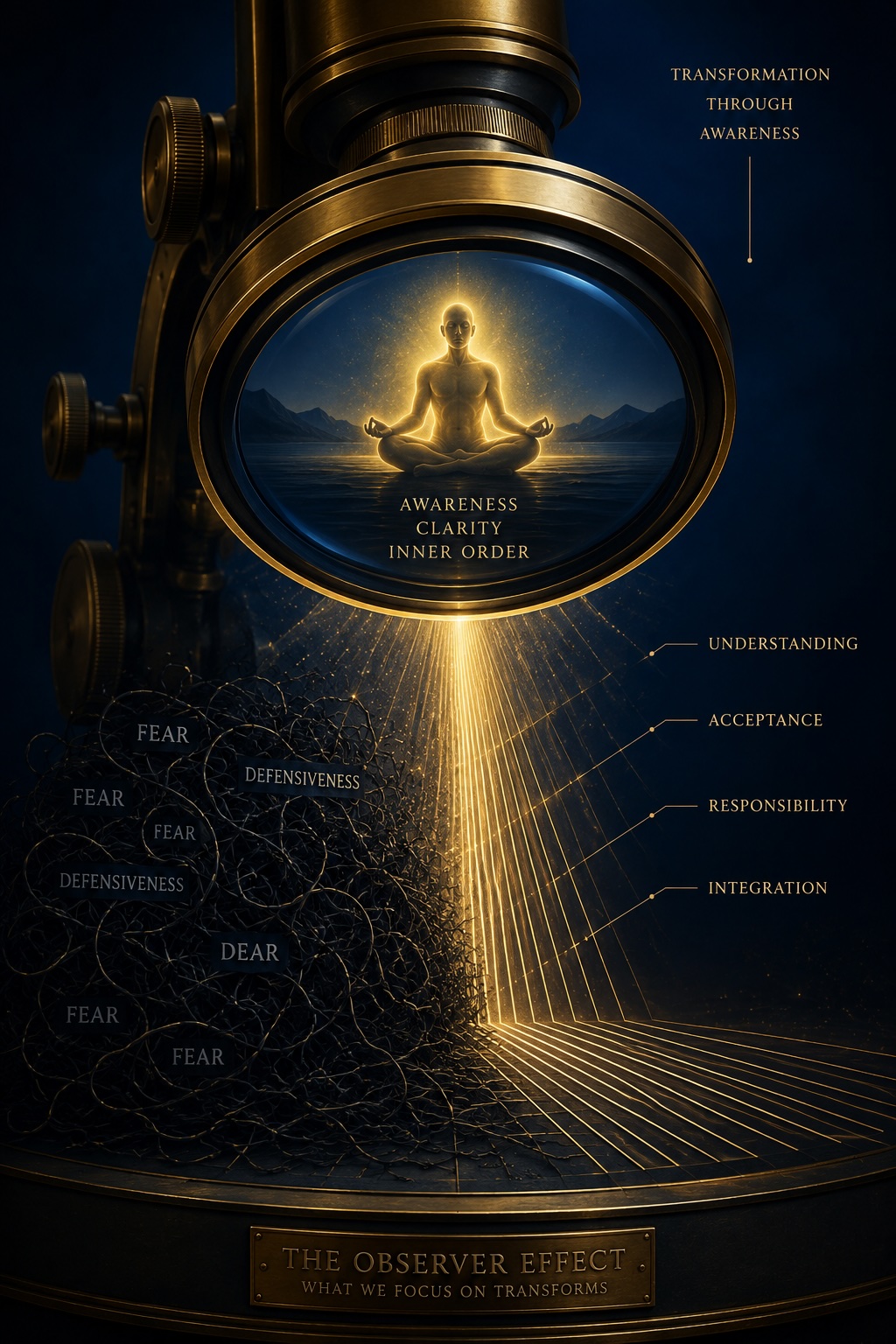
You do this through metacognition: the ability to step out of your thoughts and become the detached, objective observer of your own mind.
When a situation triggers you, instead of reacting defensively, you look at your own limiting behaviors and other people’s reactions under a microscope, exactly like a scientist analyzing a bug.
[ TRIGGER EVENT ] ──► Pause 3 Seconds ──► Metacognitive Label ──► The Strategic Filter
                                                              "What is my actual goal?"
The moment a trigger occurs, apply a 3-second circuit breaker. Do not speak. Look inward and label the program: “Fascinating. My old pattern of fear of rejection is acting up right now.”
By putting your feelings under a microscope, you stop being the emotion; you become the person observing the emotion. You slide back into the driver’s seat and ask yourself the ultimate strategic question: “What is my goal in this interaction?”
Part 5: Master the Upgrade—The A.C.E. Framework
Once you have identified your strategic goal, bypass your old fear-based reflexes entirely by structuring your verbal response using the A.C.E. Method.
Crucial Rule: Always lead with what is good first. If you point out a mistake first, the listener’s amygdala triggers, their defensive firewall goes up, and they experience “mental deafness”. Leading with authentic, specific praise opens their brain’s communication ports.
- A – Acknowledge Reality: Validate the current situation or the other person’s emotional state to instantly disarm their defensive ego network.
- Strategic Script: “I completely understand that this timeline is causing a massive amount of stress for the team.”
- C – Curiosity & Data: Shift the conversation completely away from personal blame and ground it in objective, microscopic facts.
- Strategic Script: “The research you did in section two is brilliant. Let’s look at the workflow data for section three together to see where the bottleneck is actually occurring.”
- E – Execute the Goal: Move the conversation fluidly into a collaborative, future-focused next action.
- Strategic Script: “Let’s map out a quick process fix for this section by tomorrow morning so we stay aligned.”
Part 6: From Personal To Geopolitical—Can We Stop Wars?
When scaled to the global stage, this framework reveals why nations fight. International relations operate on “Total Signal Communication.” A speech by a president is just a tiny fraction of the data; nations communicate through “costly signals” like military maneuvers, state-media broadcasts, and economic sanctions.
If world leaders practiced flawless intentional communication, we could completely eliminate accidental wars born of pride, paranoia, and misinterpretation—just as President John F. Kennedy and Nikita Khrushchev did during the Cuban Missile Crisis by ignoring aggressive military noise and responding only to each other’s core intent.
However, even perfect communication cannot stop all wars. When conflicts are driven by structural realities like zero-sum resource scarcity (sharing a drying river) or the commitment problem (the inability to guarantee future peaceful intentions), communication simply clarifies that two nations are locked in a mathematical battle for survival.
Enforcing Structural Boundaries
Because we cannot control the structural limitations of the outside world, intentional communication requires us to build firm, unshakeable boundaries. Do not use emotional anger; use neutral, process-oriented architecture:
- Personal Level Boundary: “To keep my energy sharp for the family, I take my phone completely offline from Friday at 6 PM until Monday at 8 AM. If an urgent matter comes up, email it, and it will be the first line of code I review Monday morning.”
Rewriting Your Code
Life is not a series of random, upsetting accidents. Every broken appliance, difficult team meeting, or relationship hurdle is a dynamic feedback loop designed to give you the data you need to optimize your internal programming.
You are not the automated, defensive code written by your past conditioning. You are the conscious programmer. By stepping into the seat of the observer, you can keep your inner anchor fixed, adjust your sails strategically, and consciously design a life of absolute clarity, innovation, and impact.