The Sniper’s Secret: A Journey Through the Calculus of the Sling
Introduction
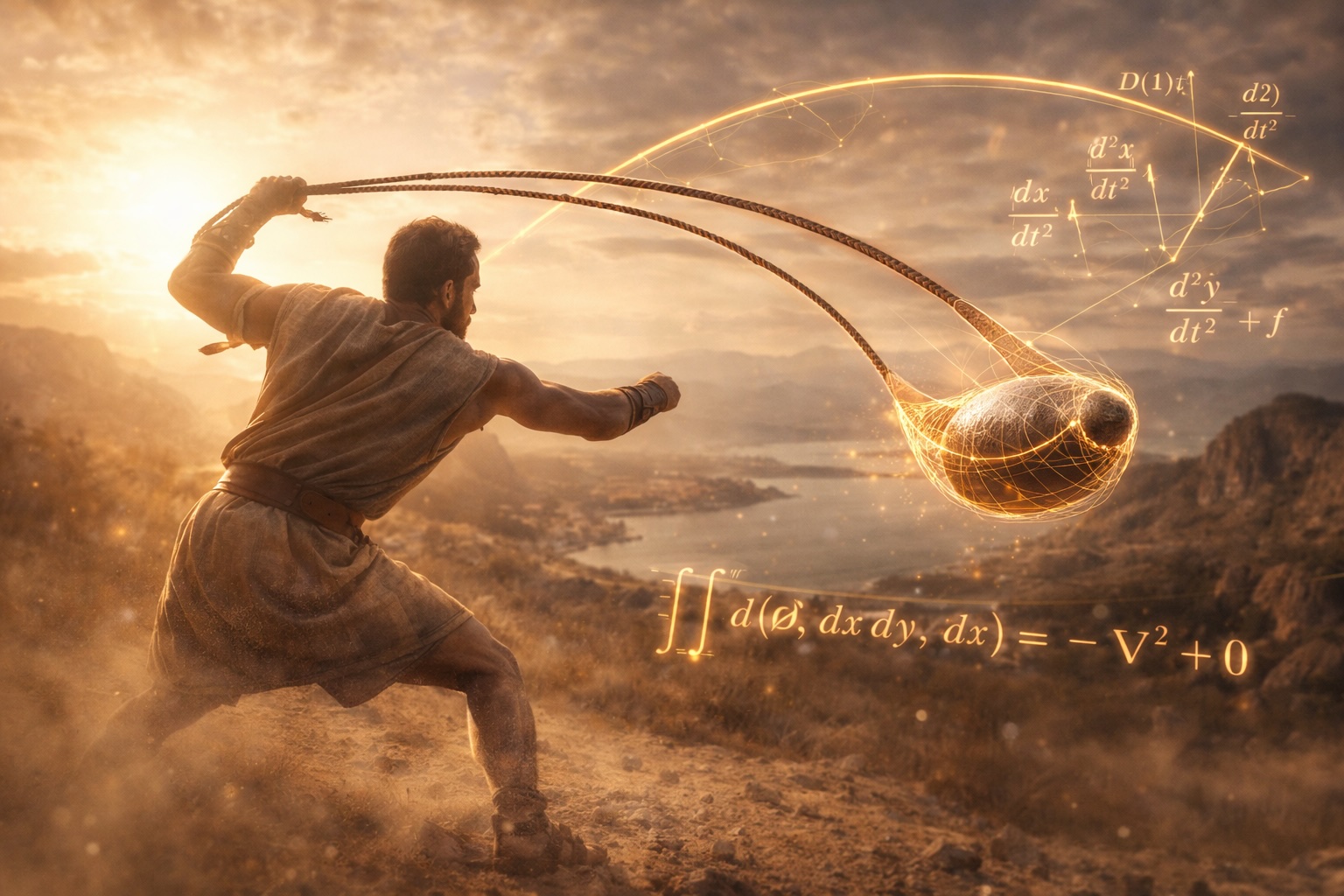
Imagine standing on a sun-drenched Mediterranean hillside two millennia ago. You are a Balearic slinger, an elite mercenary prized by the greatest empires of antiquity. In your hand is a simple braided cord; in its pouch rests a 120-gram lead projectile called glandes plumbeae. To strike a Roman centurion’s helmet from 30 meters away, you are not relying on instinct alone. Your nervous system is solving, in real time, some of the deepest equations ever written, the language of change itself.
To understand how the stone finds its mark, we must climb the hierarchy of calculus.
Beyond the Snapshot: The Birth of Flow
Before the 17th century, mathematics was largely static. Euclidean geometry described shapes frozen in space. But motion required a new language.
Newton and Leibniz invented calculus to describe change.
If the stone’s position is x(t), then its instantaneous velocity is:
Velocity is the derivative of position.
Acceleration, the true source of power in the throw, is the second derivative:
When you snap your wrist at release, you are manipulating acceleration over an infinitesimal interval of time. Every ounce of force is encoded in how quickly velocity changes.
Differentiation is the mathematics of the present moment.
The Grand Sum: Integration
If differentiation breaks motion into tiny slices, integration rebuilds it.
The integral symbol:
comes from the Latin summa—sum.
Distance traveled is the accumulation of velocity:
But the slinger’s mathematics goes deeper.
Double Integral: Volume
To cast a lead bullet in a hemispherical mold, we accumulate area into volume:
A double integral stacks infinitely thin slices to construct three-dimensional mass.
Triple Integral: Mass Distribution
If density varies within the bullet—due to air pockets or material inconsistency—we compute total mass with:
This triple integral scans every cubic millimeter of space.
Without it, we cannot compute the center of mass:
If the center is misaligned, the projectile wobbles, creating vortex shedding that destroys accuracy.
Integration is the mathematics of accumulation and structure.
The Final Boss: Partial Differential Equations
Once the stone leaves the sling, it enters a field—air.
An ordinary differential equation (ODE) tracks motion in time:
But real physics lives in space and time.
Enter the Partial Differential Equation (PDE).
A PDE describes how quantities vary with respect to multiple variables. The symbol:
means “partial derivative”—change with respect to one variable while holding others constant.
Most fundamental physical laws are PDEs.
A. The Wave Equation
This governs vibrations in the sling cord and sound waves in the air. The Laplacian operator
measures spatial curvature.
B. The Heat Equation
This describes diffusion—heat spreading through metal or energy dissipating in air.
C. The Laplace Equation
This governs equilibrium fields—steady gravity or electrostatics.
And then there is the monster: the Navier–Stokes equations for fluid flow:
These describe how air moves around the projectile.
When the stone flies, it is negotiating with Navier–Stokes.
Numerical Methods: From Perfect to Practical
In theory, calculus uses infinitesimals dx.
In practice, we approximate using small finite steps
Numerical integration replaces:
with:
Computers build smooth curves from millions of small linear approximations.
Your brain does something similar—sampling, predicting, adjusting.
Chaos and the Butterfly
Air resistance is nonlinear:
A tiny change in initial angle \theta produces large changes in impact position.
This is sensitivity to initial conditions.
To handle uncertainty, we use Monte Carlo simulation:
Instead of predicting one outcome, we simulate thousands with small variations in:
- release angle
- wind speed
- spin
- grip
We get a probability cloud instead of a single point.
The master slinger aims not at perfection, but at statistical dominance.
The Total Derivative
In a moving field, change comes from multiple sources.
The total derivative combines time change and spatial change:
This is the derivative “along the path.”
For the sling stone, total change includes:
- gravity
- wind velocity field
- rotational spin
- changing air density
The master slinger intuitively integrates all variables.
He does not calculate symbols.
He reads the field.
The Hierarchy of Change
From simple to complex:
- Algebra & Geometry → static structure
- Derivatives → instantaneous motion
- Integrals → accumulation
- ODEs → motion through time
- PDEs → motion through space and time
- Numerical Methods → real-world approximation
- Chaos Theory → humility before complexity
Each layer adds dimensionality.
Each layer moves closer to reality.
The Language of the Now
Calculus transforms a stone into a dynamic event.
When you release the sling, you are solving:
while immersed in the Navier–Stokes field of the atmosphere.
Your nervous system performs a biological Monte Carlo simulation, predicting trajectories before they happen.
Calculus is not about symbols.
It is about continuity.
It is the recognition that every large outcome is the integral of tiny changes.
The ancient slinger did not know the equations.
But he embodied them.
And when the stone struck the helmet 30 meters away, it was not magic.
It was mathematics.