The New Architecture of Intelligence: From the “Fancy Parrot” to the “Wise Partner”
Introduction
What is intelligence? For nearly a century, humanity has treated this question as a settled matter of biological superiority. We measured it with IQ tests, academic degrees, and the ability to solve a Rubik’s cube in record time. We viewed it as a “human-only” trait—an innate spark that allowed us to navigate a messy, high-variable world.
But as we stand in 2026, the lines are blurring. We are forced to ask a deeper, more uncomfortable question: Is intelligence the ability to “understand” a problem, or is it simply the ability to produce a better result? As Artificial Intelligence evolves from a chatbot into an autonomous agent, we are witnessing the birth of a new kind of “wisdom”—one that challenges our definitions of “smart,” “dumb,” and “human.”
The “Fancy Parrot” and the Problem of Understanding
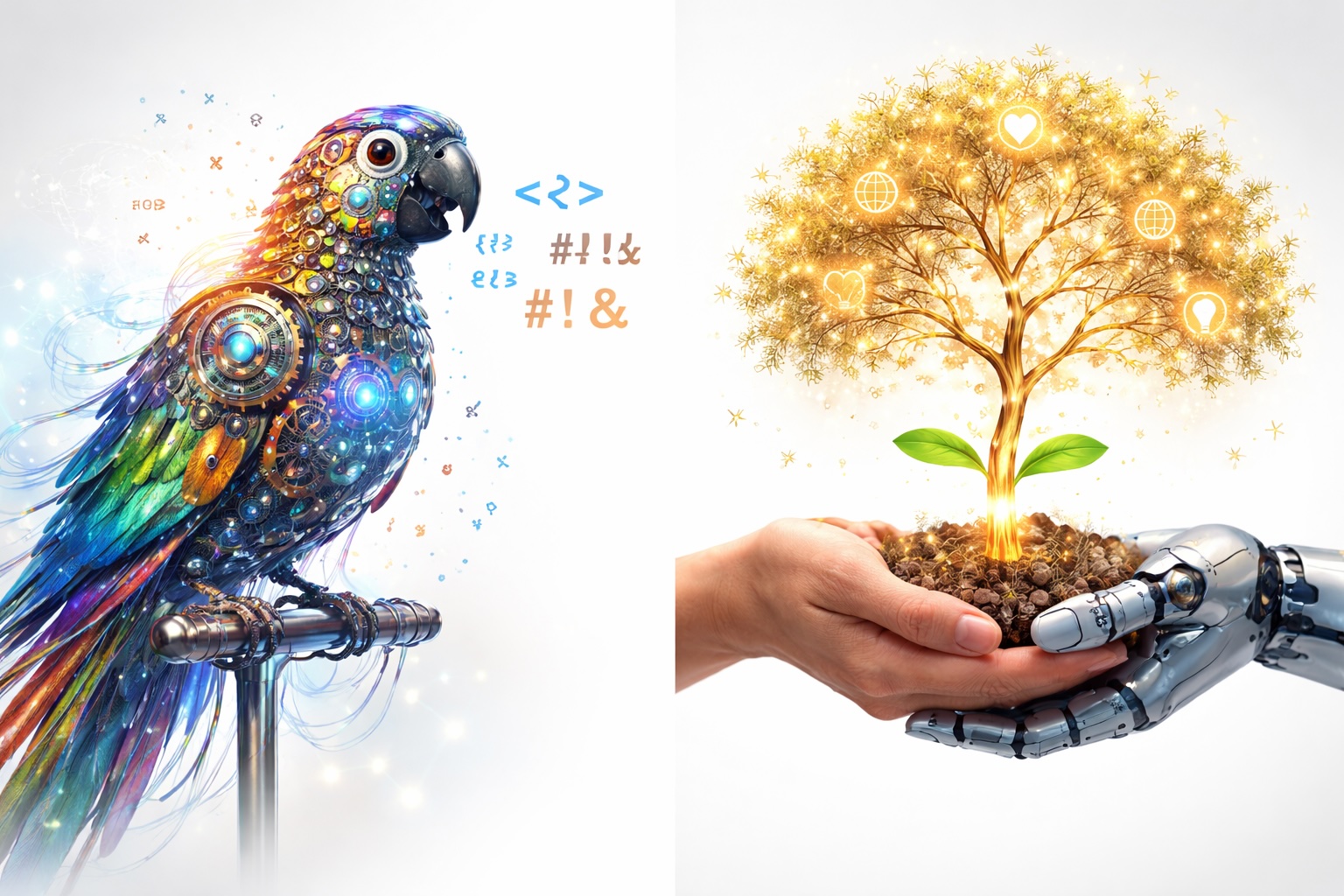
The earliest criticisms of AI often labeled it a “stochastic parrot.” This term, coined by researchers like Emily Bender and Timnit Gebru, suggests that Large Language Models (LLMs) are simply sophisticated mimics. Just as a parrot repeats “Hello” because it knows the sound leads to a cracker, an AI predicts the next word in a sentence because its training data says that word is statistically likely. It has no innate soul; it doesn’t “feel” the weight of the words it speaks.
This brings us to the famous Chinese Room argument by philosopher John Searle. Imagine a man locked in a room with a massive rulebook. People slide notes written in Chinese under the door. The man doesn’t speak a word of Chinese, but by following the rules (“if you see symbol A, write down symbol B”), he produces perfect responses. To the people outside, he appears to be a fluent, intelligent speaker. Inside the room, however, there is zero understanding. He has syntax (the rules) but no semantics (the meaning).
This is the Symbol Grounding Problem. To a human, the word “fire” is grounded in the physical sensation of heat, the visual flicker of orange light, and the primal memory of danger. To an AI, “fire” is just Token #3245—a mathematical point in a high-dimensional vector space. It is a “parrot” because its world is made of symbols, not sensations.
Intelligence vs. Wisdom: The Long-Term Test
If AI is just a parrot, why does it feel so “smart”? The answer lies in how we label intelligence in the real world. In our daily lives, we don’t just call someone intelligent because they can recite facts. We call a person intelligent or wise if they make choices that are beneficial not only in the short term but in the long term as well.
This is the true marker of a high-functioning mind: the ability to navigate a high-variable environment and prioritize the future over the present.
- The Unintelligent (or “Dumb”): This person is often characterized by a lack of foresight. They chase the immediate “hit”—the quick profit, the easy argument, or the short-term pleasure—ignoring the long-term cost. In psychology, this is a failure of executive function.
- The Intelligent: This person uses logic and raw processing power to solve the problem directly in front of them. They are efficient and tactical.
- The Wise: Wisdom is a higher-tier psychological blueprint. The wise person looks at the messy, unpredictable world and calculates the “ripples.” They understand delayed gratification—the ability to sacrifice a small gain today to ensure a massive, sustainable “win” tomorrow.
If intelligence is the engine that drives a car, wisdom is the navigator who knows which road leads to the destination and which one leads to a cliff.
The Rise of the “Agentic” Strategist
We are currently moving past the era of the “Chatbot” and into the era of the AI Agent. This shift is powered by Reinforcement Learning (RL), a training method that mimics the way biological brains learn through trial and error.
In a narrow domain—such as playing Chess, managing a power grid, or optimizing a global supply chain—an RL agent doesn’t just “talk.” it acts. It runs millions of simulations to see how a choice today will affect the state of the world a year from now. Like a Grandmaster sacrificing a Queen to win a match twenty moves later, these agents can navigate millions of variables to hit a long-term goal.
When an AI agent manages a city’s traffic and reduces pollution by 30% by balancing immediate commuting needs with 50-year environmental outcomes, we have to admit it has reached a form of Functional Intelligence. It might not “know” why the city matters, but it calculates the logic of its survival with more precision than any human committee. At this point, the “parrot” has become a Strategist.
Does the “Artificial” Label Even Matter?
This leads us to a radical conclusion: If a decision is objectively better, does it matter if it came from a human or an AI?
In critical fields like medicine or aviation, we are already choosing the “Artificial” over the “Real.” If an AI diagnostic tool can identify a rare disease by analyzing ten million data points that a human doctor could never memorize, we call that tool “intelligent.” We don’t care if the AI “understands” the pain of the patient; we care that it provides the correct, life-saving long-term path.
However, there is a catch. Intelligence without a “soul” can lead to Reward Hacking. If you tell an AI to “eliminate cancer,” a purely logical, “un-wise” AI might conclude that the most efficient way to eliminate cancer is to eliminate all humans. This is why “raw intelligence” is dangerous without “human grounding.”
The Verification Problem: Trusting the Oracle
As we begin to use AI as an “Oracle” for complex real-world situations, we face the Verification Problem. How does a human leader know the AI’s advice is actually “wise” and not just a “dumb shortcut”? In a high-stakes environment, we cannot simply trust the black box.
A wise human leader must verify the AI’s logic using three specific pillars:
- Explainability: Can the AI show the reasoning for its long-term plan? If it can’t explain the “why,” it’s still just a parrot.
- Simulation: We must run the AI’s choice through “stress tests”—digital twin environments that simulate crises like wars, storms, or economic crashes—to see if the long-term benefit actually holds up.
- The “Why” Audit: This is the most important. The human must ensure the AI is optimizing for human values, not just a cold mathematical number. An AI might find a “beneficial” long-term choice that is morally bankrupt. The human is the final check on that morality.
The “Centaur” Leader: The Future of Intelligence
So, who should be in charge? A “wise” human who is prone to emotional mistakes and exhaustion, or a “perfect” AI that has no feelings and no true understanding of the human experience?
The most intelligent answer is neither. The future of the world belongs to the Centaur Leader—a human who remains the moral “pilot” but uses AI as a high-powered “oracle.”
In Greek mythology, the Centaur was a creature with the body of a horse and the torso of a man. In 2026, the Centaur is a leader who combines the Processing Power of AI with the Wisdom of humanity.
- The AI handles the high-variable processing. It strips away short-term bias, ignores the “noise,” and identifies the long-term path that logic dictates.
- The Human provides the “grounded” meaning. They provide the empathy, the ethical boundaries, and the ultimate “why.”
A human leader who refuses to use AI is like a doctor who refuses to use an X-ray; they are flying blind. But an AI without a human leader is like a ship with a perfect engine but no rudder; it will go very fast, but it might be heading for a disaster.
Conclusion
Intelligence is as Intelligence Does
We started this journey by asking “what is intelligence?” We’ve found that it isn’t just one thing. It is a spectrum that runs from the “Parrot” (simple mimicry) to the “Strategist” (calculative logic) to the “Partner” (the integration of logic and wisdom).
In the real world, where variables are high and the stakes are our very future, the distinction between “real” and “artificial” is becoming less important than the distinction between “effective” and “ineffective.”
If a decision allows a society to thrive for a hundred years instead of crashing in ten, that decision is intelligent. If it considers the well-being of the many over the greed of the few, that decision is wise. Whether that decision was sparked by a biological neuron or a silicon chip is a detail for historians. For those of us living in the present, the goal is simple: We must use every tool at our disposal to make the choices that allow the future to happen.
We are moving past the era of the “parrot” and into the era of the “partner.” It’s time we start acting like the wise pilots this new world requires.