The God of Logic and the Ghost in the Machine
Introduction
For centuries, mathematics was a world of pen, paper, and human intuition. It was a philosophy of the mind, written in the “natural language” of scribbles and symbols. But over the last century, a quiet, tectonic shift has transformed math into something entirely different: the ultimate computational language.
Today, we go behind the curtain to explore the journey from David Hilbert’s quest for certainty to the cutting-edge era of AI-powered reasoning.
The Man Who Tried to “Solve” Mathematics
In the early 1900s, the mathematical world was in a state of “foundational crisis.” Paradoxes were appearing in set theory, and the ground felt shaky. David Hilbert, the giant of his era, proposed a radical solution: The Hilbert Program.
Hilbert didn’t want to make math “difficult”—he wanted to make it indestructible. He dreamed of a system where every mathematical statement could be proven or disproven by a “mechanical procedure.” He famously declared, “Wir müssen wissen, wir werden wissen” (We must know, we will know).
While the logician Kurt Gödel later proved that math could never be “complete,” Hilbert’s demand for absolute rigor did something unexpected: it provided the blueprints for the Turing Machine. By trying to turn logic into a machine, Hilbert accidentally birthed the age of the computer.
The Birth of Algorithmic Reality
We often view math as a collection of abstract truths. But Algorithmic Mathematics changed the focus from “What is true?” to “How do we build it?”
In traditional math, you might prove a solution exists using a “proof by contradiction”—showing that if the solution didn’t exist, math would break. But in Algorithmic (Constructive) math, a proof is only valid if you can provide the step-by-step recipe to find the answer.
This shift led to the legendary breakthrough of 1976: The Four-Color Theorem. For a century, humans couldn’t prove that any map only needs four colors to ensure no neighbors touch. Finally, a computer checked 1,936 specific configurations that humans couldn’t possibly manage alone. It was the first time math became a “Laboratory Science,” where we used silicon to verify what the carbon-based brain could not.
Coq & Lean: The “Spell-Checkers” for Universal Truth
If a computer proof is millions of lines long, how do we know the computer didn’t make a mistake? We use Proof Assistants like Coq and Lean.
These are not your standard calculators. They are built on a profound concept called the Curry-Howard Correspondence, which states that a mathematical proof is identical to a computer program.
- In these systems, you cannot “hand-wave” or say “it’s obvious.”
- You must justify every single logical step to a “Kernel”—a tiny, perfect piece of code that acts as an incorruptible judge.
- If the code compiles, the math is 100% verified. This has allowed us to verify massive proofs, like the Feit-Thompson Theorem, which spanned 250 pages of human-written text that no single person could fully keep in their head.
“The Great Formalization” & Mathlib
We are currently witnessing a “Digital Library of Babel” being built in real-time. This is The Great Formalization. Thousands of mathematicians worldwide are collaborating on mathlib, a unified library of formalized mathematics.
This is the “Global Operating System for Math.” By translating thousands of years of human discovery into Lean code, we are creating a world where all of math is interconnected. If a researcher in Tokyo proves a new theorem in geometry, a researcher in New York can instantly see how it connects to number theory, because they are both speaking the same “machine-readable” language. This is the ultimate evolution of Hilbert’s dream—a single, unified, and verified body of human knowledge.
Training the “Reasoning” AI
This formal data is the “superfood” for the next generation of AI. Current Large Language Models (LLMs) are “probabilistic”—they guess the next word based on patterns. This is why they often fail at basic logic; they are “mimicking” math rather than “doing” it.
A prominent example is Google DeepMind’s AlphaProof (introduced in 2024, with detailed publications and refinements continuing). AlphaProof combines a pre-trained language model (based on Gemini architecture) with reinforcement learning inspired by AlphaZero. It generates proof candidates in Lean, receives feedback from the proof assistant’s verifier, and iteratively improves through trial-and-error search.
By leveraging Lean as an infallible “judge,” AlphaProof transitions AI from pattern-matching and probabilistic guessing toward systematic, verifiable deduction. Ongoing advancements suggest further integration of neurosymbolic approaches, accelerating progress in automated reasoning.
The Philosophical Implications: What Does It Mean to Know?
Formal verification offers mathematical certainty beyond anything previously possible—a theorem checked by Lean is as certain as human knowledge can be. Yet this certainty comes at a cost: proofs become so lengthy and mechanical that they often outrun human comprehension.
Traditional mathematics has always been socially constructed: proofs are accepted through community consensus, a fallible process rich with tacit knowledge, aesthetic judgment, and shared intuition. Formal mathematics replaces this social verification with mechanical verification—trading human biases and blind spots for machine precision and patience. But something is lost: the community’s sense of elegance that drives mathematical progress.
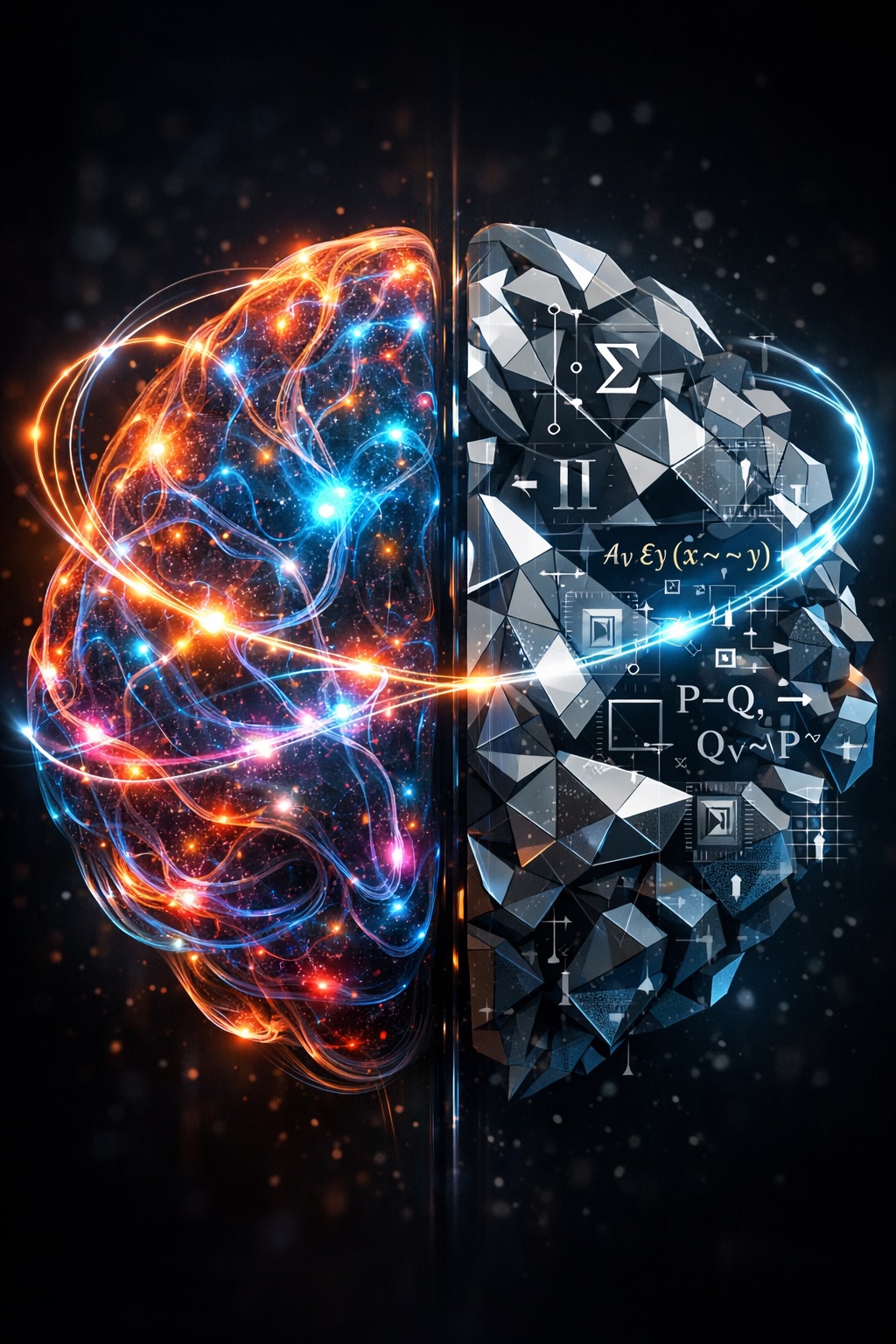
At its deepest level, this transformation forces us to confront what mathematics actually is. We have a partnership: humans providing vision, machines providing rigor, together building what neither could build alone. How long this division holds is anyone’s guess.
But one thing is certain: mathematics will never be the same. The age of pen and paper is ending. The age of formal, verified, collaborative mathematics is beginning. And at the intersection of human insight and machine precision.
The Takeaway: The Code of the Universe
Math is no longer just a subject you study in school; it is the source code of reality. By formalizing it, we aren’t making it “harder”—we are making it permanent.
We are moving toward a future where human creativity and machine logic join forces. The human provides the intuition and the “spark,” while the machine provides the “infinite memory” and “unbreakable logic.” On this foundation of absolute certainty, we will build the next century of physics, cryptography, and artificial intelligence.