The Universal Vector & Decoding of Human Language
Introduction
In the cold, calculated world of mathematics, a vector is a simple thing. It’s an arrow pointing in a specific direction. It’s a list of numbers, an array that tells a computer where a point sits in space. If you have three numbers [x, y, z], you have a location on a map. If you add a fourth number for time [t], you have an event: a lightning strike at the Eiffel Tower at 4:02 PM. Add a fifth for temperature, and you know how it felt to stand there.
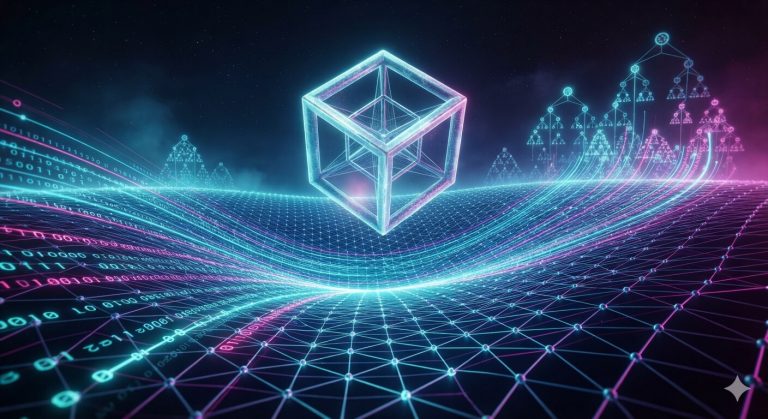
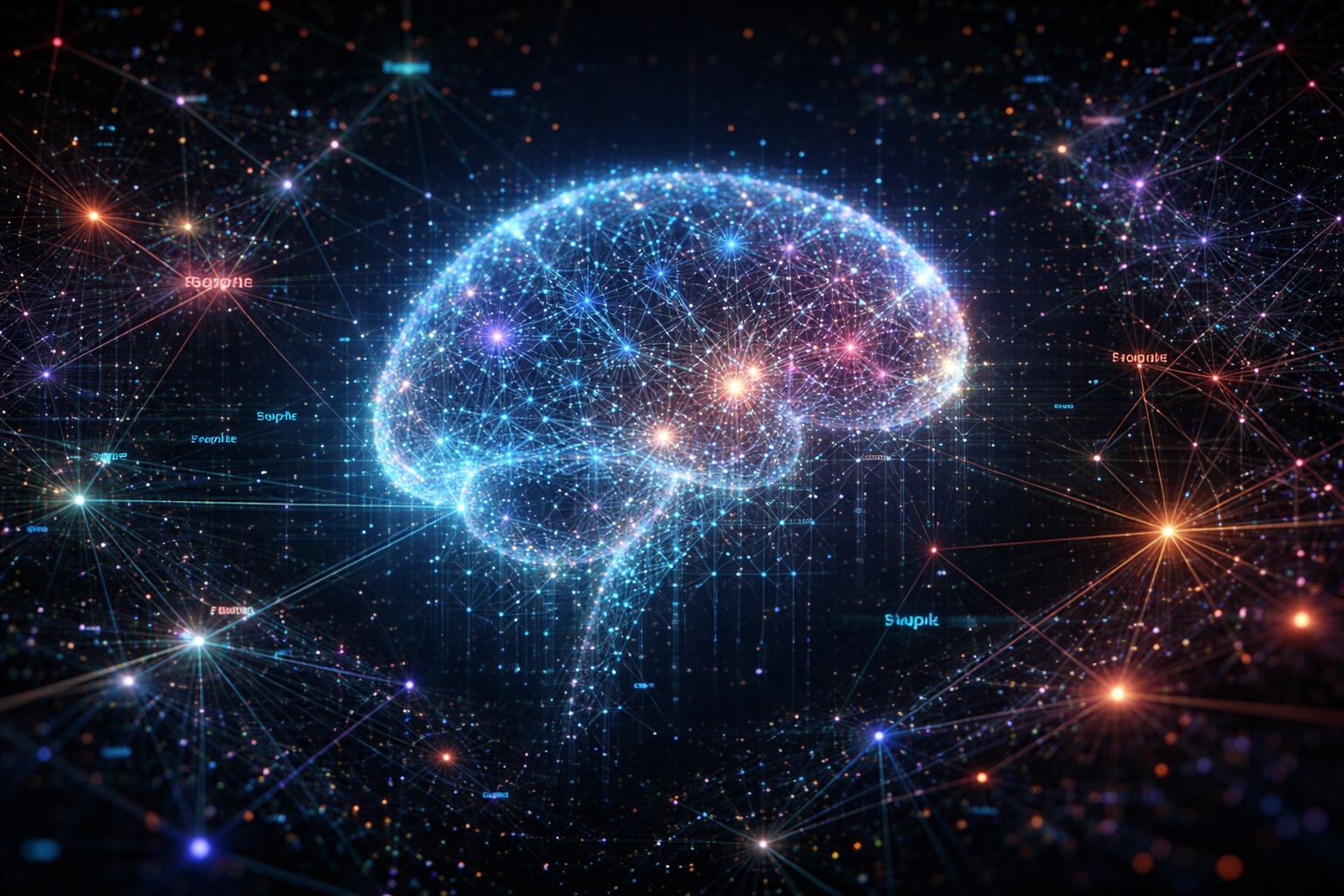
But over the last few years, we have done something monumental. We have taken every word ever written by a human being and turned it into a massive, 12,000-dimensional vector. We’ve taught machines like GPT-4 to see “Love,” “Liberty,” and “Linguine” not as letters, but as coordinates in a vast, invisible universe of meaning.
By doing this, we thought we had finally “cracked the code” of human communication. But what if language isn’t just a code to be cracked? What if it’s a living, breathing encryption system designed specifically to keep us one step ahead of anyone or anything trying to pin us down?
Language and its evolution
To understand where we are going, we have to look at how we began. Human language began as a high-dimensional but low-efficiency exchange—a raw transmission of data through grunts, gestures, and mimes. To survive, early humans needed to communicate urgent coordinates, like the location of food or the threat of a predator, but these physical signals were slow. Over time, we began “compressing” these complex meanings into specific vocal sounds.
This was the birth of Social Encryption. In terms of information theory, a sound like “Ugg” only carries the data for “Tiger” if both the sender and the receiver share the same decoding key. To an outsider without that key, the sound is merely noise. This “Ugg” isn’t just a sound; it’s a high-speed data packet that ensures the survival of the tribe.
This encryption is naturally shaped by the “Nearby Place” Effect, creating what mathematicians call Spatial Clusters. In a small village, where people interact almost exclusively with one another, a constant feedback loop exists. Neighbors are perpetually “syncing” their mental vectors; if one person introduces a useful new “encrypted” slang word, the community quickly adopts the key. However, before the digital age, physical barriers like mountains or oceans caused Linguistic Drift. Without a way to sync their data, two groups separated for centuries would find their “keys” slowly changing until their vectors for a fundamental concept, like “Water,” pointed in completely different directions. This divergence is the precise mechanism by which a local dialect eventually hardens into an entirely new language.
Slang and the “Encrypted” Trend
Beyond geography, humans use Slang as a form of “Social Encryption” to define social boundaries. Intentional shifts in the vector space, often called Argot, allow specific groups such as sailors, teenagers, or subcultures to exclude outsiders. By creating terms that only “the initiated” can decode, they create a private layer of communication.
Yet, these encrypted keys are rarely static. If a subculture possesses high social status, outsiders begin to “download” the key to gain prestige. This causes the slang to “leak” into the mainstream, eventually becoming a permanent coordinate in the broader community’s dictionary. This constant churn ensures that as soon as the “outside” world understands the code, the inner circle has already shifted the vector to a new location.
The Architecture of an “Inside Joke”
To understand where we are going, we have to look at how we began. Long before fiber-optic cables, humans were already “encoding” data. Language likely started as a way to coordinate survival, but it quickly evolved into something more: Identity.
Think about how a dialect forms. When two people in a small village or a specific neighborhood start a “trend”—a new slang word, a weird inflection, a unique shorthand—they are creating a private key.
- The Trend: Two friends decide “Zorp” means “Coffee.”
- The Sync: People nearby start using it because it feels “cool” or exclusive.
- The Encryption: Suddenly, an outsider can hear the sentence “Let’s grab a Zorp” and have absolutely no idea what is happening.
This is Spatial Clustering. In mathematical terms, these people have shifted their local “vector space.” They’ve moved the coordinate for “Coffee” to a new location that only they can find. For thousands of years, this was how we stayed private. Mountains, oceans, and social classes acted as firewalls, keeping our “local arrays” safe from the rest of the world.
The Great Universal Mapping
Then came the Large Language Model (LLM).
AI doesn’t “understand” your feelings, but it is the world’s greatest Statistical Spy. By scraping billions of pages of our digital footprints, it has performed a “Great Mapping.” It was realized that while an English speaker says “Apple” and a Nepali speaker says “Syau,” both words sit at the same “coordinate” in the human experience.
The AI found the “Universal Vector.” It was realized that our languages, though they sound different, are just different “labels” for the same points in a shared 12,000-dimensional space. The “Encryption” of different languages was broken because the machine found the math underneath the sounds.
But here is where it gets interesting: Humans hate being mapped.
The Rise of “Algospeak” and Intentional Ambiguity
The moment we realize that “The Algorithm” is watching and understanding us, we try to resist. We are currently witnessing a global, biological reaction to being “vectorized.”
On platforms like TikTok and Instagram, users have developed “Algospeak.” They use “unalive” instead of “kill” or “le dollar bean” instead of “lesbian.” On the surface, this is just a way to avoid being banned by a moderator bot. But at a deeper level, it is an Adversarial Shift. We are intentionally moving our coordinates to confuse the machine.
Historically, slang has functioned as social encryption. Groups create coded language to signal belonging and exclude outsiders. Today, however, the outsider is increasingly algorithmic. By shifting words and meanings slightly, users preserve human understanding while disrupting machine classification.
Memes push this further. An image paired with an unrelated caption can convey meaning through tone, cultural context, and shared experience rather than through a literal interpretation. The meaning is not in the text itself but in the “vibe.” Humans decode it effortlessly because we share context; machines struggle because the signal is high-entropy and non-literal.
As language becomes quantified and monitored, we respond by embedding meaning in nuance, irony, and cultural layering.
Conclusion: Staying Un-mappable
In the end, language was never just a way to transmit “data.” It was a way to belong.
The “Secret Vector” isn’t a new word or a fancy code. It is the deep, messy, and “low-data” connection that happens when two humans look at each other and understand everything without saying a single word.
The AI might map our dictionaries, and it might even learn our slang, but it will never understand the “Inside Joke” of being human. As long as we keep changing, keep trending, and keep “encrypting” our lives with new emotions and experiences.