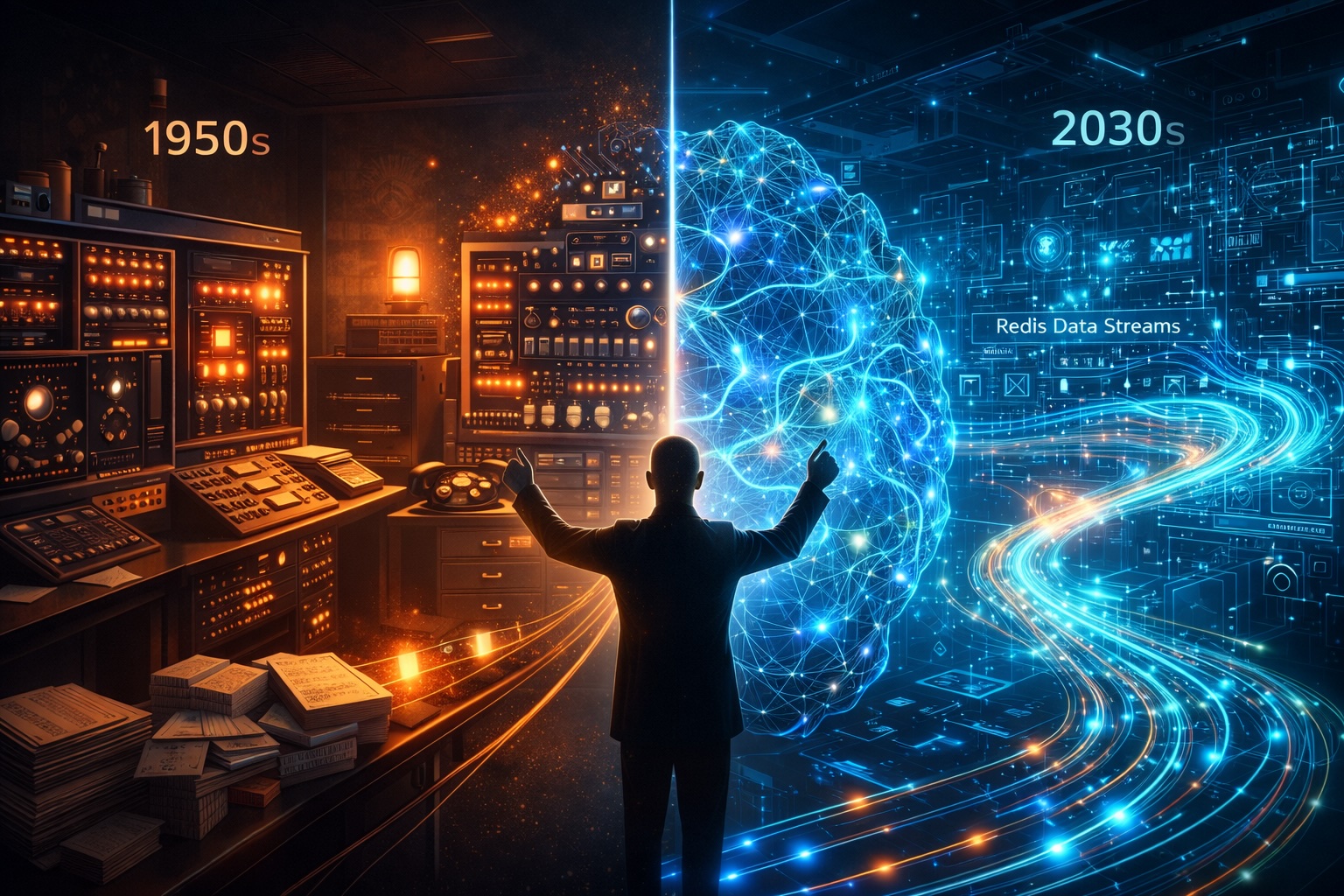
The Architect’s Renaissance: From 1950s Binary to the 2030s Digital Immune System
Introduction
In 1954, programming an IBM 650 wasn’t just a job; it was a physical endurance test. To add two numbers, you didn’t type code; you toggled mechanical switches and meticulously punched holes into paper cards. One slip of the hand meant hours of “clerical accounting” to recalculate memory addresses for a machine that could only hold 2,000 words on a spinning magnetic drum.
Fast forward to the 2030s. We are no longer “writing” software in the traditional sense. We are orchestrating digital organisms—infinite, self-healing systems that breathe with the internet. This journey from the “priesthood” of binary to the “renaissance” of strategic design represents the most profound leap in human-machine history.
The Era of Scarcity: When Humans Thought Like Vacuum Tubes
In the 1950s, the machine was the master. Because memory was expensive and CPUs were slow, the human brain had to adapt to the computer’s limitations. Software was written in Machine Language—raw binary strings of 1s and 0s.
The first revolution came in 1957 with FORTRAN (Formula Translation). By introducing algebraic syntax, John Backus and his team at IBM reduced the manual labor of coding by a factor of 20. For the first time, a human could write a mathematical intent X = A + B and let a Compiler handle the “clerical work” of translating it into machine code. We learned our first strategic lesson: Human time is the ultimate bottleneck; automation is the only cure.
The Era of Abstraction: Building the “Vaults” of Logic
As hardware became more powerful, our programs became too complex for one person to hold in their head. We entered the era of Object-Oriented Programming (OOP).
We moved from a “pile of wood” approach, where any part of the program could touch any data, to creating Objects. These were digital “vaults” that encapsulated data and logic together. We began to explicitly program the “No”, building guardrails directly into the software’s DNA so it could protect its own integrity. We stopped being just “translators” and became Builders of Systems.
The Era of Abundance: Decoupling “State” from “Hardware”
The 2020s brought the “Infinite Memory” revolution. With the rise of Cloud-Native architecture, we achieved the Strategic Optimum: Statelessness.
By moving a user’s “memory” (their state) out of individual servers and into a centralized Distributed Redis Cache, we turned hardware into “cattle,” not “pets.” We realized that if a server dies, we don’t fix it—we just replace it. This decoupling allowed for Microservices: small, independent “organs” of code that can be killed, updated, and reborn without ever turning the “Total System” off.
The Digital Immune System: Chaos and Self-Healing
Today, we are moving beyond building “robust” systems to building Resilient ones. We treat software like a biological organism. Through Chaos Engineering, we intentionally inject “viruses” (failures) into our systems to ensure they can survive the real world.
Chaos Engineering turns panic into practice. By breaking things on purpose, you build muscle memory. When a real failure happens at 3:00 AM, the system’s automated defenses (like the Stateless Redis Cache ) simply take over, and your customers never even notice.
We use Control Loops—the digital equivalent of a heartbeat—to constantly compare the “Desired State” (5 servers running) with the “Actual State” (4 servers running). The system doesn’t call a human; it self-heals by spinning up a new instance in milliseconds. We have moved from being “Repairmen” to being Architects of a Digital Immune System.
As a Strategic Designer, your most powerful tool isn’t a compiler—it’s storytelling. You need to convince your stakeholders and team that this “Digital Organism” is the future.
The 2030s Partnership: The Human as the “Creative Director”
As we look toward 2030, a new partnership is emerging. Gartner and other industry leaders predict that zero IT tasks will be executed without human-AI collaboration.
- The AI as the “High-Speed Workforce”: By 2030, AI will handle 75% of routine maintenance, code generation, and testing. It will automatically identify bugs, propose optimal database schemas, and even “trip the circuit breaker” if it detects an security anomaly.
- The Human as the “Strategic Composer”: As the cost of generating code drops to near zero, the human role shifts from “How to build” to “What to build and Why”. We are the ones who define the Intent, set the Ethical Guardrails, and judge the Strategic Alignment.
The successful developer of the 2030s is a “Systems Architect” who orchestrates a fleet of autonomous AI agents. We aren’t just writing code anymore; we are managing Hardened Digital Realities that are secure by default, resilient by choice, and infinite by design.