The Incommensurable Truth: From Number Theory to Human Nature
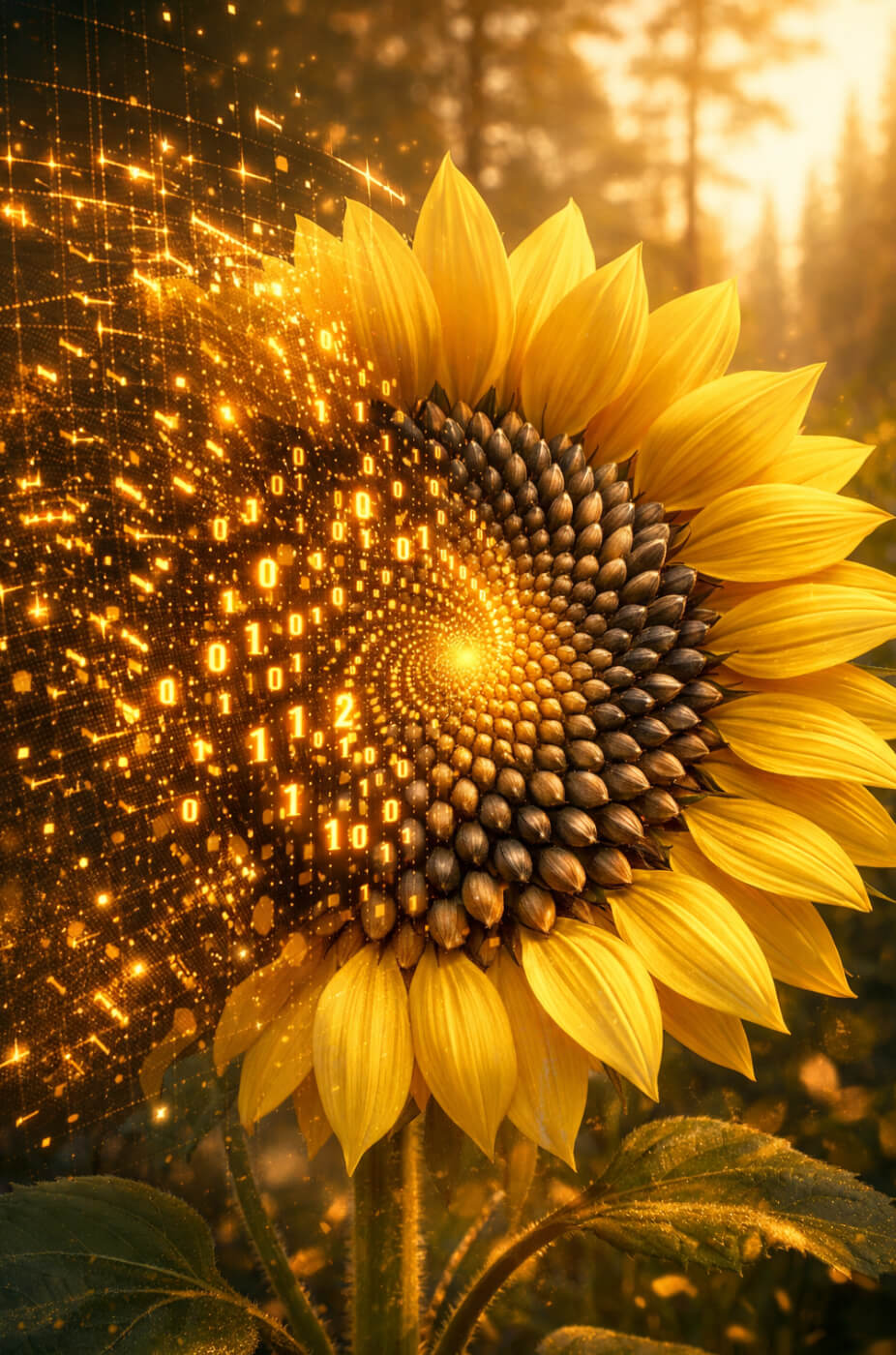
Why does a sunflower look so mathematically perfect, yet a computer feels “brittle”? Why do we fear the “logic” of AI while grappling with the “irrationality” of human cruelty? The answer lies in the Fundamental Theorem of Arithmetic and the “glitch” that defines our universe.
The Rationality Trap: Fixed Algorithms
In mathematics, a Rational Number is any value that can be expressed as a ratio. These numbers are the ultimate “fixed algorithms.” When converted to decimals, they either terminate or fall into a periodic, repeating loop.
If the universe were purely rational, it would be a “closed system.” Everything would be predictable and periodic. But as we’ve seen, nature opposes fixed things.
Nature loves these numbers because they avoid “Resonance.
Nature “loves” irrational numbers for one very specific, practical reason: to avoid resonance and overlap. In the physical world, “rational” means a repeating pattern (like 1/2, 1/3, or 2/5). While repeating patterns are great for building a brick wall, they are terrible for organic growth and stability.
Here are the three specific reasons why Nature chooses the “chaos” of irrationality:
Maximum Packing (The Sunflower Strategy)
As we touched on, if a sunflower grew seeds at a rational fraction of a turn (like 0.25 or 1/4), the seeds would eventually line up in straight rows.
- The Problem: Straight rows leave huge triangular gaps of empty space between them.
- The Irrational Solution: Because the Golden Ratio is the “most irrational” number, it never repeats a pattern. This ensures that every new seed finds the absolute smallest gap available. This creates the most efficient packing density possible, allowing the plant to fit more seeds into the same space.
Infinite Surface Area (The Lung/Leaf Strategy)
Nature often needs to fit a massive surface area (to absorb oxygen or sunlight) into a tiny volume.
- The Rational Problem: Simple geometric shapes (like spheres or cubes) have a very poor surface-to-volume ratio.
- The Irrational Solution: Nature uses Fractals, which are shapes based on irrational scaling. Because the pattern never “closes” or “finishes” (just like the decimals of it can branch forever. This allows your lungs to have the surface area of a tennis court while still fitting inside your chest.
The Prime Distribution: The “DNA” of Order
Prime numbers are the atoms of our world. The Fundamental Theorem of Arithmetic states that every integer has a unique prime factorization.
- As we move toward 100 trillion, the Prime Number Theorem shows that primes become rarer (density.
- This “thinning out” is what makes modern cryptography secure. We rely on the “irrational” difficulty of finding these needles in an infinite haystack.
Human Complexity: The Ultimate Irrationality
We often use “irrational” as an insult in psychology, but perhaps we have the definitions backward.
- The “Rational” Danger: A stubborn, cruel person behaves like a repeating decimal. No matter the input, their output is a fixed, looping bias. They have become a “brittle algorithm” that refuses to adapt.
- The “Irrational” Strength: True human adaptability is like. It is fluid, continuous, and non-repeating.
While we worry about AI—which currently operates on fixed, rational weights and biases—we should perhaps be more concerned with the “fixed” loops of human history. AI lacks the “ego” required for malice; humans, however, can be destructively stubborn, trapped in a “ratio” of behavior that no longer fits the geometry of the modern world.
Conclusion: Embracing the Infinite
Mathematics teaches us that without irrational numbers, the number line would be full of holes. Similarly, without the “unpredictable” parts of our nature—our ability to break from the “repeating loops” of the past—we would be nothing more than machines.
The universe isn’t a grid; it’s a continuous flow. To be “irrational” is to be alive.